What a dashboard would never see
Technology is often measured by what it allows us to do. But sometimes its greatest achievement is who it allows us to know.
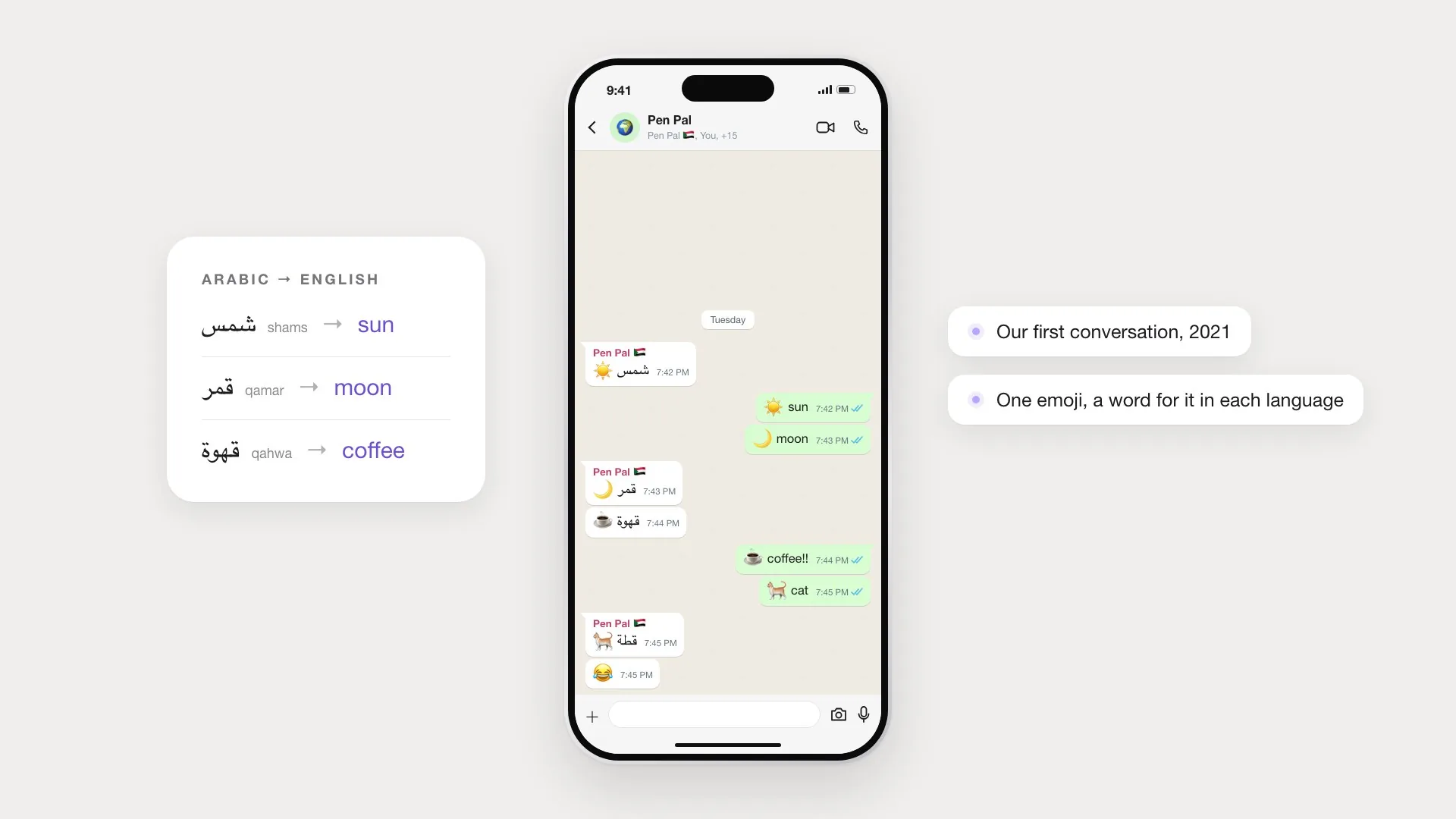
In 2021, during my first year of university, I met someone who would completely change the way I think about technology.
She lived in Sudan. I lived in the United States. We had never met, knew almost nothing about each other’s everyday lives, and on our very first call we discovered that neither of us could understand a word the other was saying.
So we started sending emojis.
One of us would send an emoji with the word for it in our own language. The other would look it up and send it back in theirs. A sun and shams. A sun and sun. A moon and qamar. Back and forth we went, with a translation app and a handful of tiny pictures, piecing together a conversation one word at a time.
It was simple, a little ridiculous, and surprisingly fun. Neither of us could say very much, but we kept trying. We were curious about each other, and that was enough to begin.
Five years later, she has become a wonderful friend. We still haven’t met in person, and my Arabic is still terrible. She deserves most of the credit for how far our conversations have come. But somewhere along the way, I started to see the technology that made it possible very differently.
A world beyond my own
I’ve always been fascinated by languages, history and the different ways people experience the world. I’ve backpacked alone through eight countries, and what stays with me isn’t the sights. It’s the people: hearing their stories, and coming to know a place through the people who call it home.
That’s why I signed up for an Arabic and religious studies course in my first year. I wanted more than a language. I wanted to understand the culture, art, history, faith and everyday life that live inside it. My professor happened to know a professor at a university in Sudan, and together they set up a pen pal exchange between their students.
That’s how we met.
At the time, most of what I knew about Sudan came from its history and its conflicts. I knew very little about what an ordinary day looked like for someone my age. Over the years, she has shown me. We’ve talked about Islam, food, music, family, school, our routines and what we hope to do with our lives. She is smart, hardworking, determined, kind and genuinely funny. She’s studying English so she can become a teacher, and the way she commits to that goal has pushed me to chase my own interests with more conviction.
One of my favorite conversations we’ve ever had was about childhood games. We started sending each other pictures of games we remembered, explaining the rules and telling stories about playing outside with the other kids. And slowly we realized we had grown up playing many of the same games.
Different countries. Different languages. Different names for the games. And there we were, laughing over memories that felt almost identical.
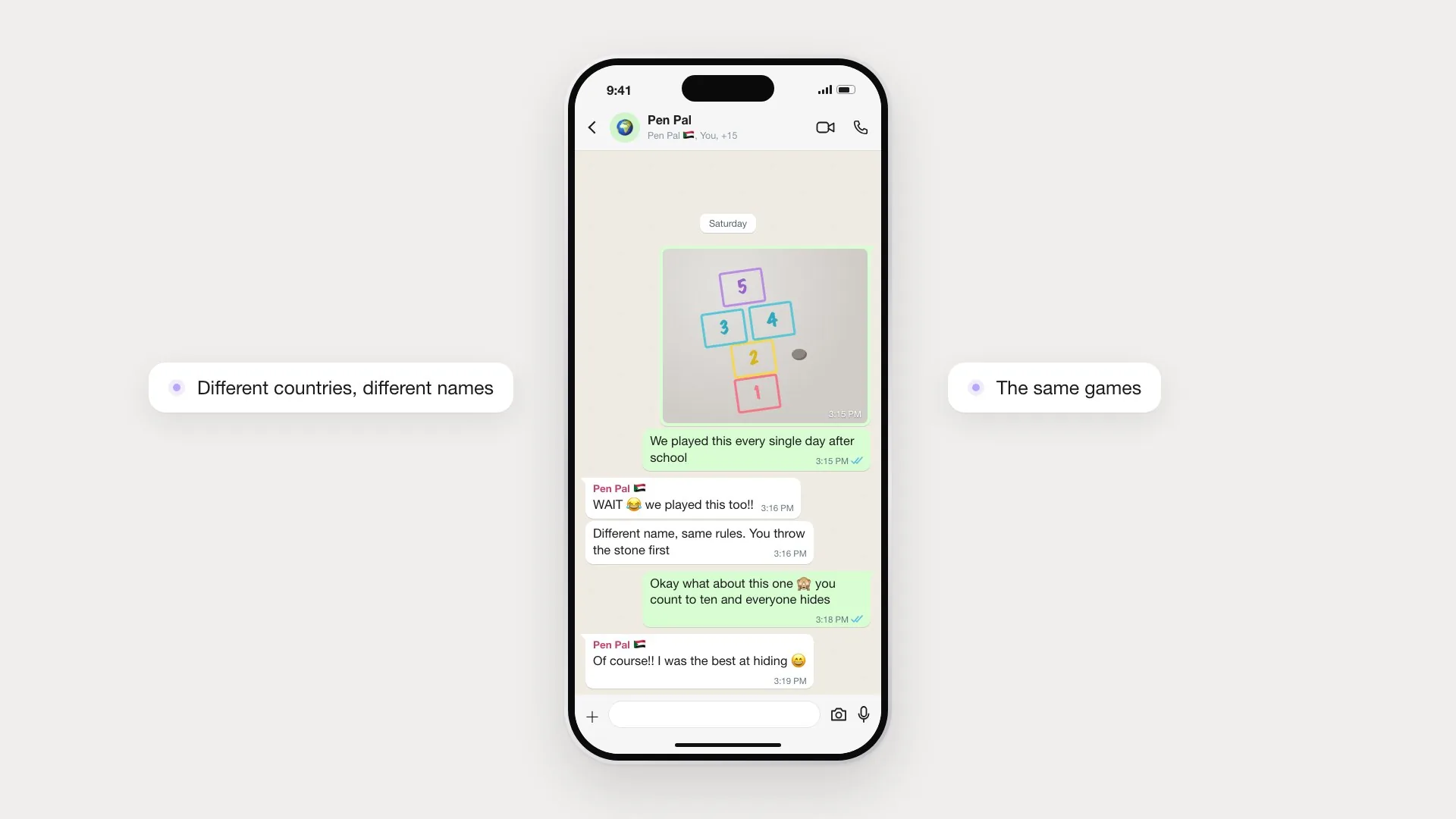
It’s such a small thing, but I think about that conversation often. We didn’t need to grow up in the same place to recognize something of ourselves in each other.
Knowing about a place isn’t knowing someone from it
This friendship has made me much more aware of the gap between how we learn about the world and how we actually come to understand it.
When we hear about a country through the news, we usually meet it through its hardest moments. Conflict, instability and suffering become the story we attach to an entire place. Those stories matter, and they deserve our attention. But they are not the whole of a country, and they are certainly not the whole of the people who live there.
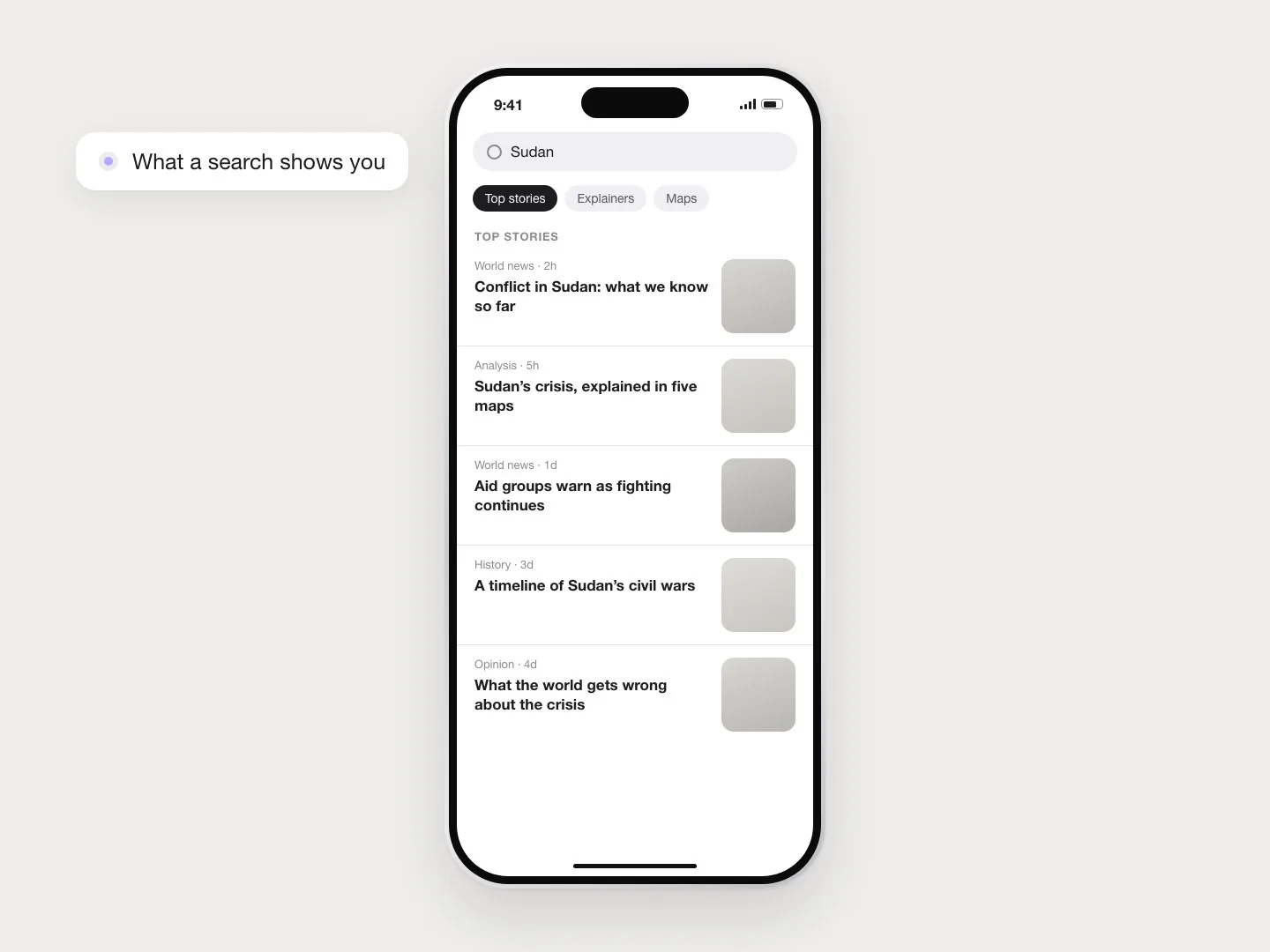
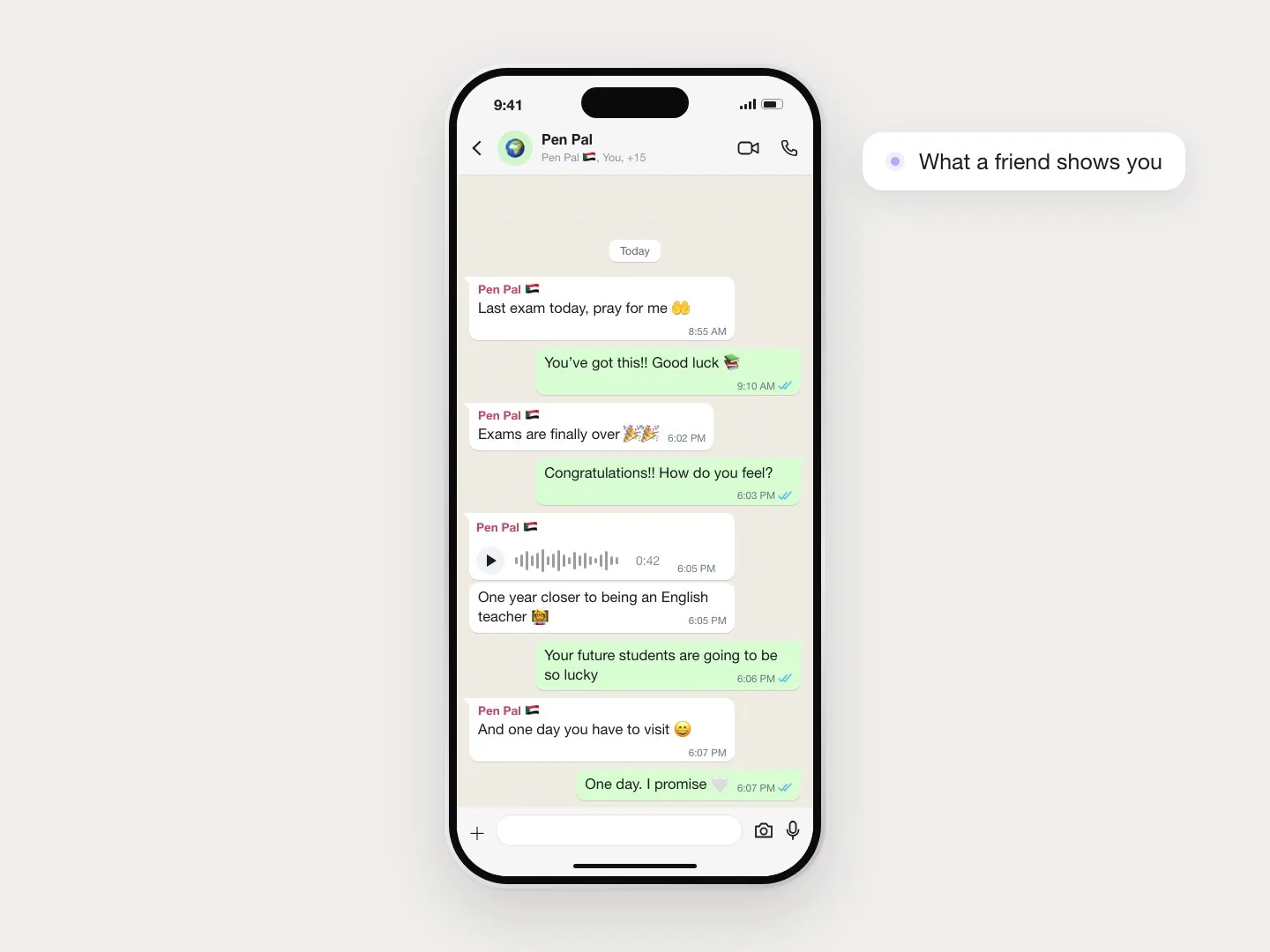
Before I met my friend, Sudan was mostly a history lesson to me. Now when I think of Sudan, I also think of childhood games. I think of the food she’s introduced me to, what she’s taught me about her faith, her sense of humor, her ambitions and the dedication she brings to her studies.
I think of someone I care about.
Our friendship hasn’t made me an expert on Sudan, and no single person could speak for a whole country. But it has given me something that reading about a place never could: a real relationship with someone whose life unfolds there.
It has also made me more careful about the way technology shows us the world. The same internet that let me find my friend can flatten millions of people into headlines, statistics, arguments and images that tell only part of their story.
It’s easy to form opinions about people we’ve never spoken to. It’s much harder to reduce someone to a category once you’ve spent years getting to know them.
The strange contradiction of growing up online
I have a complicated relationship with technology. I got Instagram in second grade, so the internet was part of my life long before I understood how much it could shape the way I saw myself. Like a lot of people my age, I’ve spent more time than I’d like to admit scrolling, comparing, and closing an app feeling worse than when I opened it.
For all its promises of connection, technology can leave us strangely disconnected. We measure our lives against other people’s best moments. We turn self-expression into something that can be counted, ranked and compared. Likes, followers and views become scores for experiences that were never meant to be scored.
There’s some research behind that feeling, though it’s messier than the headlines suggest. In experiments by the psychologist Philippe Verduyn and his colleagues, people who scrolled Facebook passively, without posting or messaging anyone, felt worse afterward, and envy helped explain the dip. But when Patti Valkenburg and her colleagues reviewed 40 survey studies, most didn’t find a neat split between “active” and “passive” use. They suggest it depends on what you’re seeing and who you are when you see it.
And yet I can’t believe technology is isolating by nature. The same device I sometimes wish I looked at less is the one that lets me talk to her on the other side of the world.
We’ve sent long messages, swapped photos, traded voice notes and stayed on calls for hours. Translation tools have carried thoughts across that neither of us had the words for yet. There have been stretches when we couldn’t talk at all because the connection wasn’t there. Calls drop. Time zones get in the way. Sometimes I know exactly what I want to say and still can’t find the words.
Those moments remind me how much our friendship rests on something extraordinary I usually take for granted: a vast web of networks and infrastructure that lets two people, thousands of miles apart, be present in each other’s lives. And despite every limit, we keep finding ways to talk.
Technology didn’t create our curiosity about each other. It didn’t make us care, or listen, or work to understand one another. We did those things.
But technology gave us the chance. I think about that distinction a lot.
Designing for the person, not the metric
The deeper I get into product design, the more this friendship shapes what I want to make.
In tech we talk constantly about efficiency, engagement, conversion and growth. Those are useful ways to tell whether a product works. They don’t always tell us whether it’s making someone’s life better. A platform can be brilliant at keeping people engaged without ever helping them feel connected. And a three-minute exchange of single words and emojis, which would look like nothing on a dashboard, can be the beginning of a friendship that lasts for years.
The data scientists Rachel Thomas and David Uminsky point out that most metrics are stand-ins for things we can’t measure directly, the way “watch time” stands in for whether someone was actually satisfied. Optimize hard enough for the stand-in and it drifts away from what it was meant to track. That’s Goodhart’s law: when a measure becomes a target, it ceases to be a good measure. Their advice is to use several metrics instead of one, and to pair the numbers with people’s own accounts of what happened.
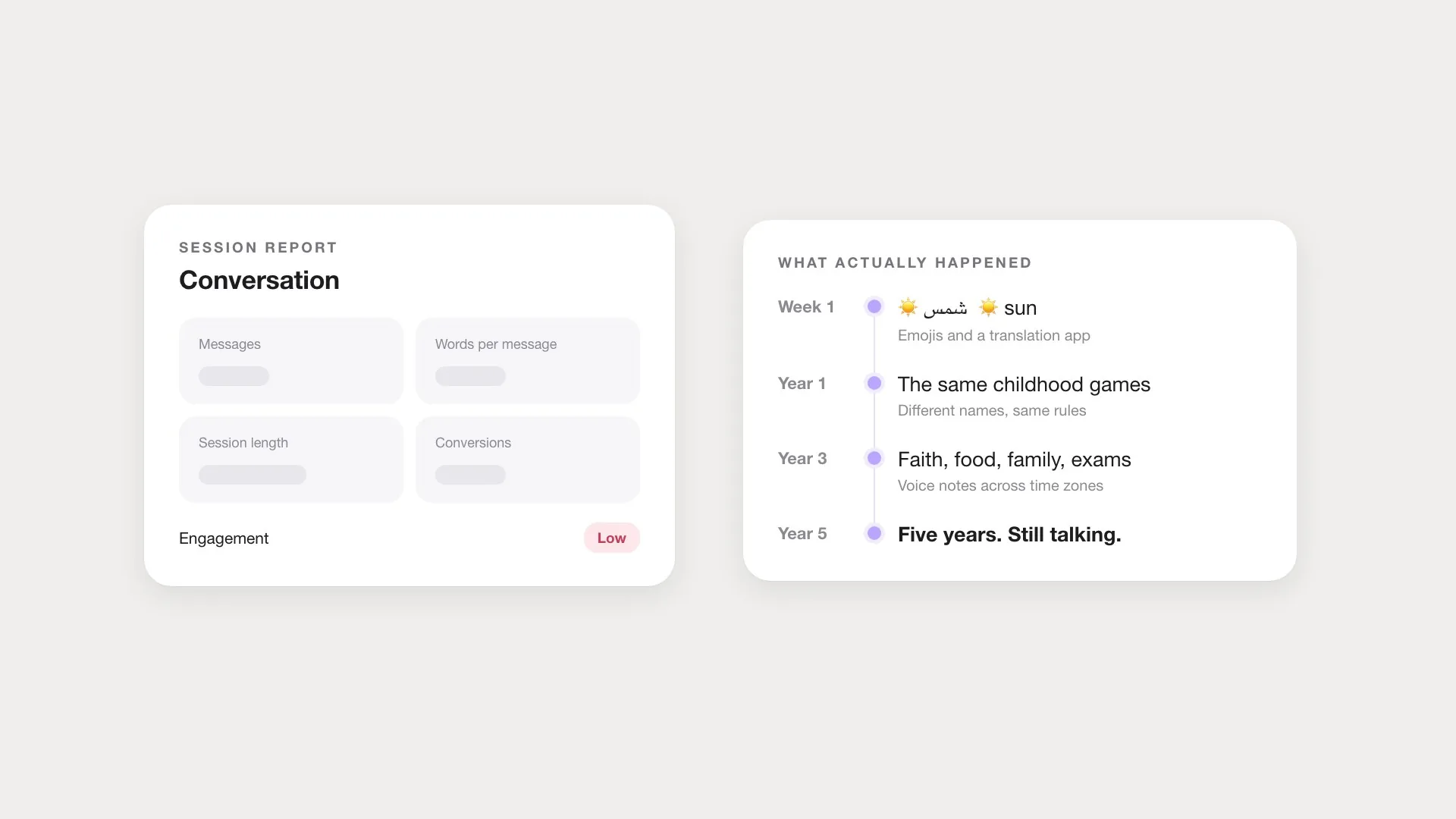
That contrast fascinates me, and it leaves me with questions I want to keep asking:
- What would our products look like if we designed for the relationships, ideas and experiences they make possible?
- What if social platforms cared less about follower counts and public approval, and more about curiosity, conversation and understanding?
- What would it take to build spaces where people feel safe asking questions, admitting uncertainty and learning from each other, without feeling they have to perform?
I don’t think there are simple answers. Human connection is complicated, and no interface can manufacture a real friendship. But designers can create the conditions that make meaningful connection more likely. We can take privacy and safety seriously. We can make technology work across languages, abilities and circumstances. We can design for people who experience the world differently from us, instead of assuming everyone arrives with the same knowledge, confidence or resources.
We can remember that behind every profile, message and tap is a real person, with their own insecurities, hopes, fears, values and ambitions. And we can keep asking whether what we encourage people to do is actually good for them.
This friendship has shown me how many different lives a single product can reach. I find that one of the most beautiful challenges in design.
Seek to understand
I still think about our first conversation. Two university students, thousands of miles apart, sending suns and moons because there was no other way to talk. Neither of us knew how much we would end up learning from each other. We just wanted to understand.
That might be what moves me most about the whole thing. We didn’t need a shared language, religion, nationality or childhood to build something meaningful. We only needed to be open to someone else’s world.
That openness has given me a wider view of the world, a deeper sense of gratitude, and a friendship I hope will one day reach beyond a screen. It has also given me the one principle I want to carry into everything I design:
Seek to understand.
Understand the people who will use what you make: their circumstances, their differences, their reasons, and what matters to them. And remember that the most meaningful thing technology does isn’t always something you can measure.
Sometimes it’s a conversation that would never otherwise have happened. A perspective you would never otherwise have met. A person you would never otherwise have known.
We spend so much time asking how technology can become faster, smarter and more capable. I think we should spend just as much time asking how it can help us become more understanding.
Because sometimes the most remarkable thing a piece of technology can do is introduce you to someone who changes the way you see the world.
References
3
- Thomas, R. L. & Uminsky, D. (2022). Reliance on metrics is a fundamental challenge for AI. Patterns, 3(5), 100476. doi.org/10.1016/j.patter.2022.100476
- Valkenburg, P. M., van Driel, I. I. & Beyens, I. (2022). The associations of active and passive social media use with well-being: A critical scoping review. New Media & Society, 24(2), 530–549. doi.org/10.1177/14614448211065425
- Verduyn, P., Lee, D. S., Park, J., Shablack, H., Orvell, A., Bayer, J., Ybarra, O., Jonides, J. & Kross, E. (2015). Passive Facebook usage undermines affective well-being: Experimental and longitudinal evidence. Journal of Experimental Psychology: General, 144(2), 480–488. doi.org/10.1037/xge0000057