Why does every social platform want us to perform?
Social apps are built like stages. Post, get seen, count the response. I keep wondering what they’d look like if they were built like kitchens instead.
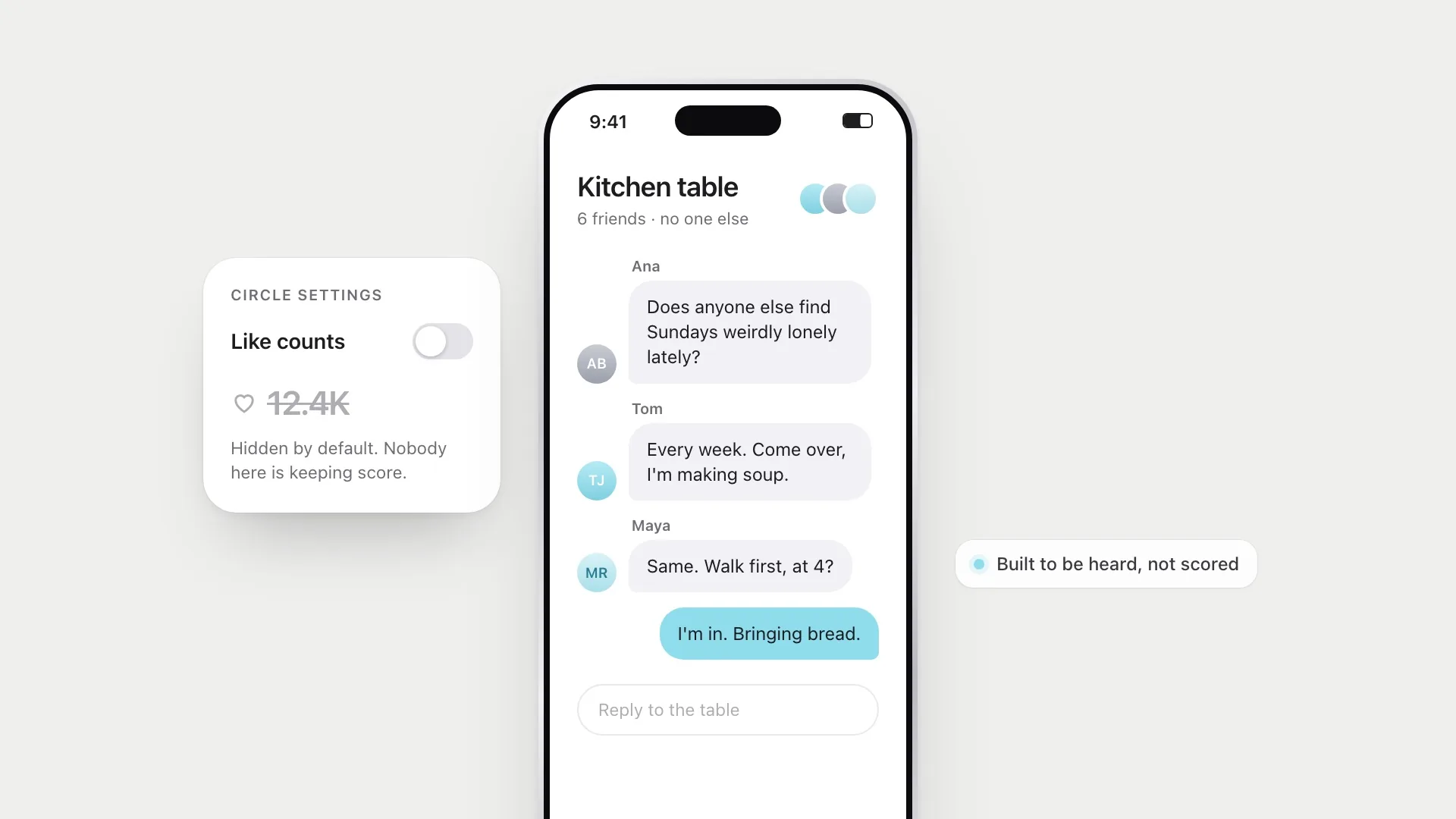
Open almost any social app and the main action is the same: make something for an audience. A post, a story, a video, a hot take. Then the interface tells you how it did: likes, views, shares, followers. Even platforms that started as a way to keep up with friends have slowly turned into places to broadcast.
None of this is accidental. These are design choices, and they reward a particular kind of behaviour. I want to look at what that is, why it works so well on us, and what the alternatives might be.
The stage and the backstage
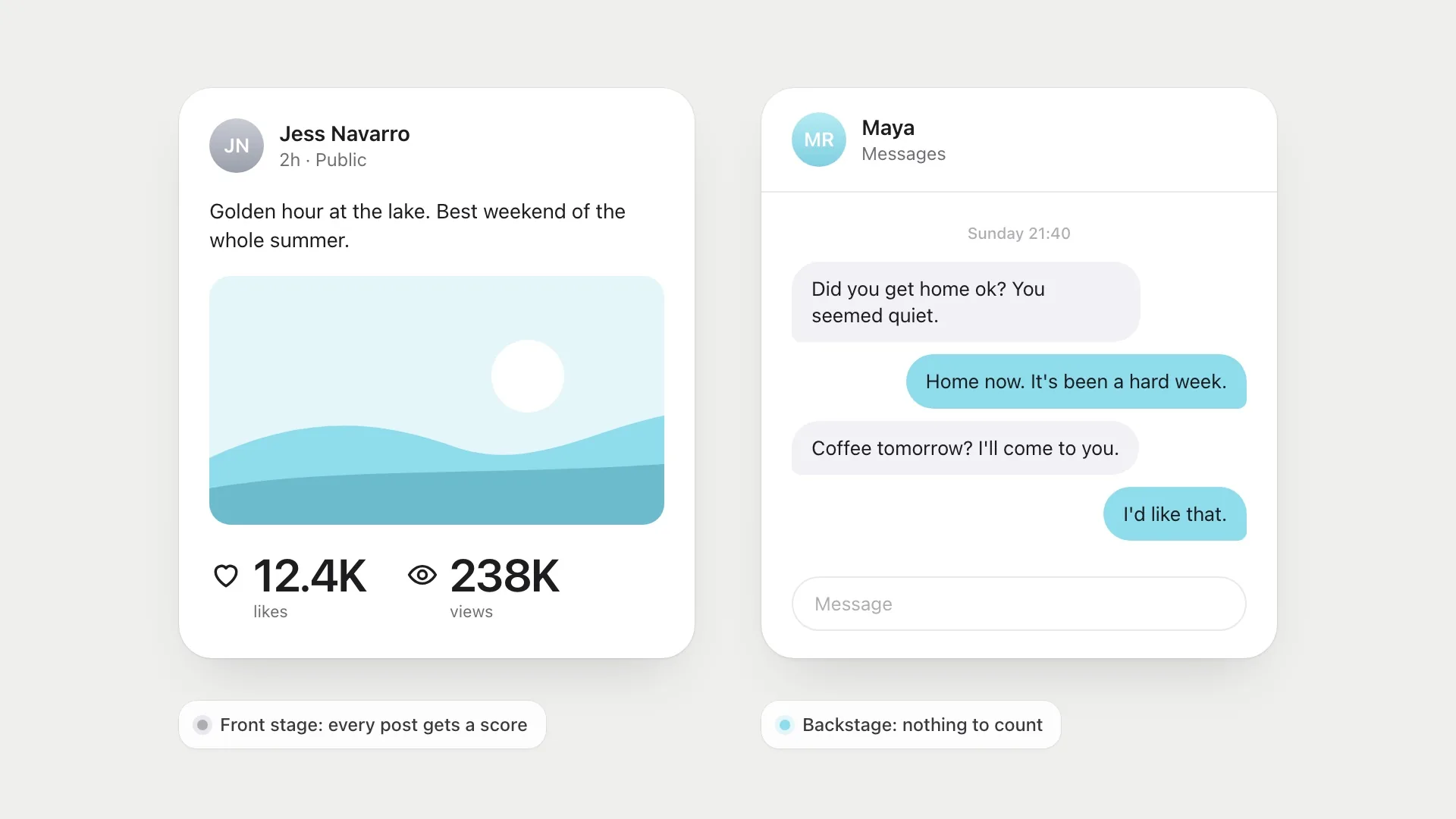
The sociologist Erving Goffman described everyday life as a kind of theatre. We have a “front stage” where we manage how others see us, and a “backstage” where we relax and can be ourselves. Both are normal. We need both.
The trouble with most social platforms is that they’re almost all front stage. Researchers Alice Marwick and danah boyd called one result context collapse: your boss, your grandmother, your old school friends and strangers are all in the same audience. With an audience that mixed, the safest thing is to perform a version of yourself that works for everyone. The Twitter users they spoke to described exactly this: imagining who might be reading, holding back on some topics, and balancing being authentic against being acceptable. That version of yourself tends to be polished, positive and a bit hollow.
Bernie Hogan adds a distinction I find really useful. Goffman was describing performances, which happen live, in a situation, in front of people who are actually there. Most of what we put on social media isn’t a performance in that sense. It’s an exhibition: a post, a photo, a profile that sits there and gets shown to people later, often by the platform, to audiences the author never pictured. A performance can adjust to the room. An exhibition can’t, so people write for the strictest person who might ever see it. Hogan calls this a lowest common denominator approach. It explains why so much posting feels safe and samey. It isn’t a failure of personality. It’s a reasonable response to not knowing who’s in the room.
We can’t see who’s watching
The strange part is that we don’t even know the size of the room. Michael Bernstein and colleagues compared what Facebook users guessed about their audience with the platform’s own logs. People guessed their audience was only about 27% of its real size. They were also bad at reading it from the signals they could see, because likes, comments and friend counts were weak indicators of how many people had actually seen a post.
Put those together and you get the core loop. The real audience, the people who read and say nothing, is invisible. The only visible evidence that anyone is there is the count. So the count stands in for the audience, and people learn to post for the count.
What the interface rewards
Look at the main design patterns and you can read the values in them:
- Public counts turn every post into a score, so people learn to post what scores well.
- Infinite feeds reward content that grabs attention in the first second.
- Follower numbers make reach the measure of a person’s presence.
- A big Post button and a small Reply field tell you that making is more important than responding.
The first item does more than it looks like. A like count isn’t just feedback to the poster. It’s a reward signal, and reward signals train behaviour. William Brady and colleagues studied 12.7 million tweets and ran follow-up experiments, and found that when people got more likes and retweets for expressing moral outrage, they expressed more outrage afterwards. That’s reinforcement learning in the ordinary sense: behaviour that gets rewarded happens more. They also found people picked up the norms of their own networks, and in networks where outrage was already common, people were less sensitive to the rewards. Nobody designed the like button to make people angrier. But a button that rewards whatever gets a reaction will, over time, teach people to produce whatever gets a reaction.
Counts also shape the audience, not just the author. Lauren Sherman and colleagues showed teenagers photos in a simulated Instagram feed while scanning their brains. They were more likely to like photos that already appeared to have many likes, and seeing a popular photo was linked to more activity in brain regions involved in reward and attention. The number doesn’t just report what people think. It nudges what they think.
Listening has almost no interface at all. Reading someone’s post carefully, thinking about it and replying privately leaves no visible trace, so the system can’t reward it.
We’ve built very good tools for being seen, and very few for being understood.
Not all social media use is the same
This is where I want to be careful. It’s easy to jump from “platforms reward performance” to “social media is bad for us”, and the evidence for the second claim is much weaker than the headlines suggest. Amy Orben and Andrew Przybylski analysed three large datasets covering more than 350,000 adolescents and found that the association between digital technology use and wellbeing was negative but tiny, explaining at most 0.4% of the variation. That doesn’t settle the debate, which is still very much alive. But it does mean anyone claiming large, simple harms is overstating the case.
The more interesting finding, to me, is that the kind of use matters more than the amount. Moira Burke and Robert Kraut followed nearly 2,000 Facebook users with monthly surveys over three months, matched to logs of their activity. Receiving targeted, composed messages from close friends, such as comments and posts written for one person, was linked to later improvements in wellbeing. One-click feedback like likes was not. Neither was simply broadcasting to everyone, or messages from weaker ties.
That’s a design argument hiding inside a wellbeing study. The interactions linked to people feeling better are exactly the ones most interfaces make smallest: slow to produce, private, aimed at one person, and impossible to count in public.
Designing for understanding
What if the core action wasn’t “post” but “understand”? A few directions I find interesting:
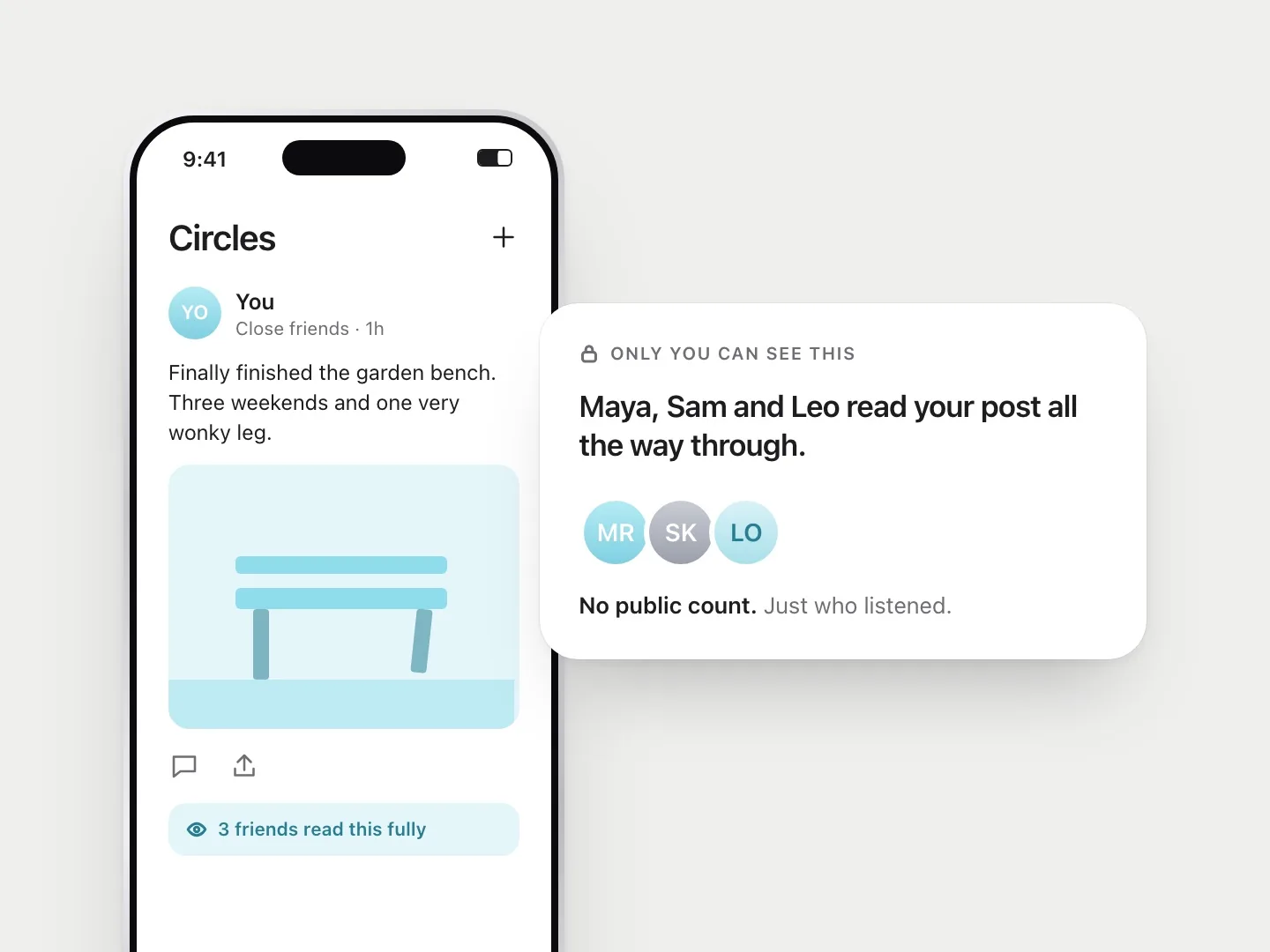
Make listening visible, to the right person. Not a public count, but a private note to the poster: “Three friends read this all the way through.” It tells you you were heard without turning it into a competition. Given how badly people underestimate their audience, even a little honest information about who actually read something could change what they feel safe saying.
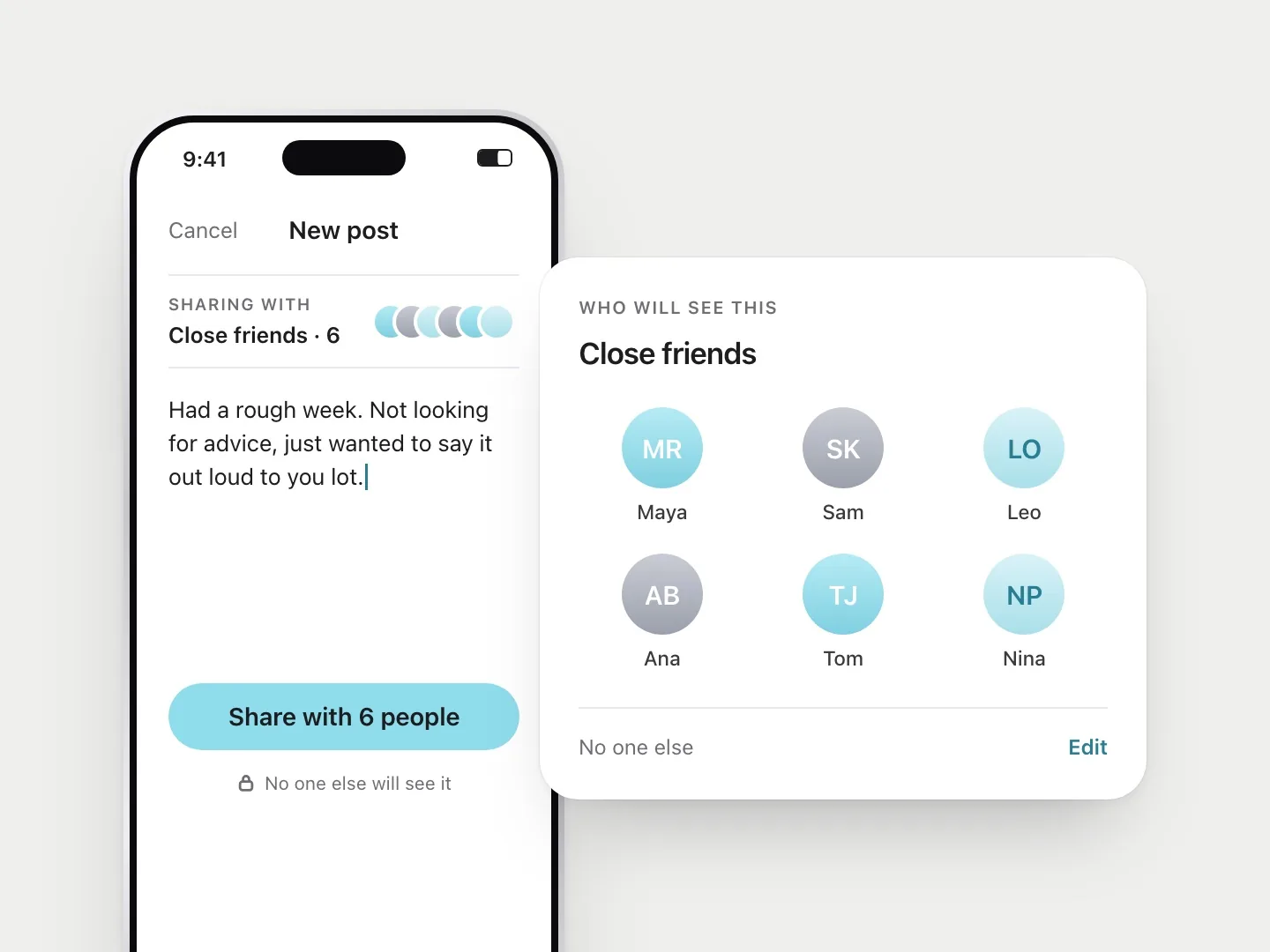
Smaller, chosen audiences. Let people speak to a defined group, and make that group easy to see each time they post. Knowing exactly who’s in the room makes honesty feel safer. It also turns an exhibition back into something closer to a performance, because you can write for the people who are actually there.
Reward questions. A thoughtful question often does more for connection than a reaction. An interface could make asking easy and highlight good questions, not just popular answers.
Slow replies. Some conversations get better with a pause. An option to send a reply later, or a gentle nudge to reread before posting in a heated thread, makes room for care.
Hide the numbers by default. Some platforms have experimented with hiding like counts. Making that the default, not a buried setting, changes what people optimize for. If counts work as rewards, removing the public version removes the scoreboard everyone else is reading.
What the backstage apps teach us
Some products have already tried pieces of this, and the research on them is useful because it shows both what works and what doesn’t.
Joseph Bayer and colleagues studied college students’ everyday Snapchat use with a two-week diary study and follow-up interviews. Interactions there were rated as more enjoyable, and linked to better mood, than texting, calling or Facebook. In interviews, students described it as a lightweight way to share small, mundane moments with close friends, with less worry about how they came across. But the same interactions were linked to less social support than other channels. Lightness made it easy to share. It didn’t make it a place to be held.
BeReal went further, with one randomly timed prompt a day, a two-minute window and both cameras at once. JaeWon Kim and colleagues interviewed teenage users and found the design did discourage staged posts and eased the pressure to present a perfect self. It also created new pressures. Some found the format limiting or dull, and the visible count of how many times you retook your photo became its own small performance. The stage didn’t disappear. It moved.
I take two lessons from this. First, constraints alone don’t remove performance. Any visible trace can become something to manage, so the question is always which traces are public and to whom. Second, lowering the cost of sharing is not the same as supporting people. Being understood needs more than a lighter way to post. It needs replies, attention and care, and those need room in the interface.
Vulnerability needs safety first
Real connection usually involves some vulnerability: admitting you’re struggling, sharing something unfinished, saying “I don’t know”. People only do that when the setting feels safe. That’s a design problem. Clear audiences, the ability to edit or remove things later, and the absence of public scoring all make it easier to be honest.
This is the same thinking behind Ditto, an app I designed for making plans with friends. The hardest moment wasn’t the interface. It was the social risk of asking someone to hang out and hearing nothing back. Most of the design was about making that ask feel less exposed.
The business problem
The honest objection is that performance makes money. Public metrics drive posting, posting drives content, content drives attention and ads. A platform built for understanding might be smaller and quieter. And the metrics that are easy to count, like posts, likes and time spent, are exactly the ones that reward the stage.
I think that might be fine. Not every social product needs to be a stadium. There’s room for tools built like kitchens: small, warm, a bit messy, where people go to actually talk. The interface decisions that would make that possible are not complicated. They just require deciding that being understood matters more than being seen, and measuring success by the conversations people have, not the audience they draw.
References
9
- Bayer, J. B., Ellison, N. B., Schoenebeck, S. Y. & Falk, E. B. (2016). Sharing the small moments: Ephemeral social interaction on Snapchat. Information, Communication & Society, 19(7), 956–977. doi.org/10.1080/1369118X.2015.1084349
- Bernstein, M. S., Bakshy, E., Burke, M. & Karrer, B. (2013). Quantifying the invisible audience in social networks. In Proceedings of the SIGCHI Conference on Human Factors in Computing Systems (CHI ’13) (pp. 21–30). ACM. doi.org/10.1145/2470654.2470658
- Brady, W. J., McLoughlin, K., Doan, T. N. & Crockett, M. J. (2021). How social learning amplifies moral outrage expression in online social networks. Science Advances, 7(33), eabe5641. doi.org/10.1126/sciadv.abe5641
- Burke, M. & Kraut, R. E. (2016). The relationship between Facebook use and well-being depends on communication type and tie strength. Journal of Computer-Mediated Communication, 21(4), 265–281. doi.org/10.1111/jcc4.12162
- Hogan, B. (2010). The presentation of self in the age of social media: Distinguishing performances and exhibitions online. Bulletin of Science, Technology & Society, 30(6), 377–386. doi.org/10.1177/0270467610385893
- Kim, J., Wolfe, R., Chordia, I., Davis, K. & Hiniker, A. (2024). “Sharing, not showing off”: How BeReal approaches authentic self-presentation on social media through its design. Proceedings of the ACM on Human-Computer Interaction, 8(CSCW2), 1–32. doi.org/10.1145/3686909
- Marwick, A. E. & boyd, d. (2011). I tweet honestly, I tweet passionately: Twitter users, context collapse, and the imagined audience. New Media & Society, 13(1), 114–133. doi.org/10.1177/1461444810365313
- Orben, A. & Przybylski, A. K. (2019). The association between adolescent well-being and digital technology use. Nature Human Behaviour, 3(2), 173–182. doi.org/10.1038/s41562-018-0506-1
- Sherman, L. E., Payton, A. A., Hernandez, L. M., Greenfield, P. M. & Dapretto, M. (2016). The power of the like in adolescence: Effects of peer influence on neural and behavioral responses to social media. Psychological Science, 27(7), 1027–1035. doi.org/10.1177/0956797616645673