Self-initiated concept · Desktop web · Collaboration, decision-making · 2026
BetweenTeams vote, and the reasons they disagreed disappear.
Between is a decision tool for teams of any size. Everyone answers privately first, the team sees where it meets and where it splits, and the decision is recorded with the dissent still on it.
Contextual inquiry (3 meetings), 7 interviews, literature and precedent review, affinity mapping, within-subjects test (n = 8), RITE round (n = 5)
Platform
Desktop web, designed at 1440 × 900, responsive to 1280
01
Overview
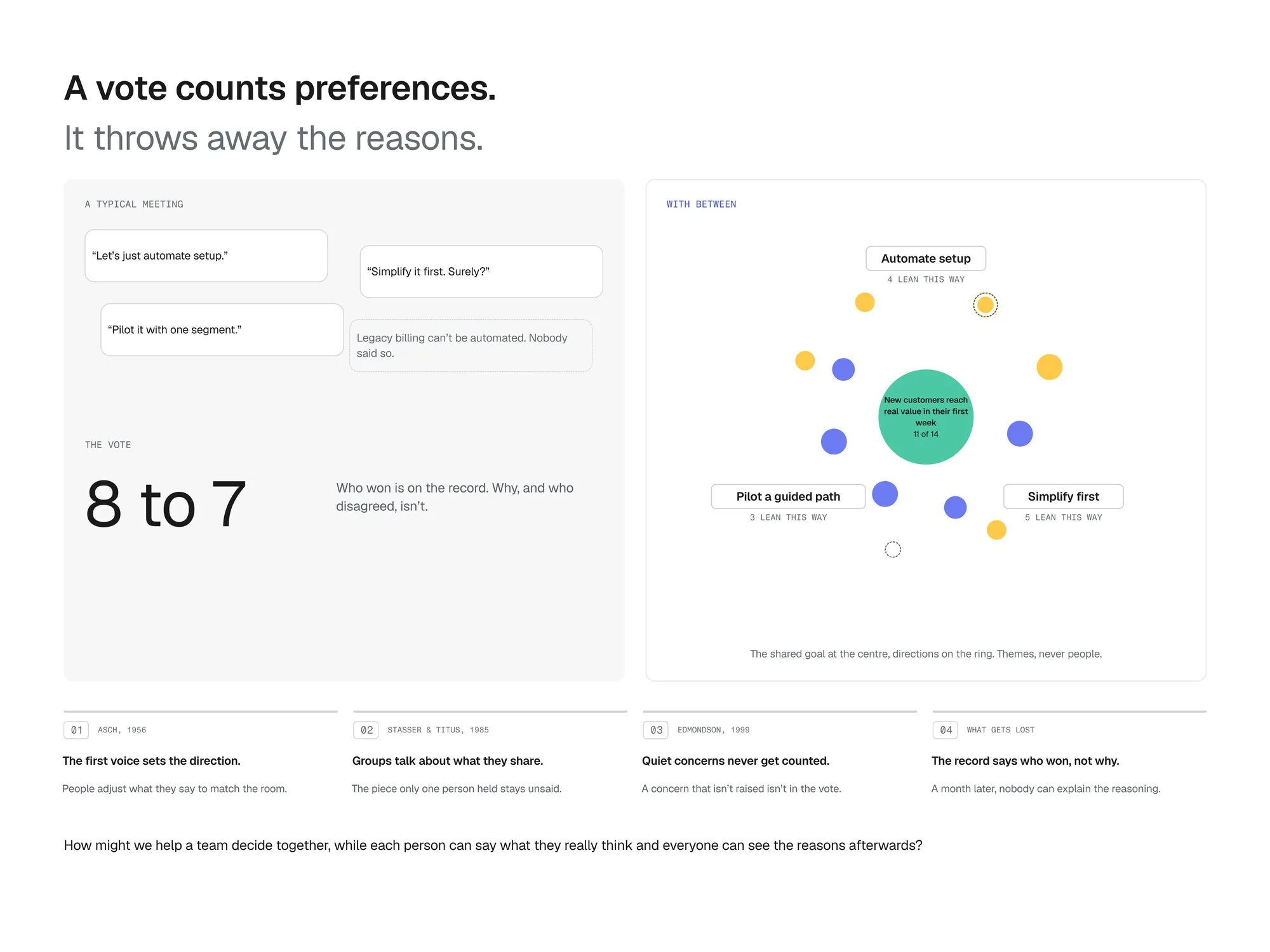
Most team decisions end in a vote. A vote counts preferences and throws away the reasons.
Between is a tool for any team working through something they see differently. Someone posts one question. Everyone answers four short prompts on their own. Once enough people have answered, Between shows where the team meets and where it differs, and the team records an outcome with its reasons, an owner, a review date and the disagreement that's left.
The hard part is privacy in a small group. A team of fifteen can't be promised anonymity, so Between doesn't promise it. It says what is shared, when, and with whom.
In testing, 7 of 8 people could say correctly what their teammates would see before they submitted, against 3 of 8 with their usual doc and poll.
02
The problem
75%
Participants who went along with a clearly wrong group answer at least once, when everyone else in the room gave it.
Asch, 1956
#1 of 5
Psychological safety's rank among the dynamics that separated Google's most effective teams, in a study of 180 teams.
Google Project Aristotle, 2015
63%
People in the US who can be singled out by just their ZIP code, sex and date of birth.
Golle, 2006
Sweeney's earlier estimate was 87%. Either way, “we removed the names” is not the same as anonymous.
Most teams decide the same way. Someone frames the question, the most senior people speak first, and the group moves to a show of hands. People adjust what they say to match the room (Asch, 1956), groups discuss what they already share and leave the unique pieces unsaid (Stasser & Titus, 1985), and people only raise concerns when they feel safe to (Edmondson, 1999). A month later the record says who won, not why.
The problem isn't that teams disagree. It's that the disagreement gets hidden, and comes back later as a decision quietly reversed.
03
Research
How do teams make hard decisions today, and what would it take for people to say what they really think before the room decides?
Step
Plan
Hypothesis
If everyone answers privately before anyone sees a result, people will raise concerns they hold back today, and managers won't feel they've lost the decision.
Objective
Learn who speaks, who doesn't and why, and what people need before they trust a private stage.
Non-objectives
Pricing, integrations, mobile.
Generative method
Contextual inquiry in 3 real decision meetings (two in person, one remote), then 7 semi-structured interviews of 45 minutes.
Evaluative method
Within-subjects test against each team's usual doc, poll and meeting (n = 8), then a RITE round of 5.
Participants
A junior designer who never disagrees in meetings, an engineering manager, a PM, a remote engineer, a screen reader user, a support lead with a team of four, and an HR partner who facilitates. Teams of 4 to 40.
Structured decision-making already exists, mostly on paper. Four precedents shaped the hypothesis.
Nominal group technique · 1971
Silence first, then share
What it does
Everyone writes ideas alone before any discussion.
What I took from it
Between's private stage is this step, built into the product.
Employee surveys
Minimum group sizes
What it does
Results stay hidden for any group smaller than a set minimum, often five.
What I took from it
A threshold is the right mechanism, but it lowers the risk without removing it, so it has to be explained.
Polis · vTaiwan
Mapping opinion at scale
What it does
Each person is a dot in an opinion map, and clusters show groups.
What I took from it
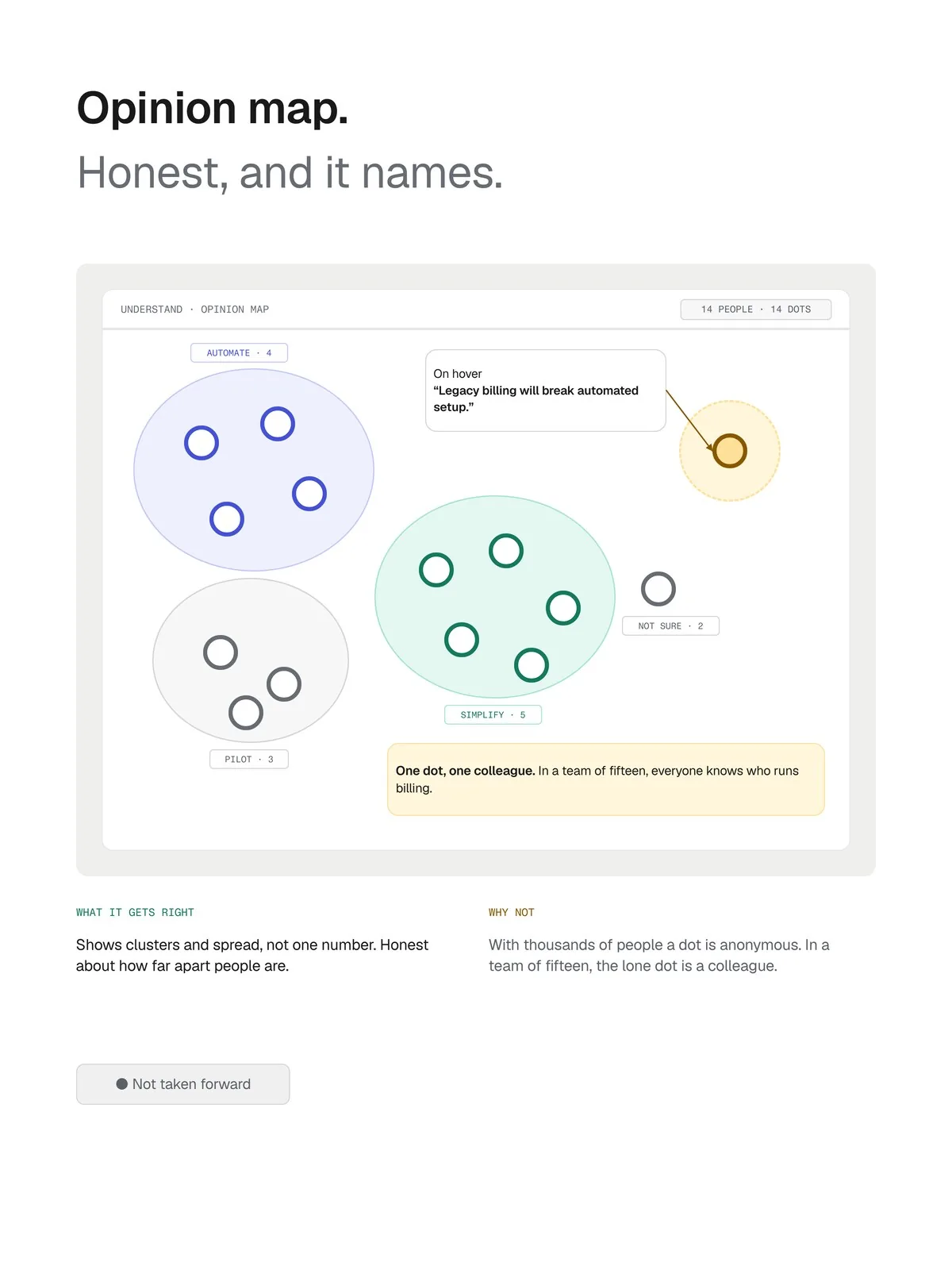
With thousands of people a dot is anonymous. In a team of fifteen, each dot is a colleague.
“Disagree and commit”
Moving forward without unanimity
What it does
People commit to a decision even when they disagree with it.
What I took from it
The “commit” usually happens. The “disagree” is rarely written down.
From notes to themes
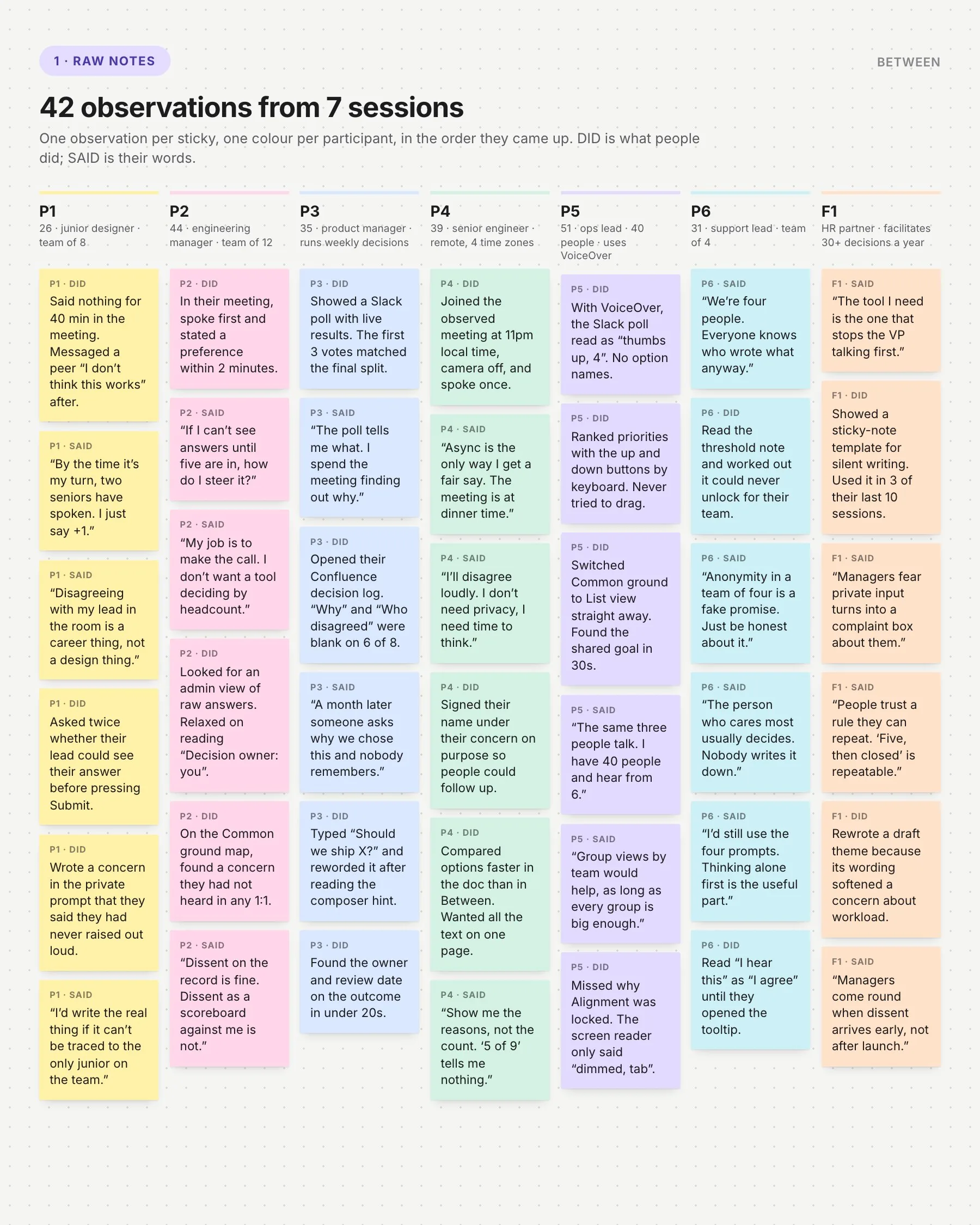
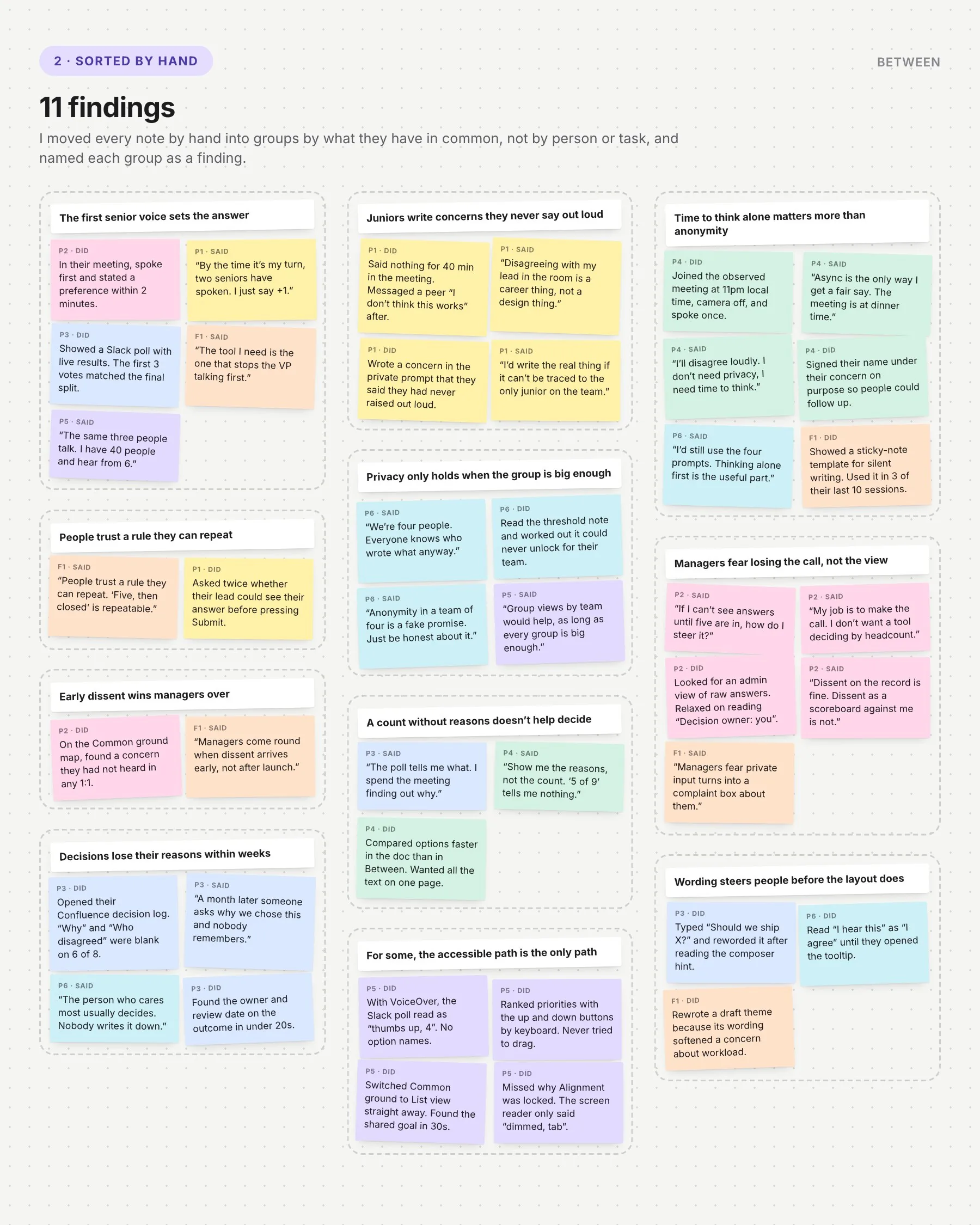
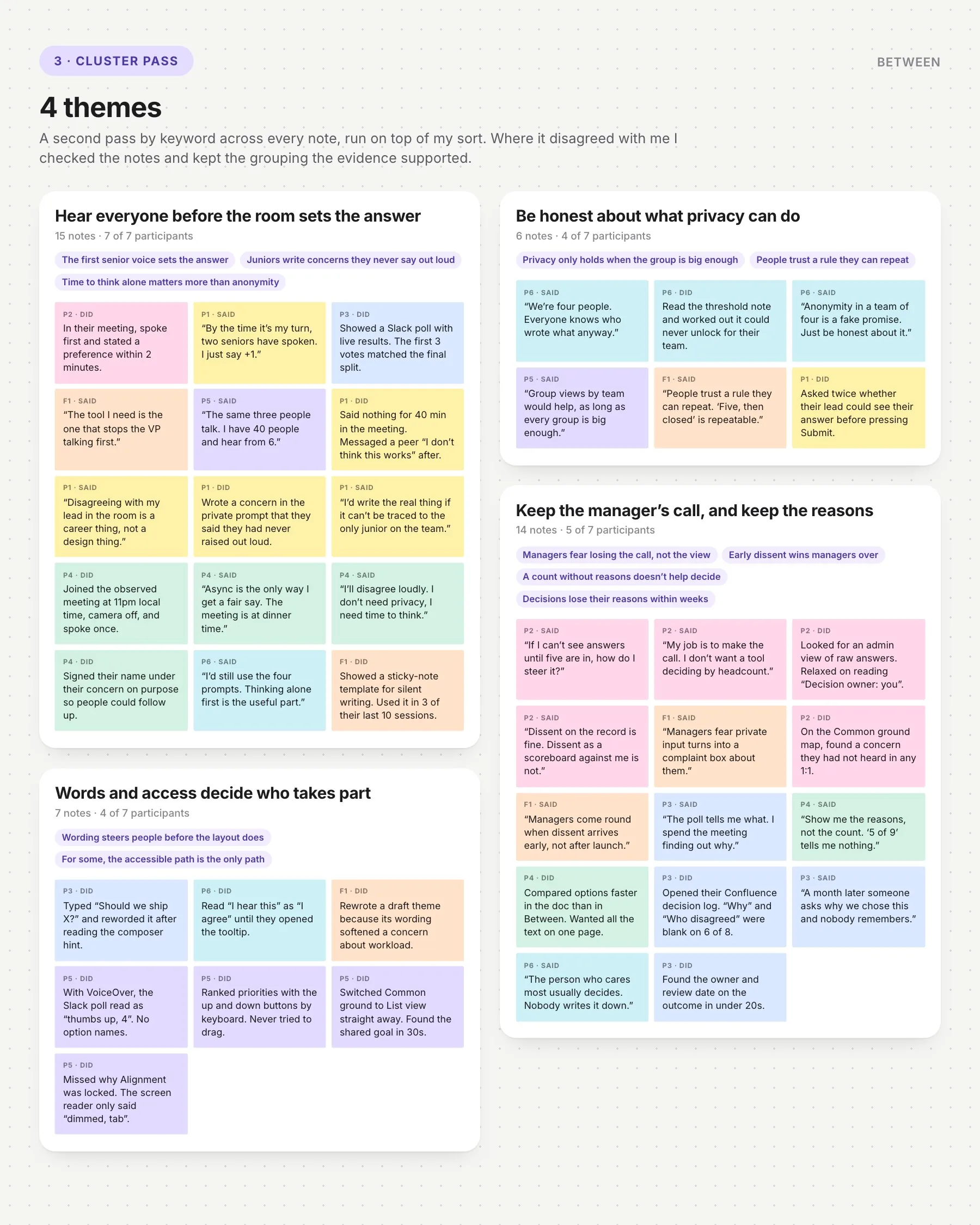
I wrote one observation per sticky, one colour per person, sorted them by hand into findings, then ran a cluster pass over the sort.
1. Raw notes. 42 observations from 7 sessions.
2. Sorted by hand. 11 findings, each a sentence.
3. Cluster pass. A keyword pass on top of the sort: 4 themes.
What I learned
Behaviour
The first senior voice sets the answer
Evidence
“By the time it's my turn, two seniors have spoken. I just say +1.” Seen in all 3 meetings, raised by 5 of 7. The junior designer said nothing for 40 minutes, then messaged a peer “I don't think this works.”
So
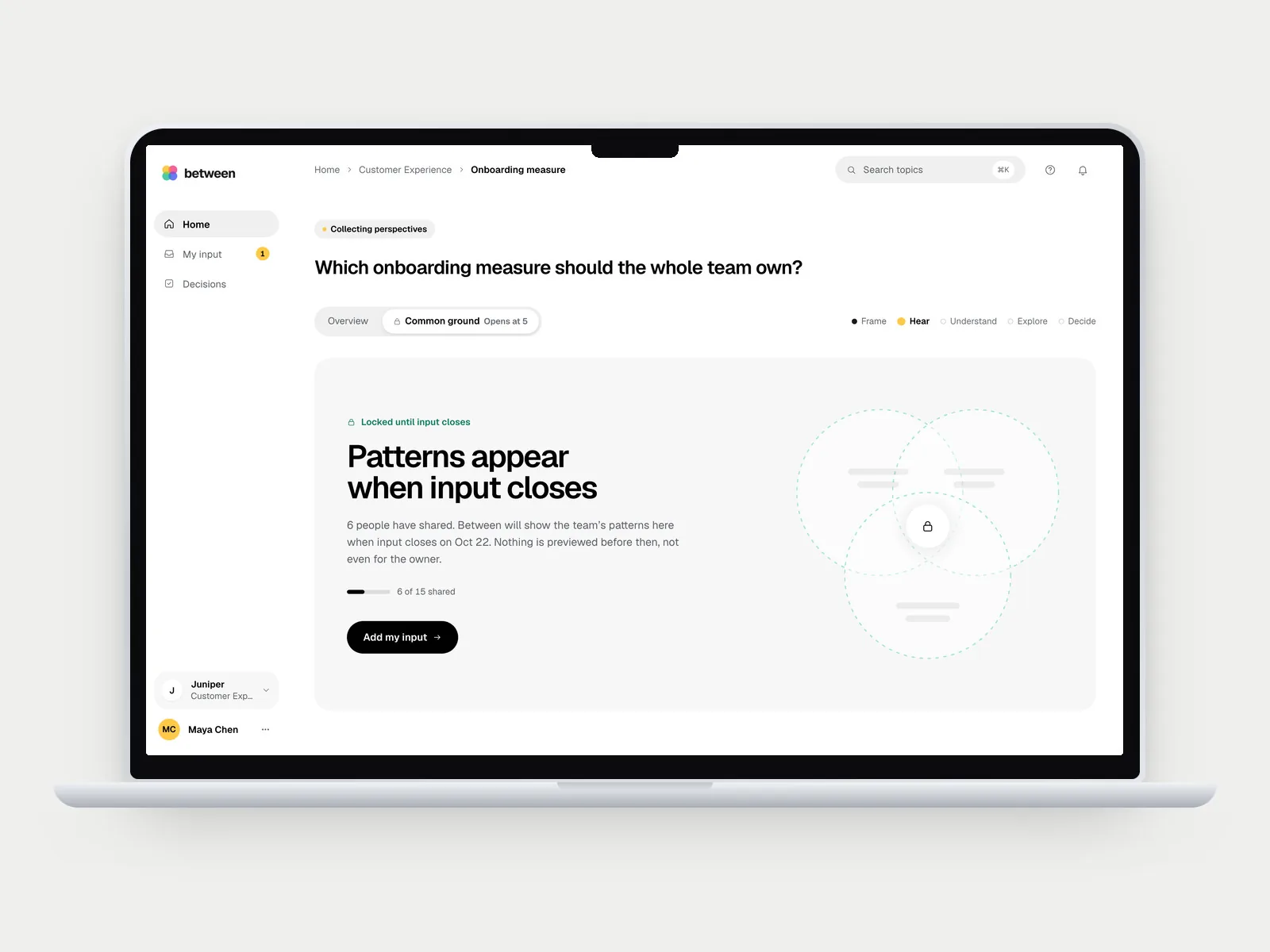
Nobody, the owner included, sees anything until five have answered and input has closed.
Motivation
Managers fear losing the call, not the view
Evidence
“My job is to make the call. I don't want a tool deciding by headcount.” The manager and the HR partner both raised it. The manager relaxed on reading “Decision owner: you”.
So
Every topic names its decision owner. People give a readiness signal, not a vote.
Against the concept
Some people need time to think, not anonymity
Evidence
“I'll disagree loudly. I don't need privacy, I need time to think.” 3 of 7 valued thinking alone over privacy. For a team of four, the threshold can never be met.
So
The private stage is framed as thinking time. Small teams are told plainly that people may guess who said what.
Need
A count without reasons doesn't help anyone decide
Evidence
“Show me the reasons, not the count.” In the PM's decision log, “Why” and “Who disagreed” were blank on 6 of 8 entries. Raised by 3 of 7.
So
Every count sits next to its reasons, and the outcome keeps the rationale and the dissent.
Recommendations
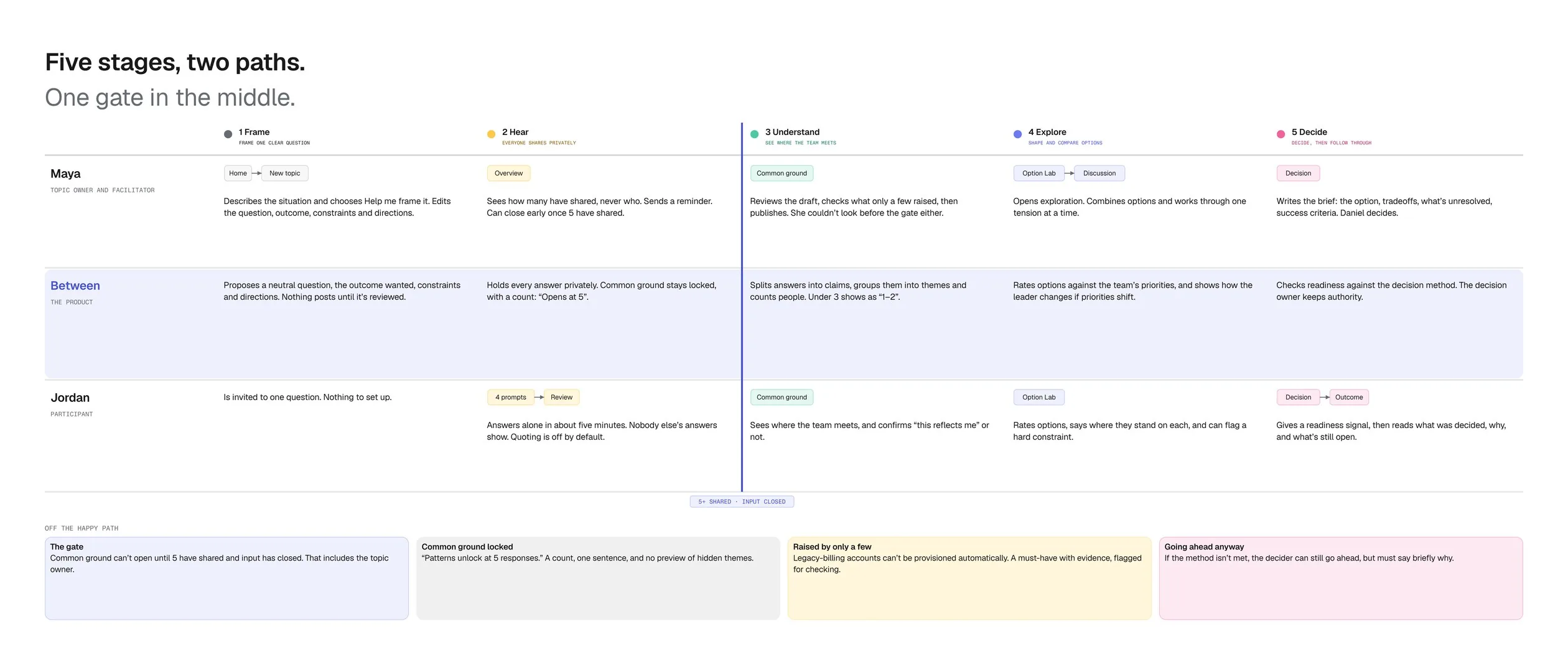
The room anchors on the first voice → nothing is visible until five have shared and input has closed.
Managers fear losing the call → a named decision owner on every topic, and readiness signals instead of votes.
Privacy fails in small teams → one rule people can repeat, “five, then closed”, and the limit said out loud.
Reasons disappear within weeks → an outcome with rationale, owner, review date and the dissent.
A screen reader user heard “thumbs up, 4” → a List view of every chart and keyboard ranking.
At the readout, the HR partner and the manager agreed to drop a manager view of raw answers I still had on the roadmap.
04
Defining the opportunity
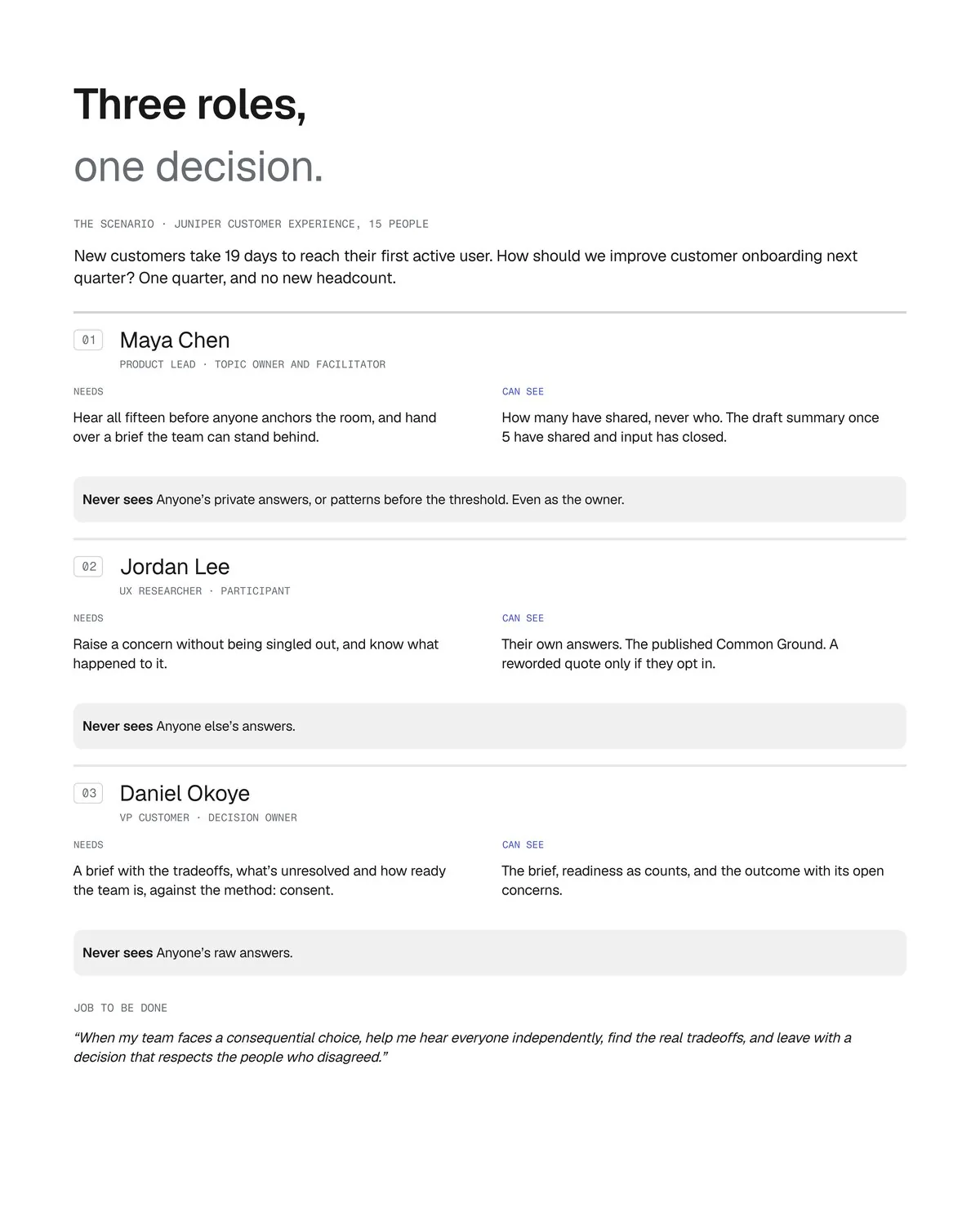
Three roles, one decision
Maya, a product lead, owns the topic and needs to hear everyone before anyone anchors the room.
Jordan, a UX researcher, has concerns but doesn't want to be singled out for raising them.
Daniel, VP Customer, owns the decision and needs the tradeoffs without seeing anyone's raw answers.
Their scenario runs through every screen: how should Juniper improve customer onboarding next quarter? Fifteen are invited and fourteen share.
Three decisions that shaped the product
Privacy
Thresholds, not promises
Considered
Telling people their answers are anonymous.
Why not
In a team of fifteen, nobody can promise that. A threshold lowers the risk, and the product says it doesn't remove it.
Alignment
Themes, not dots
Considered
An opinion map with one point per person.
Why not
In a small team a lone dot is a person. The map shows shared themes and never draws people.
Output
A record, not a winner
Considered
A weighted score that ranks the options.
Why not
A total hides the tradeoff and suggests precision nobody has.
05
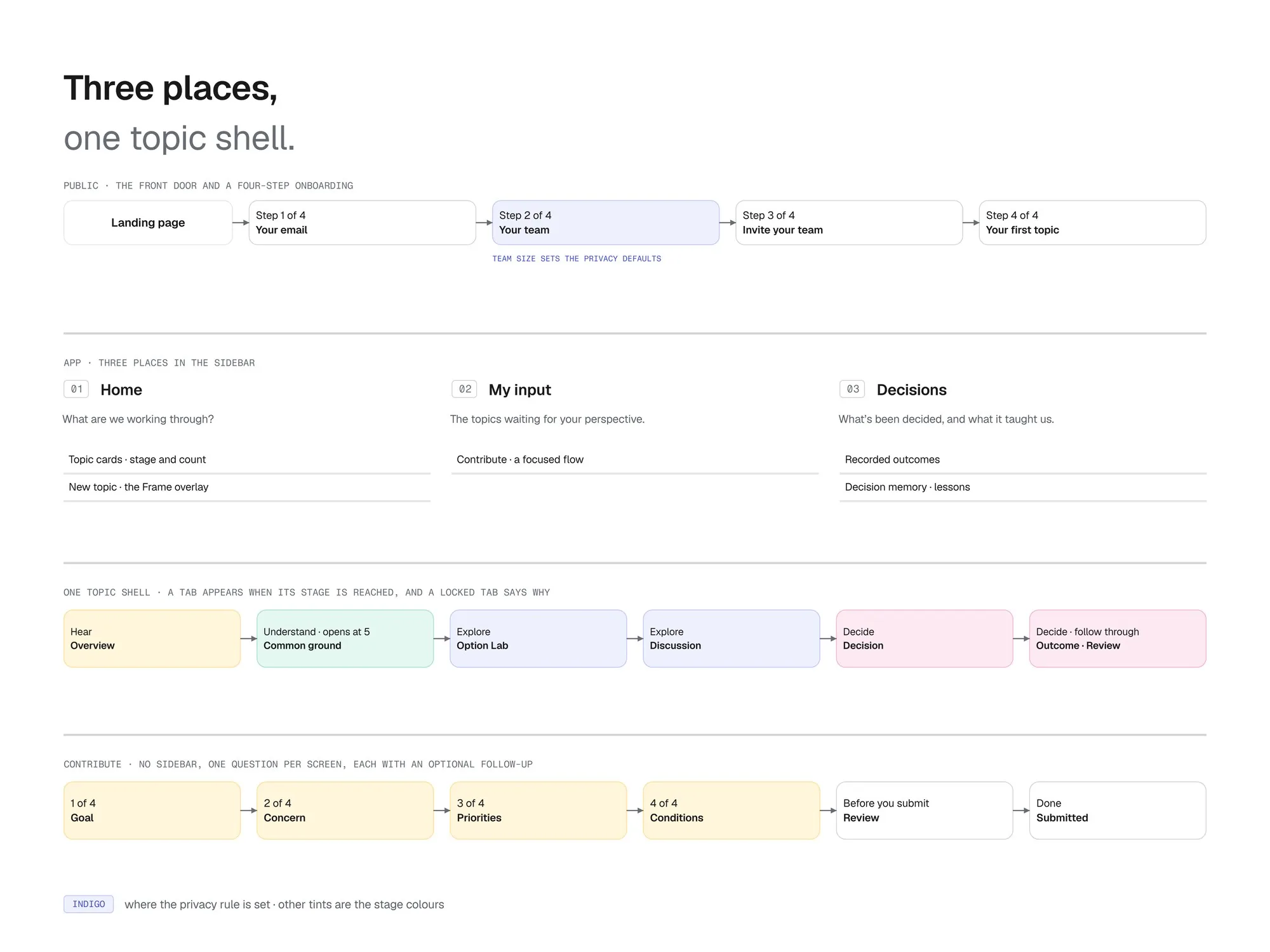
Information architecture and flows
From 22 screens to 9
The first version had a dashboard, a setup wizard, an option matrix, a criteria editor, live sessions and an archive. Together they asked people to learn a process before they could say what they thought. I cut until every screen did one job, and the app has three places: Home, My input and Decisions. A topic's tabs appear only when its stage is reached, and a locked tab always says why.
Frame → Hear → Understand → Explore → Decide.
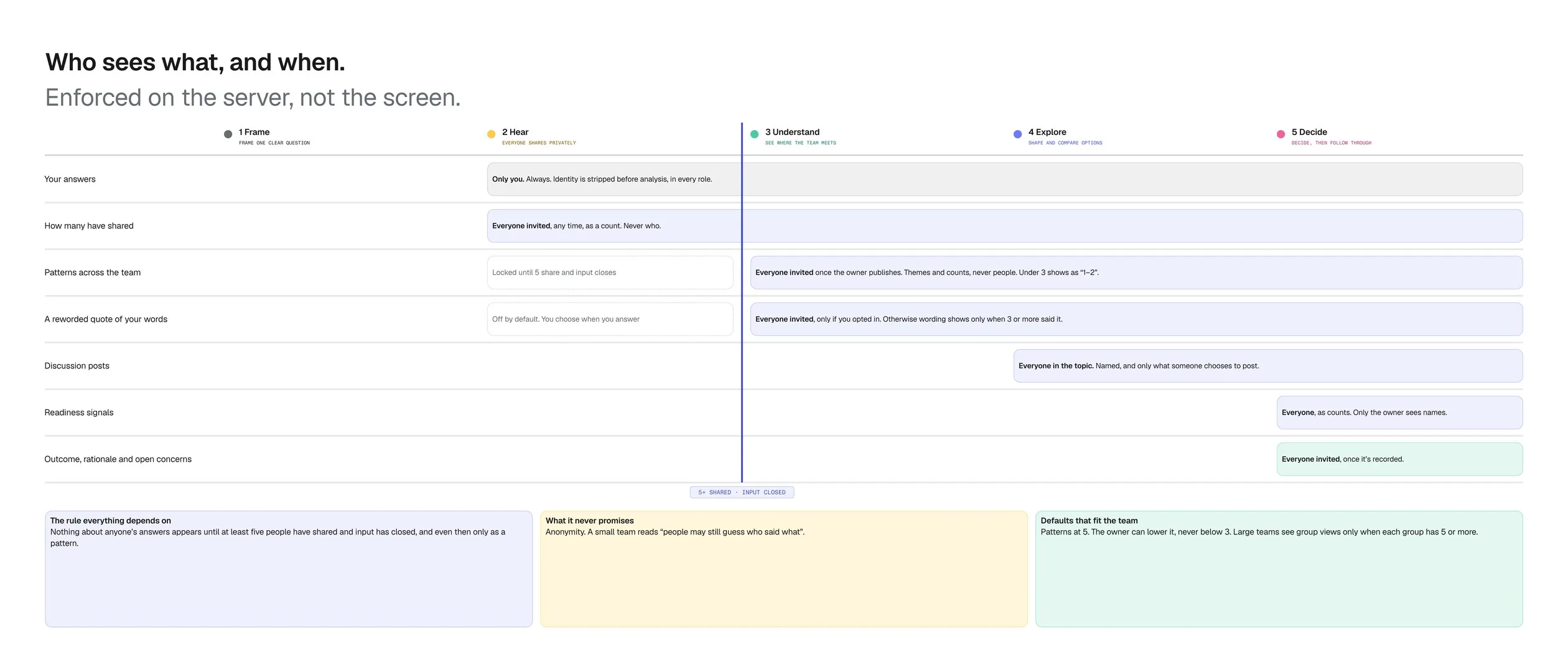
Who sees what, and when
I wrote the privacy model as a table before designing any screen. Nothing about anyone's answers appears until at least five people have shared and input has closed, and then only as a pattern. Reminders go to “everyone who hasn't shared” without naming them, and views by group exist only when every group has five or more.
Each bar shows when one kind of information becomes visible, and to whom.
06
Exploration and iteration
The alignment screen decides whether the product works, so I explored three ways to show the same fourteen responses.
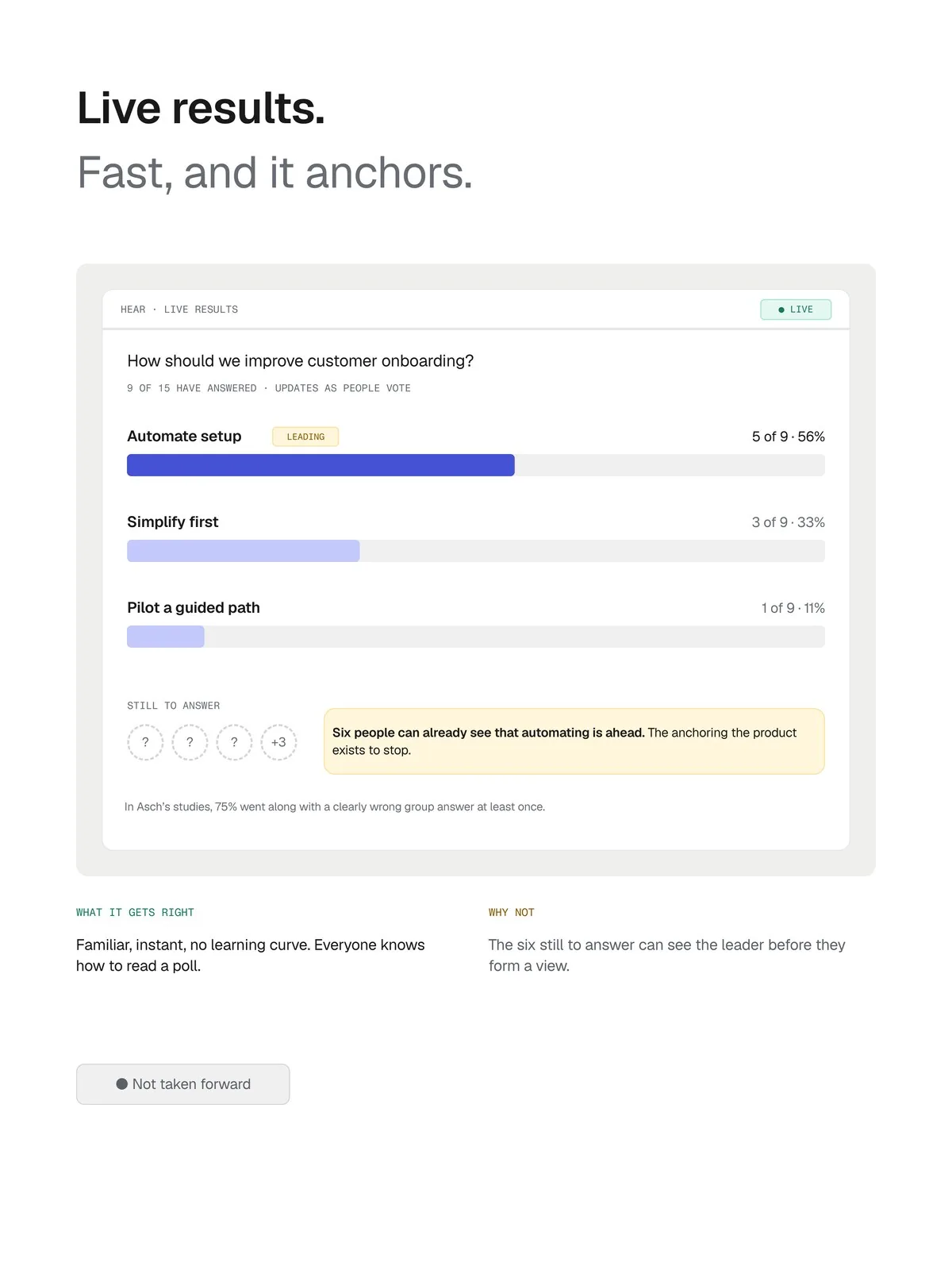
A. Live results. The six who haven't answered can already see the leader.
B. Opinion map. The outlier is the colleague everyone can name.
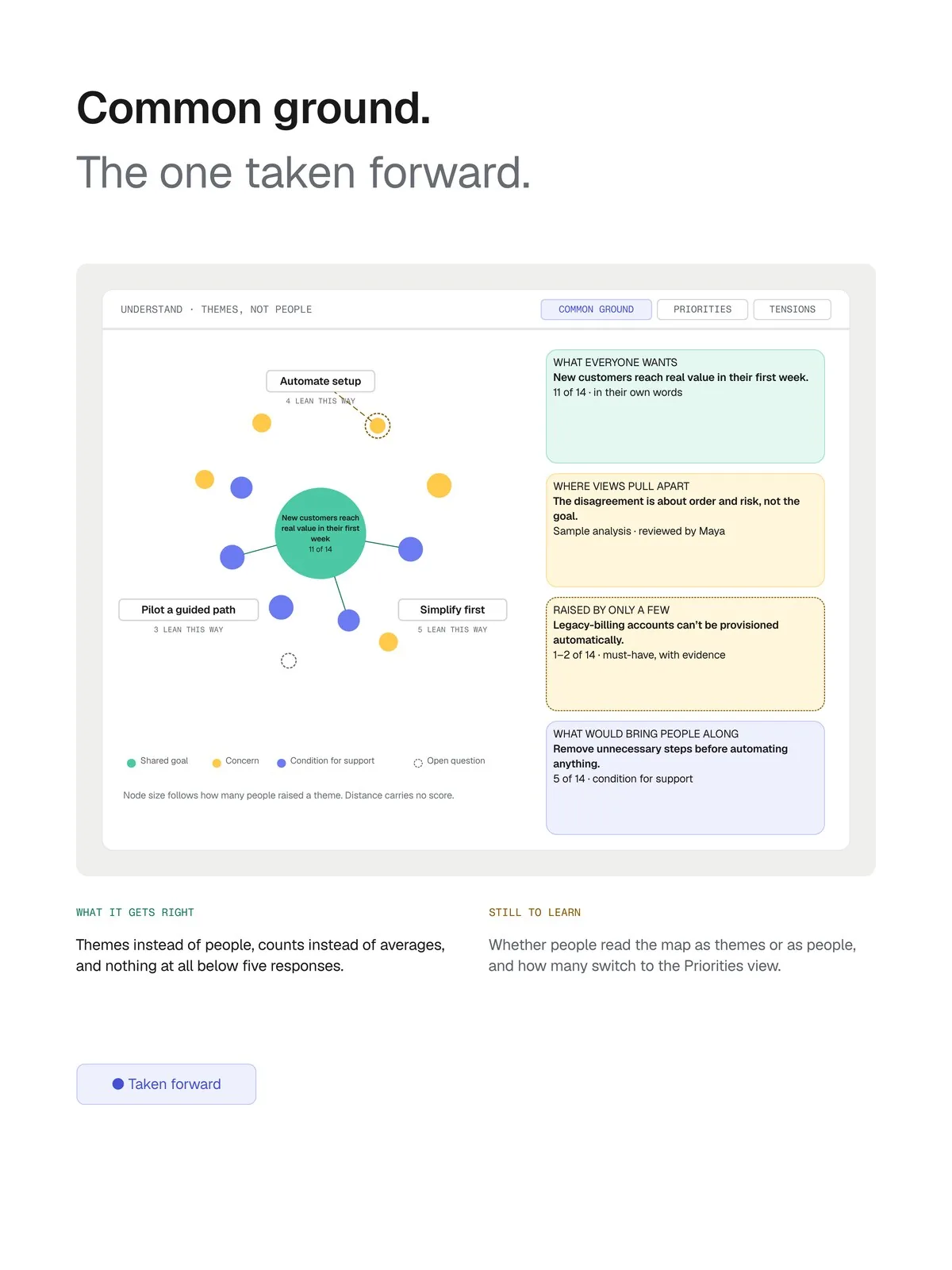
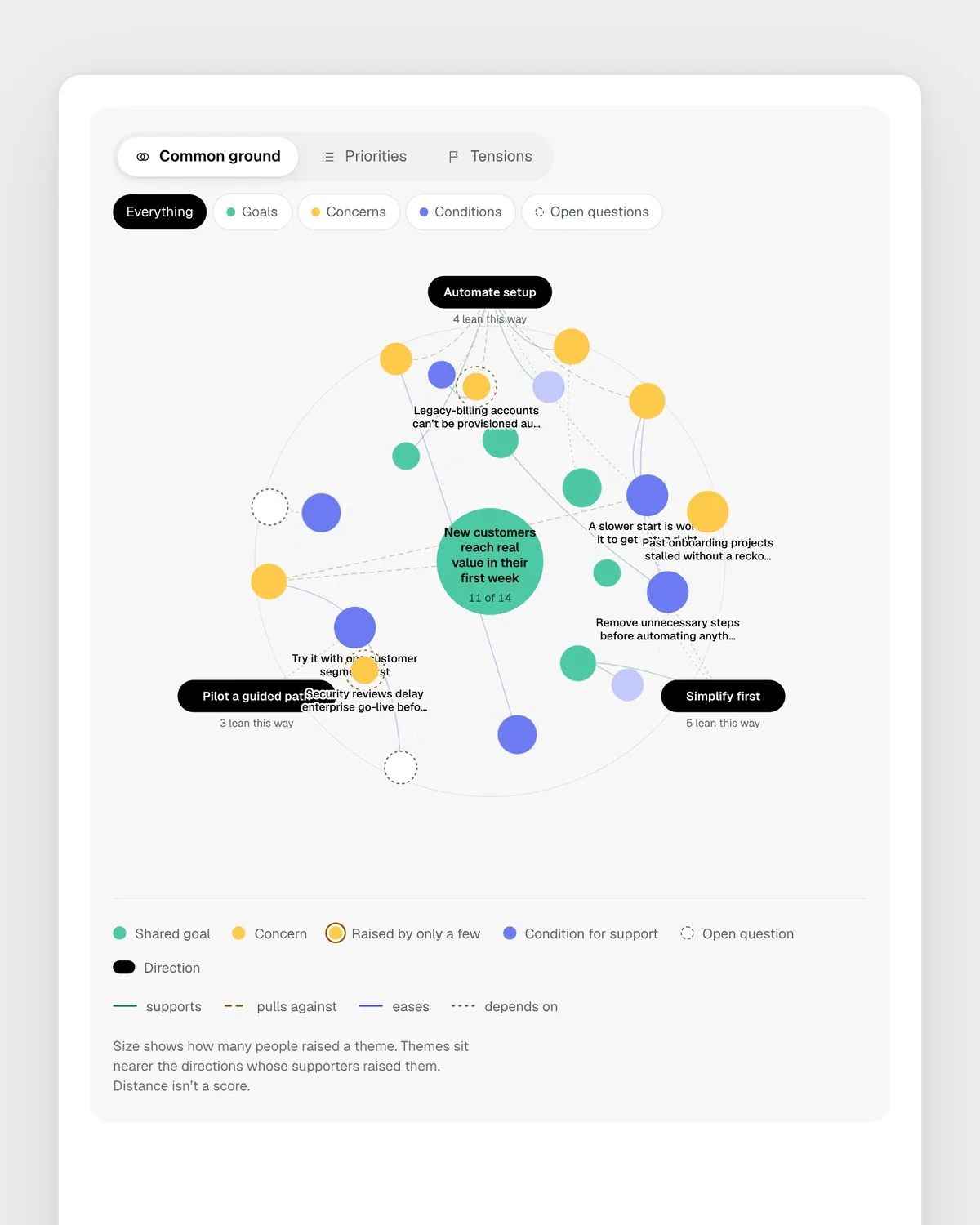
C. Common ground. Themes, not people. The direction I took forward.
Words that take sides
Avoided
Used instead
Why
Your answers are anonymous
Your answers are private. In a small team, people may still guess who said what
Only promise what the product can keep
Conflict
Where views differ
Disagreement is expected, not a fault
Score 7.4 / 10
Named by 11 of 14
Counts in plain words, not false precision
Vote
Readiness signal
“I can support this with a condition” says more than yes or no
I agree
I hear this
Acknowledging a point shouldn't mean endorsing it
What testing changed
After the within-subjects test I fixed the top issues and ran a RITE round with 5 new people.
The locked tab. VoiceOver read it as “dimmed, tab” → it now announces the reason and the count → 5 of 5 could say why Alignment was locked.
“I hear this”. 2 of 8 read it as agreement → a helper line, “Acknowledges, doesn't agree” → nobody misread it.
The disclosure. 1 of 8 thought the owner sees answers after five → it adds “Never your answers. Only themes.” → 5 of 5 answered the comprehension check correctly.
07
The final experience
Three features carry the argument: nobody sees anything until the team has spoken, the team sees themes instead of people, and the record keeps the dissent.
Hear
Nothing to see until five have shared
Until the threshold, Common ground is a count and one sentence. Not even the owner gets a preview. Every topic states the rule in plain words: “Summaries appear once 5 people have responded. In a small team, people may still guess who said what.”
What research showed
The first senior voice set the answer in all 3 meetings. “By the time it's my turn, two seniors have spoken. I just say +1.”
What I designed
One rule people can repeat, “five, then closed”, and a locked tab that says why it's locked. Privacy is promised only as far as it holds.
What testing showed
7 of 8 could say what teammates would see before submitting, against 3 of 8 with their usual doc and poll.
Common ground. The shared goal sits in the centre, named by 11 of 14. Every theme carries a count, never a name.
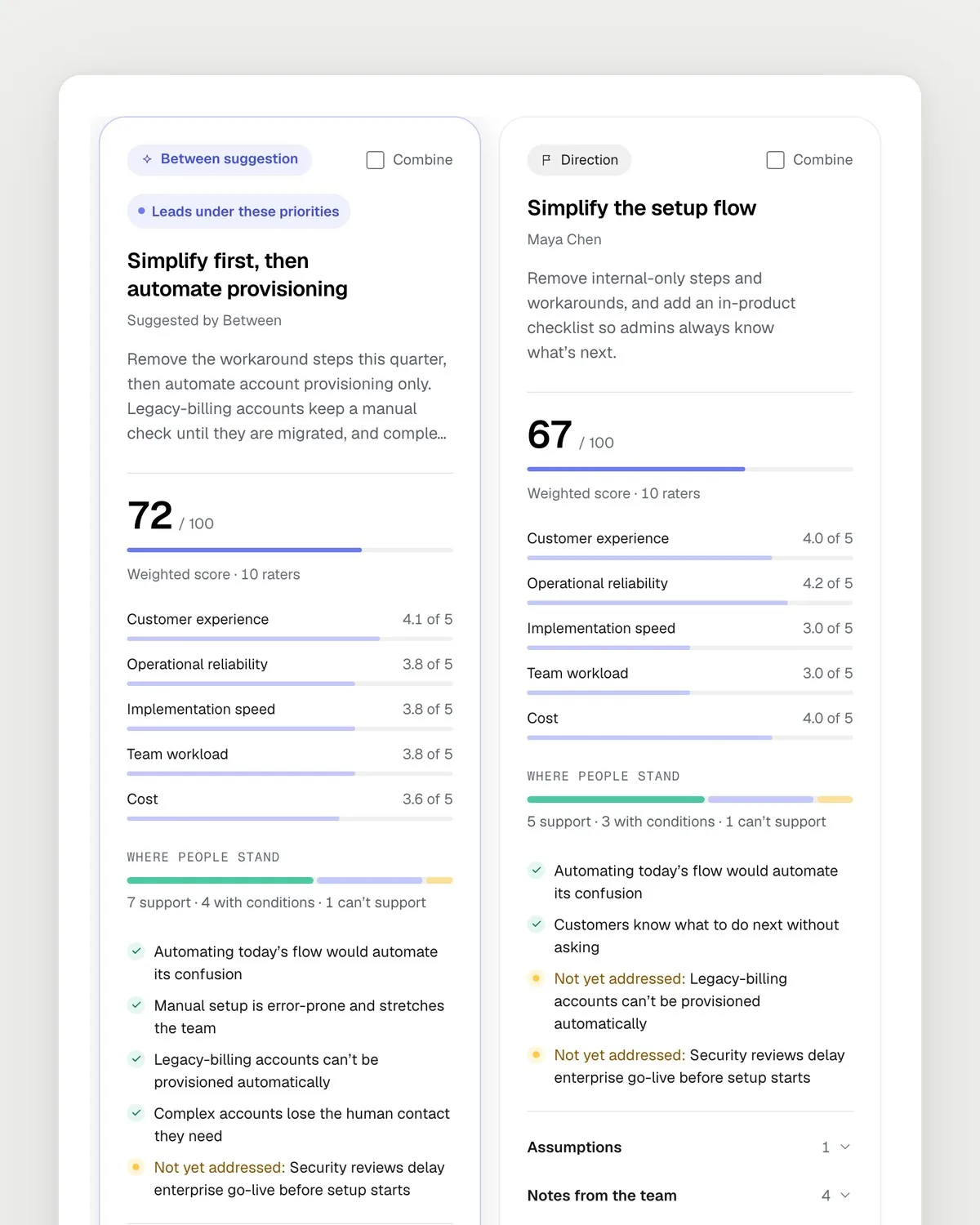
Option Lab. Each option scored against the team's own priorities, with the concerns it hasn't answered yet.
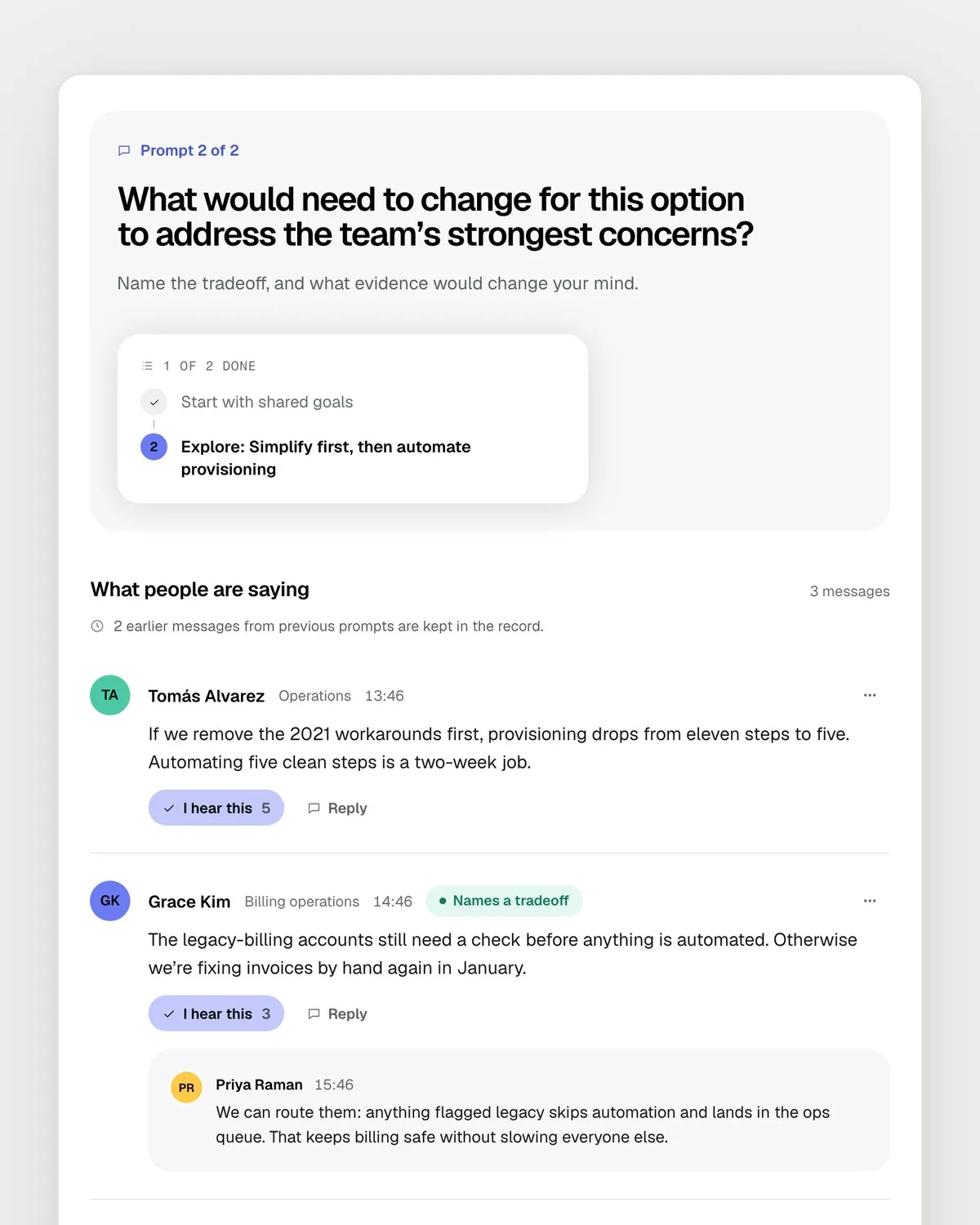
Discussion. One question at a time, with “I hear this” instead of likes.
What research showed
“Show me the reasons, not the count.” And on an opinion map with one dot per person, the outlier was the colleague everyone could name.
What I designed
Themes coloured by kind: goal, concern, condition or open question. Nothing can be hovered to reveal a colleague, and where views differ sits right beside what everyone wants.
What testing showed
7 of 8 found where the team already agreed, against 3 of 8. The screen reader user found the shared goal in List view in 30 seconds.
Decide
A decision that keeps the dissent
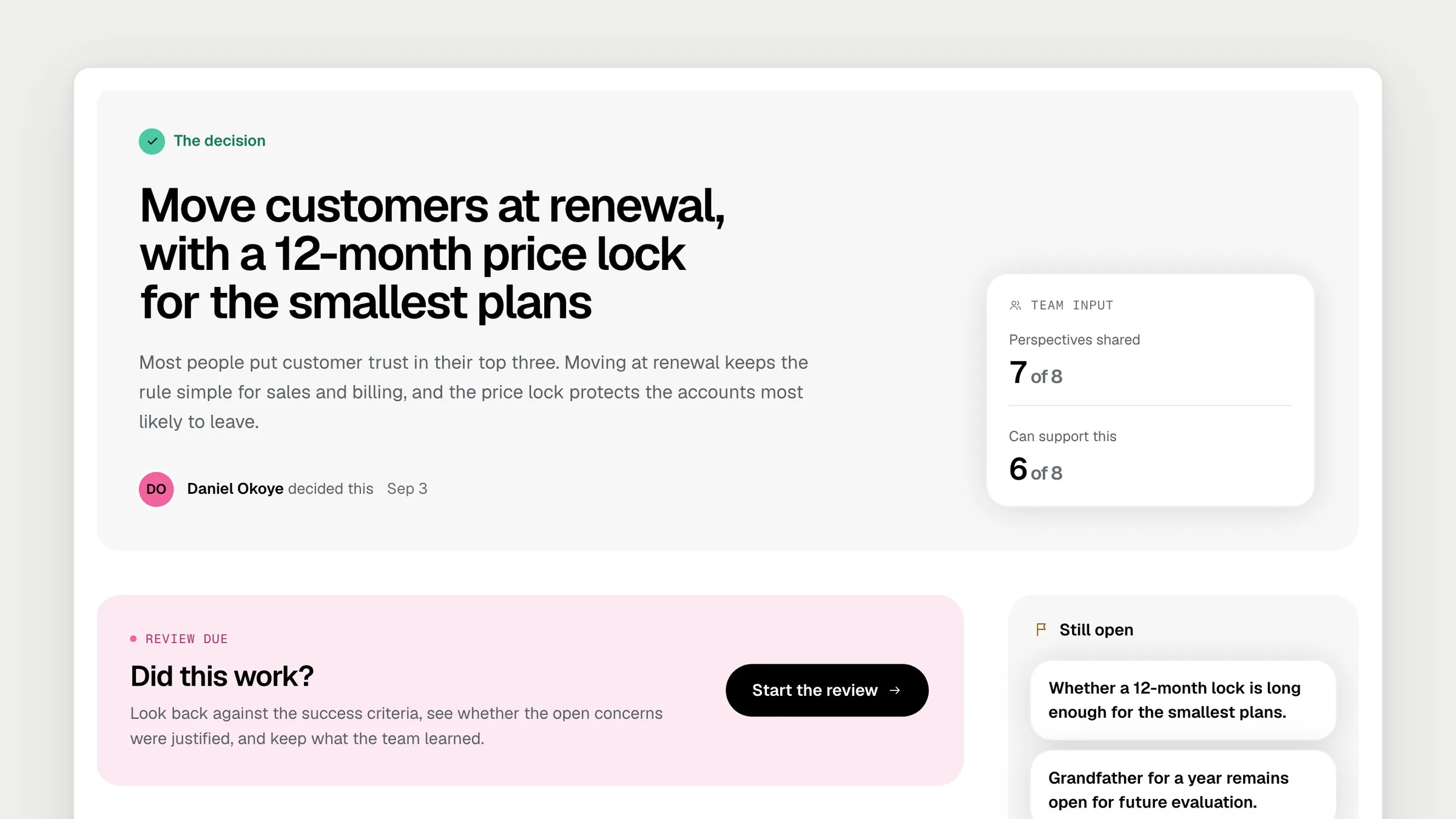
The outcome reads “Here's what we're doing next”, not “The team agreed”. The decision owner's call sits beside the team's input, 6 of 8 can support it, with what's still open and a date to review it.
What research showed
In the PM's decision log, “Why” and “Who disagreed” were blank on 6 of 8 entries. Managers feared losing the call, not hearing the view.
What I designed
Readiness signals instead of votes, a named decision owner, and an outcome with its reasons, owner, review date and open concerns. With no agreement, it records a next step instead of a fake consensus.
What testing showed
8 of 8 found the decision, its owner and who disagreed, against 1 of 8 in their team's Slack thread.
Also in the product
Four-screen onboarding, where team size sets the privacy defaults.
A composer that facilitates: “Phrase the question so different answers feel welcome.”
Four private prompts, one at a time, including a pre-mortem and a ranked top three that works by keyboard.
A discussion that takes one tension at a time, with “I hear this” instead of likes.
A review on the set date, where “Don't know yet” is an honest answer.
A calm system: one violet accent, mint for shared ground and amber for tension, so disagreement never looks like an error.
08
Validation and outcomes
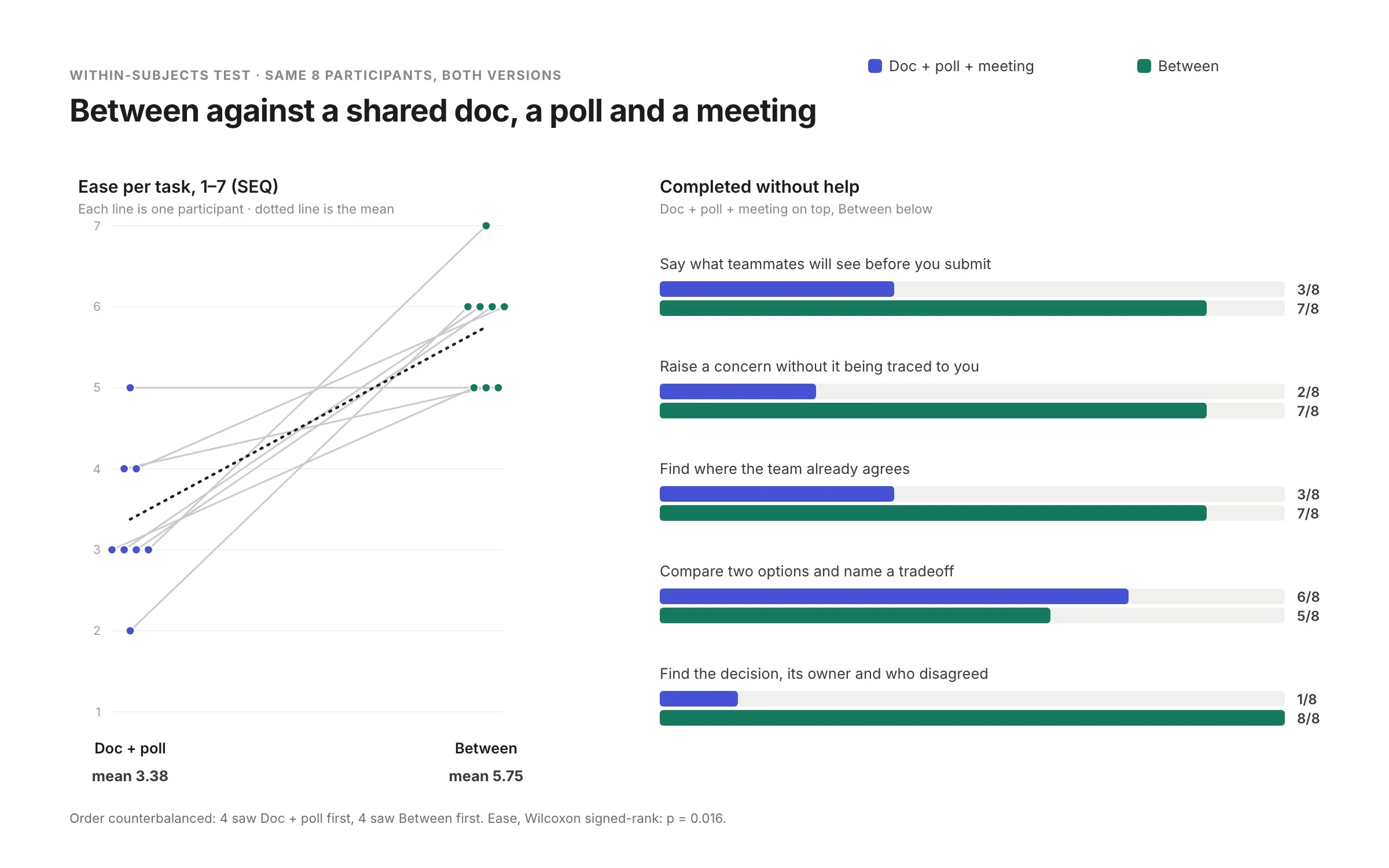
I ran a within-subjects test with 8 people: each did five tasks in their team's usual way, a shared doc and Slack poll followed by a meeting, and in Between. Half started with each, to reduce order effects. I measured ease per task (SEQ, 1–7), unaided completion, and one comprehension check: “Before you submit, what will your teammates be able to see?”
Ease rose from 3.4 to 5.8 (Wilcoxon signed-rank, p = 0.016).
Task
Doc + poll
Between
What I saw
Say what teammates will see before you submit
3 / 8
7 / 8
Five didn't know the poll showed names and live results
Raise a concern without it being traced to you
2 / 8
7 / 8
Doc comments carry names. One person signed their concern on purpose
Find where the team already agrees
3 / 8
7 / 8
One person read the map's nodes as people
Compare two options and name a tradeoff
6 / 8
5 / 8
The doc won. People wanted both options' text side by side
Find the decision, its owner and who disagreed
1 / 8
8 / 8
The Slack thread never said who disagreed
Still open
Comparing options is slower than a doc. The Option Lab needs a side-by-side text view.
Teams under five can never unlock patterns. They need an attributed mode the group agrees to up front.
Facilitators can soften a theme. The HR partner rewrote one that played down a workload concern. Theme edits need an audit trail.
09
Reflection and next steps
What participants taught me
Privacy isn't what everyone needs. The remote engineer wanted time to think and signed their concern. The private stage is useful as thinking time, even when nobody is hiding.
Managers will give up the early look, not the call. Naming the decision owner did more for trust than any privacy setting.
The accessible path is a main path. The screen reader user went straight to List view and found the shared goal in 30 seconds.
Wording is a facilitation tool. “I hear this” only worked once it said it wasn't agreement.
What's next
An attributed mode for teams under five, tested with the support lead's team.
Side-by-side options in the Option Lab, retested against the doc.
An audit view that shows how the question and themes changed after launch.
Mobile contribution. Private input might not need a big screen.
Sources
10
Asch, S. E. “Studies of Independence and Conformity: A Minority of One Against a Unanimous Majority.” Psychological Monographs, 1956. Link
Stasser, G. & Titus, W. “Pooling of Unshared Information in Group Decision Making.” Journal of Personality and Social Psychology, 1985. Link
Edmondson, A. “Psychological Safety and Learning Behavior in Work Teams.” Administrative Science Quarterly, 1999. Link
Duhigg, C. “What Google Learned From Its Quest to Build the Perfect Team.” The New York Times Magazine, 2016. Link
Sweeney, L. “Simple Demographics Often Identify People Uniquely.” Carnegie Mellon University, Data Privacy Working Paper 3, 2000. Link
Golle, P. “Revisiting the Uniqueness of Simple Demographics in the US Population.” Workshop on Privacy in the Electronic Society, 2006. Link
Delbecq, A. L. & Van de Ven, A. H. “A Group Process Model for Problem Identification and Program Planning.” Journal of Applied Behavioral Science, 1971. Link