Can an interface make you feel more intelligent?
Every product teaches you something about yourself. Some teach you that you’re good at this. Others teach you that you need them.
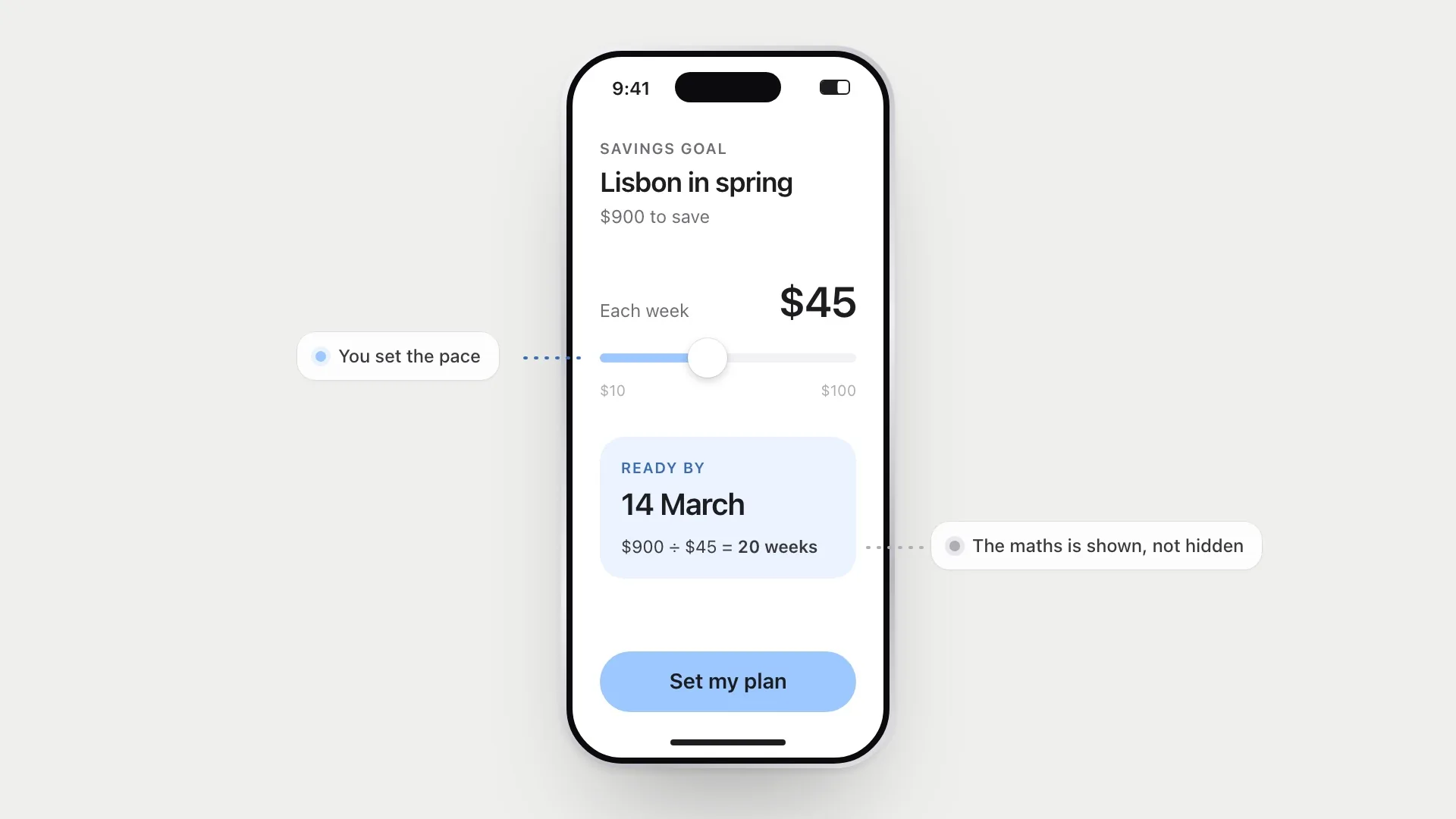
Think of the last time you finished something in an app and felt quietly pleased with yourself. Maybe you set up a budget and finally understood where your money goes. Maybe you edited a photo and it looked the way you imagined. Now think of a time you got the result you wanted but felt slightly stupid, because you had no idea how it happened or how you’d do it again.
Both products worked. Only one left you more capable than before. I’ve become interested in that difference, because it’s rarely measured and it shapes whether people trust themselves or the tool.
Competence is a feeling, and products shape it
Psychologists call the belief that you can do something self-efficacy. Albert Bandura, who named it, argued that the most dependable source of that belief is direct experience of succeeding at something slightly hard. Not being told you’re good. Not watching someone else do it. Doing it.
The reason is attribution. When you succeed, you ask, mostly without noticing, why it worked. If the honest answer is “because I understood what I was doing”, the success counts as evidence about you. If the honest answer is “because the app sorted it”, it counts as evidence about the app. Bandura made this point himself: success reached with a lot of outside help does less for the belief, because people can credit the help instead of themselves. That’s why the approach he described withdraws the supports step by step, until people are succeeding on their own.
That gives designers a clear lever. If the product does the hard part invisibly, you get the result without the experience. If it lets you do the hard part with good support, you get both.
But there’s a catch, and it’s the part I find most interesting. The feeling of competence and actual competence can come apart, and interfaces are very good at producing the first without the second.
Matthew Fisher, Mariel Goddu and Frank Keil ran a series of experiments in which some people searched the web for explanations and others didn’t. Afterwards, the searchers rated themselves as better able to answer questions on topics they had never looked up. Having the internet in hand made people feel more knowledgeable in their own heads. They mistook access to information for understanding it.
Learning research has a name for the wider pattern. Nicholas Soderstrom and Robert Bjork reviewed decades of work separating performance, how well you do while you’re practising, from learning, what you can still do later, somewhere else. The two often diverge. Some conditions make practice feel smooth and leave little behind. Others make practice feel slow and clumsy and produce much better long-term results. And people consistently judge their own learning by how smooth the practice felt.
That matters for how we evaluate design. Almost everything we measure in a usability test is performance: completion, time on task, errors, a confidence rating at the end. A product can score beautifully on all of it while teaching nothing.
Tools change what we practise
There’s some evidence that the invisible path has a cost over time. Louisa Dahmani and Véronique Bohbot tested 50 regular drivers and found that people with more lifetime GPS use had worse spatial memory when they had to find their own way. They retested 13 of them three years later, and those who had used GPS more in between showed a steeper decline. The follow-up sample was small, and the study is correlational. But the heavier users didn’t report a worse sense of direction to begin with, which makes “bad navigators reach for GPS” a weaker explanation than “GPS stops you practising navigation”.
The better-known version of this story is the “Google effect”. In 2011, Betsy Sparrow, Jenny Liu and Daniel Wegner reported that when people expect information to stay available, they remember where to find it rather than the information itself. It also hasn’t held up as well as its fame suggests. When Colin Camerer and colleagues re-ran a set of social science experiments published in Nature and Science, the Sparrow experiment they repeated didn’t replicate. That doesn’t mean we don’t hand memory over to our devices. We obviously do. It means one famous study is a shakier foundation than it looks, and I’d rather lean on findings like the GPS work, which measure the skill itself.
The clearest recent evidence comes from a classroom. Hamsa Bastani and colleagues ran a field experiment with nearly a thousand high school maths students in Turkey. Some practised with a standard GPT-4 chat interface, some with a version set up to give teacher-designed hints instead of answers, and some with no AI at all. With the standard chat, practice scores went up by 48% compared with the control group. Then, on an exam without the AI, those students did 17% worse. The hint-giving tutor lifted practice scores even more, and largely removed the harm on the exam, though it didn’t produce a measurable gain either.
I read that study as a design result, not an AI result. The same model, framed two ways, produced opposite effects on what students could do on their own. The difference was the interface: what it offered by default, and what it held back.
Neither line of research says tools are bad. They say tools change what we practise. Every feature quietly decides which part of a task the person will keep doing and which part they’ll stop.
Three things that make people feel capable
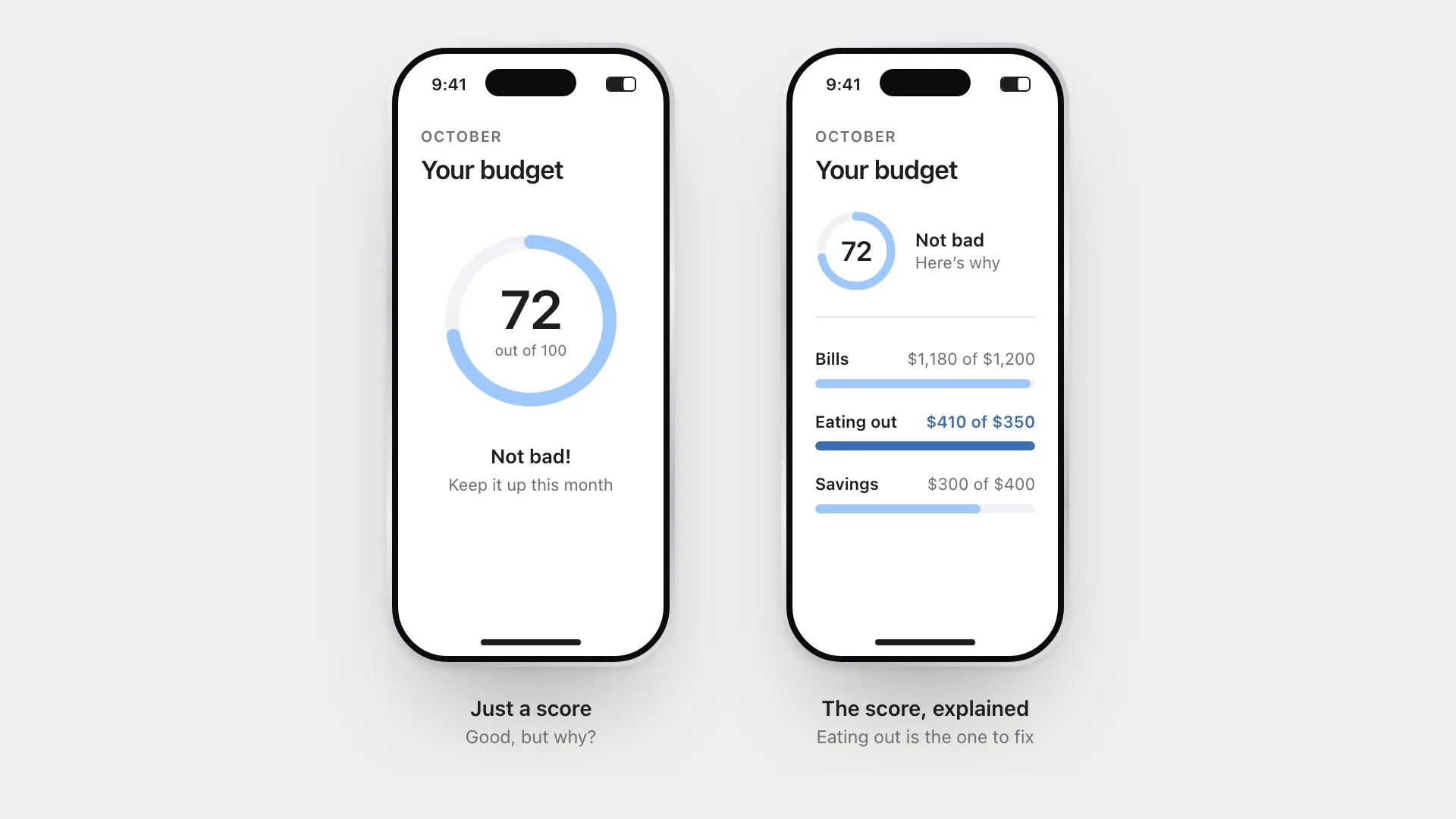
A structure you can see. When information architecture matches how people think about a task, they can predict where things are. Prediction is a form of mastery. When the structure is hidden, or follows the company’s org chart instead of the user’s mental model, people feel lost, and lost feels like stupid. A visible structure also does something quieter: it gives people a model of the domain itself. The budget screen that shows three categories behind a score is teaching how budgets work. The one that only shows the score is asking to be trusted.
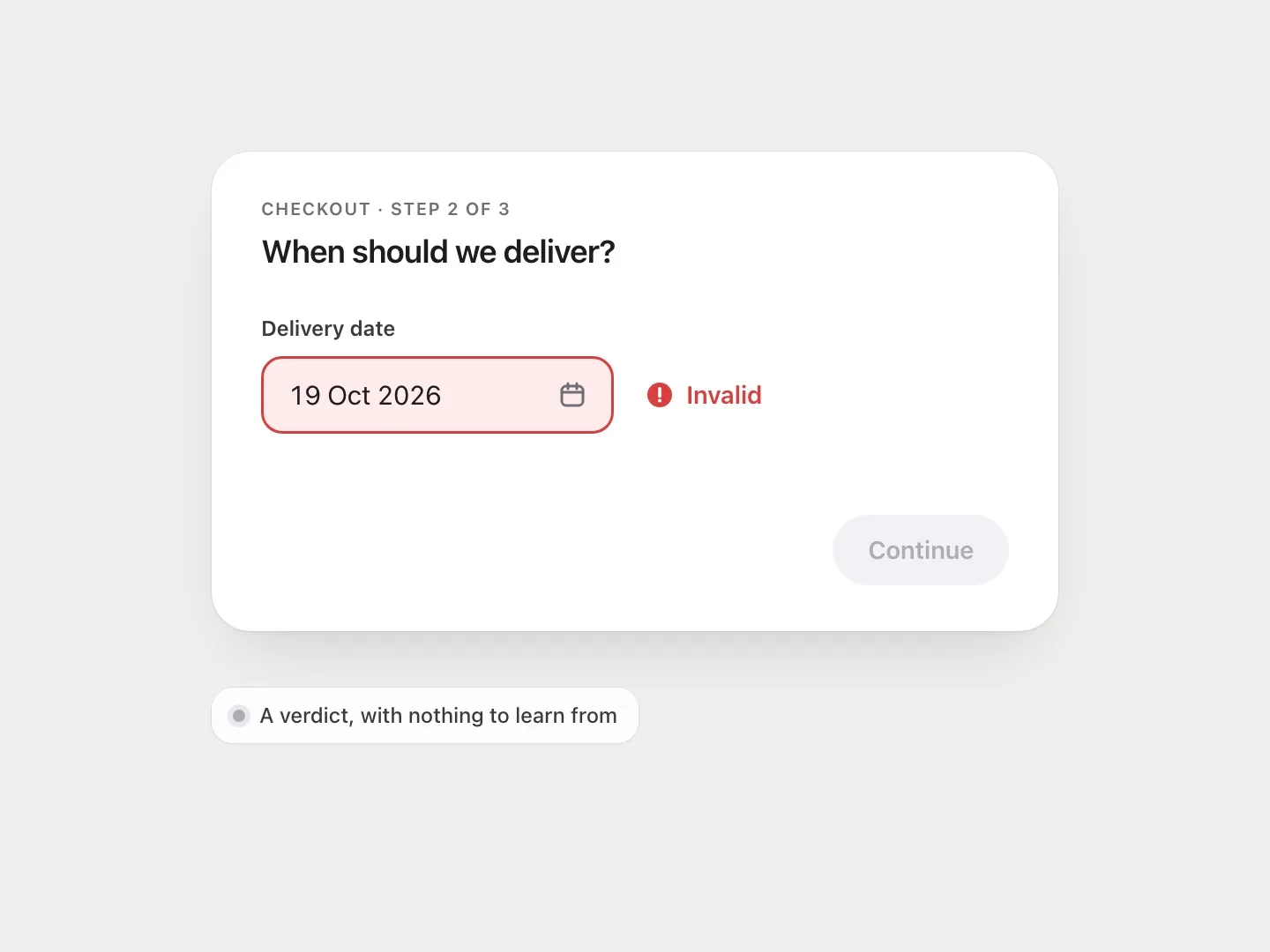
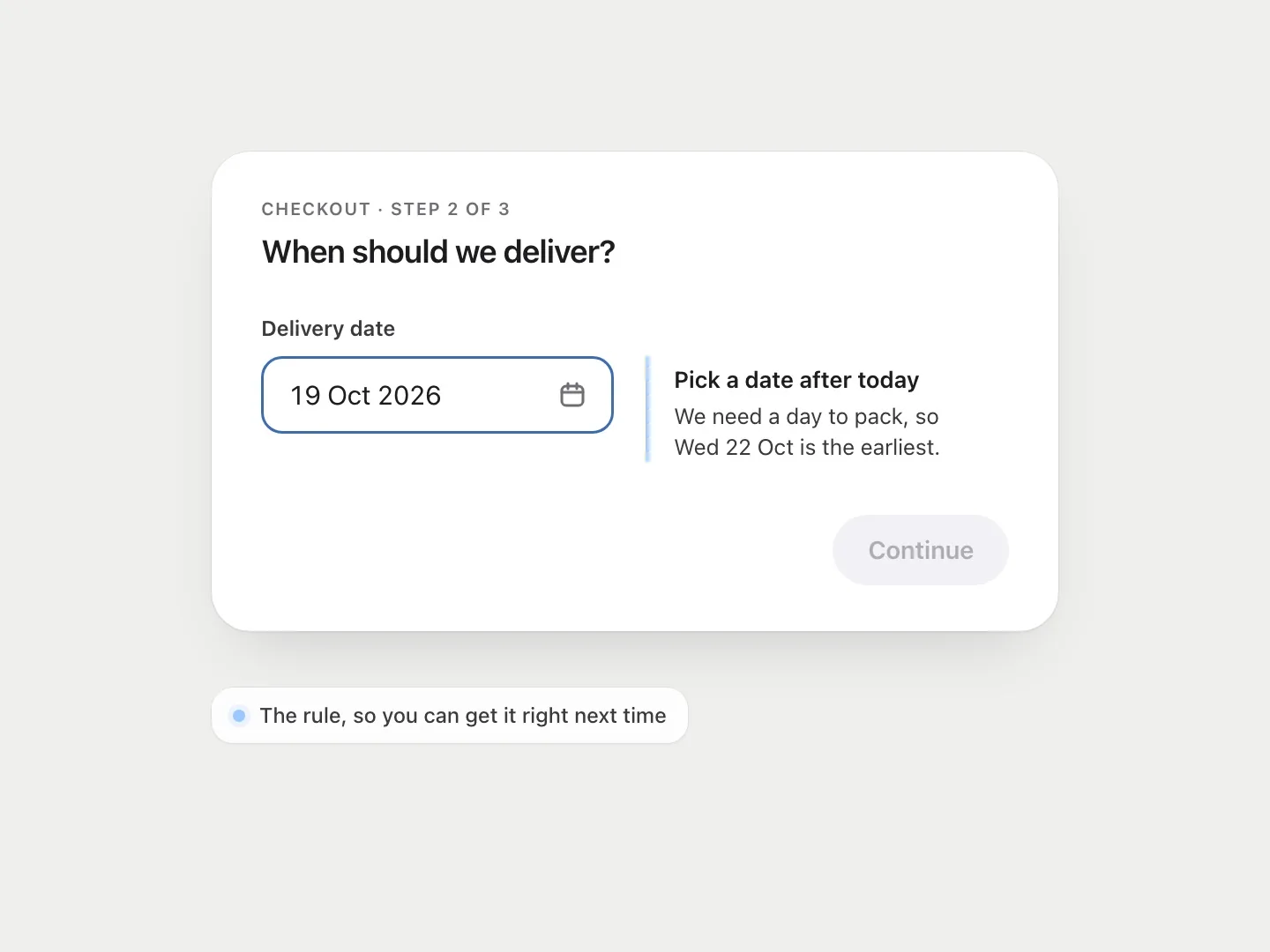
Feedback that explains, not just judges. “Error” teaches nothing. “That date is in the past, pick one after today” teaches the rule. A green tick tells you that you passed. Showing why it passed tells you how to pass again without the product. John Hattie and Helen Timperley’s review of feedback research makes a distinction I use a lot. Feedback can be about the task (was this right?), about the process (how do you get it right?), or about the self (“great job!”). Feedback about the self, the confetti and the cheerful praise, turned out to be among the least effective kinds. Process-level feedback is what supports deeper learning. Most product feedback is either a verdict or a celebration. Very little of it is process.
Progressive disclosure that grows with you. Showing only what’s needed at first lowers the fear of a new tool. In the 1980s, John Carroll and Caroline Carrithers built a “training wheels” version of a word processor that simply blocked off the error states beginners usually stumbled into. People using it learned faster and understood the system better afterwards. The control group spent almost a quarter of their time recovering from errors the training version made unreachable.
But the best versions also make it easy to discover the next layer when you’re ready, so the beginner mode doesn’t become a ceiling. That isn’t only about respect for experts. Slava Kalyuga, John Sweller and colleagues described the expertise reversal effect: guidance that helps novices can stop helping, and even get in the way, as people gain experience. Step-by-step help that was a gift on day one becomes noise on day thirty, because the person now has to read past an explanation they no longer need. So the guidance has to fade, and ideally the person should be able to see it fading. Noticing that you no longer need the hint is itself a small mastery experience.
The dependence trap
There’s a business reason products drift toward dependence. A user who needs you comes back. A user who has learned the skill might not. Automating everything, hiding the logic, and making each result feel like magic can all look good on a retention chart.
I think this is short-sighted. People sense when a tool is making them smaller. They may keep using it, but they don’t love it, and they leave as soon as something easier appears. The products people recommend to friends are usually the ones that made them feel good at something.
There’s a fair counter-argument, though. Plenty of dependence is fine. I don’t want to learn to calculate my tax by hand, and I’m glad my phone remembers phone numbers. Offloading is how people have always freed up attention for the things they care about. The question isn’t whether a tool takes work away. It’s whether it takes away work the person wanted to keep, or work they’ll need when the tool isn’t there.
The research above suggests a test for that. Dependence becomes a problem when three things are true: the skill matters to the person, the tool won’t always be available, and the tool hides enough that the person can’t tell how much it’s doing. The last one is the designer’s responsibility. People can make good choices about what to hand over, but only if they can see what they’re handing over.
The best tools feel like an extension of your own ability, not a replacement for it.
This is the central question for AI products
AI makes the dependence path very easy. Ask a question, get a full answer. Describe a design, get a finished screen. The result is often good, and the person learns almost nothing about how it was reached.
It also makes the illusion of competence much stronger. Fisher’s participants only had to search to feel smarter. A fluent, confident, finished answer is even easier to absorb as your own. You read it, it makes sense, and it feels as though you knew it all along. That’s performance, in Soderstrom and Bjork’s sense, wearing the clothes of learning.
That’s why I built Parallax around questions instead of answers. It doesn’t tell you whether your opinion is right. It asks what you’re assuming, what evidence you have, and what the strongest counter-argument is, and you do the thinking. At the end you can ask “Where do I stand?” for a summary, but the summary describes reasoning you did yourself. That makes it harder work than chatting with a normal assistant. My bet is that the effort is what makes it worth coming back to.
Not every product should work this way. Sometimes you just want the answer. But it’s worth deciding on purpose, for each feature, whether the goal is to do the task for someone or to help them get better at it. If it’s the second, that has consequences for what we measure. A smooth session isn’t proof of anything. The evidence that someone got better at a task only shows up later, when they try it without you.
Questions I ask in reviews
- After using this, could the person explain what happened?
- Does the feedback teach a rule, or only give a verdict?
- Can a confident user see more, or are they stuck in the beginner view?
- Does the help fade as the person gets better, or does it stay at day-one levels forever?
- Are we measuring what people can do with the product, or what they can do after it?
- If the product disappeared tomorrow, would the person be better at this task than before they started?
That last question is uncomfortable, and that’s why I like it.
References
10
- Bandura, A. (1977). Self-efficacy: Toward a unifying theory of behavioral change. Psychological Review, 84(2), 191–215. doi.org/10.1037/0033-295X.84.2.191
- Bastani, H., Bastani, O., Sungu, A., Ge, H., Kabakcı, Ö. & Mariman, R. (2025). Generative AI without guardrails can harm learning: Evidence from high school mathematics. Proceedings of the National Academy of Sciences, 122(26), e2422633122. doi.org/10.1073/pnas.2422633122
- Camerer, C. F., Dreber, A., Holzmeister, F., Ho, T.-H., Huber, J., Johannesson, M., et al. (2018). Evaluating the replicability of social science experiments in Nature and Science between 2010 and 2015. Nature Human Behaviour, 2(9), 637–644. doi.org/10.1038/s41562-018-0399-z
- Carroll, J. M. & Carrithers, C. (1984). Training wheels in a user interface. Communications of the ACM, 27(8), 800–806. doi.org/10.1145/358198.358218
- Dahmani, L. & Bohbot, V. D. (2020). Habitual use of GPS negatively impacts spatial memory during self-guided navigation. Scientific Reports, 10, 6310. doi.org/10.1038/s41598-020-62877-0
- Fisher, M., Goddu, M. K. & Keil, F. C. (2015). Searching for explanations: How the Internet inflates estimates of internal knowledge. Journal of Experimental Psychology: General, 144(3), 674–687. doi.org/10.1037/xge0000070
- Hattie, J. & Timperley, H. (2007). The power of feedback. Review of Educational Research, 77(1), 81–112. doi.org/10.3102/003465430298487
- Kalyuga, S., Ayres, P., Chandler, P. & Sweller, J. (2003). The expertise reversal effect. Educational Psychologist, 38(1), 23–31. doi.org/10.1207/S15326985EP3801_4
- Soderstrom, N. C. & Bjork, R. A. (2015). Learning versus performance: An integrative review. Perspectives on Psychological Science, 10(2), 176–199. doi.org/10.1177/1745691615569000
- Sparrow, B., Liu, J. & Wegner, D. M. (2011). Google effects on memory: Cognitive consequences of having information at our fingertips. Science, 333(6043), 776–778. doi.org/10.1126/science.1207745