Who owns an idea when AI helps you think it?
If a tool gives you fifty ideas and you pick one, whose idea is it? I think the honest answer is: it depends on what you did next.
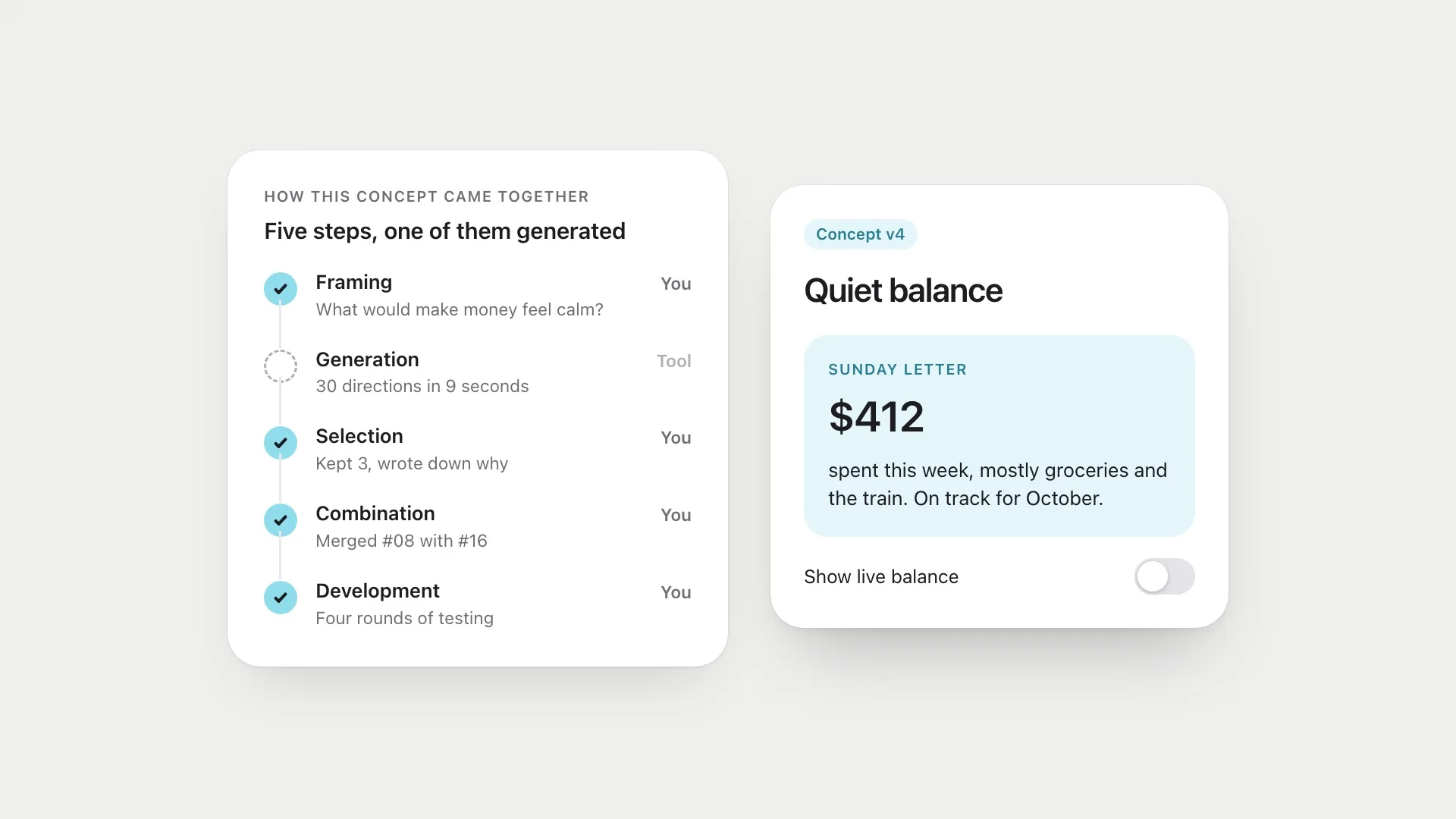
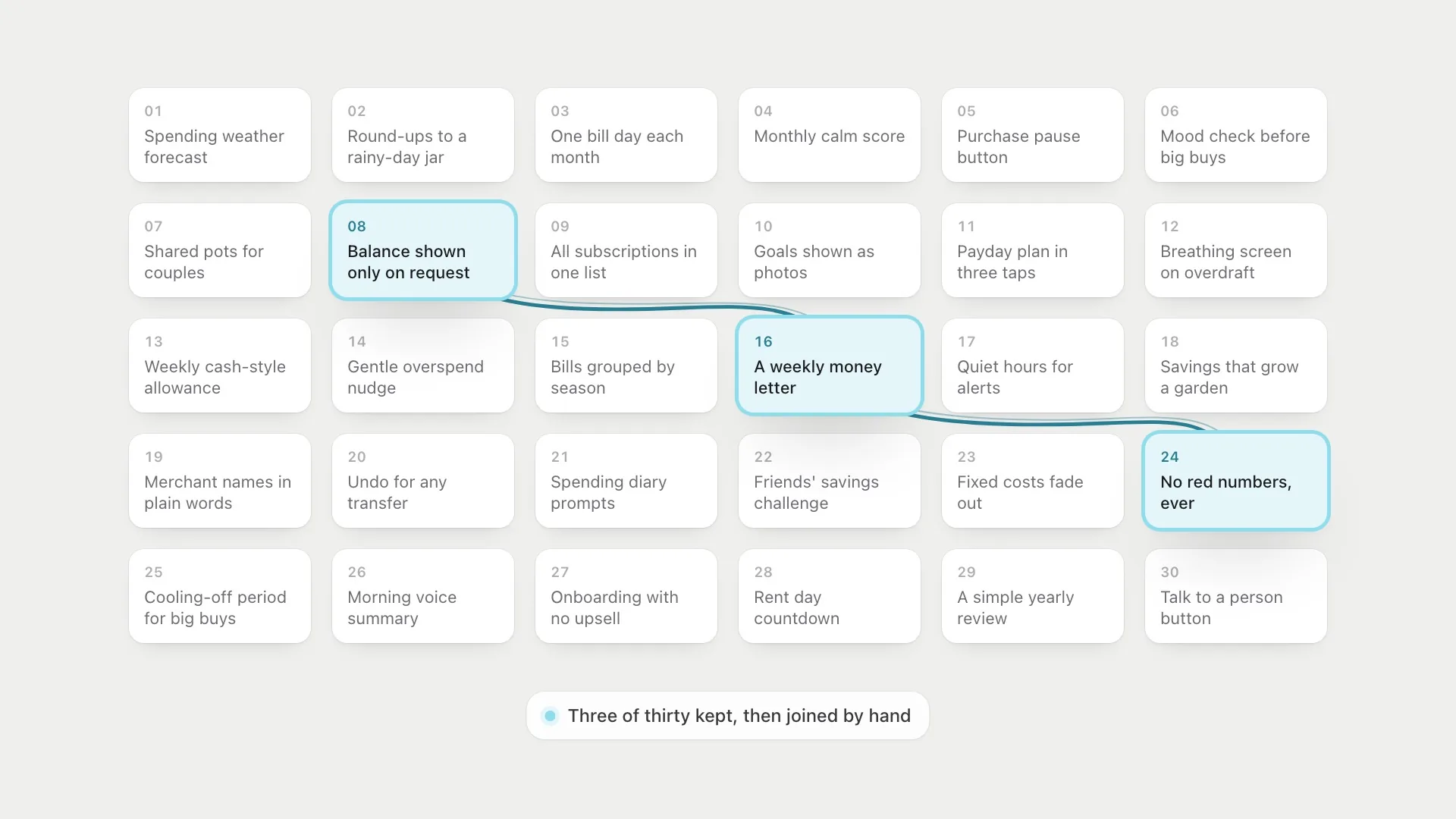
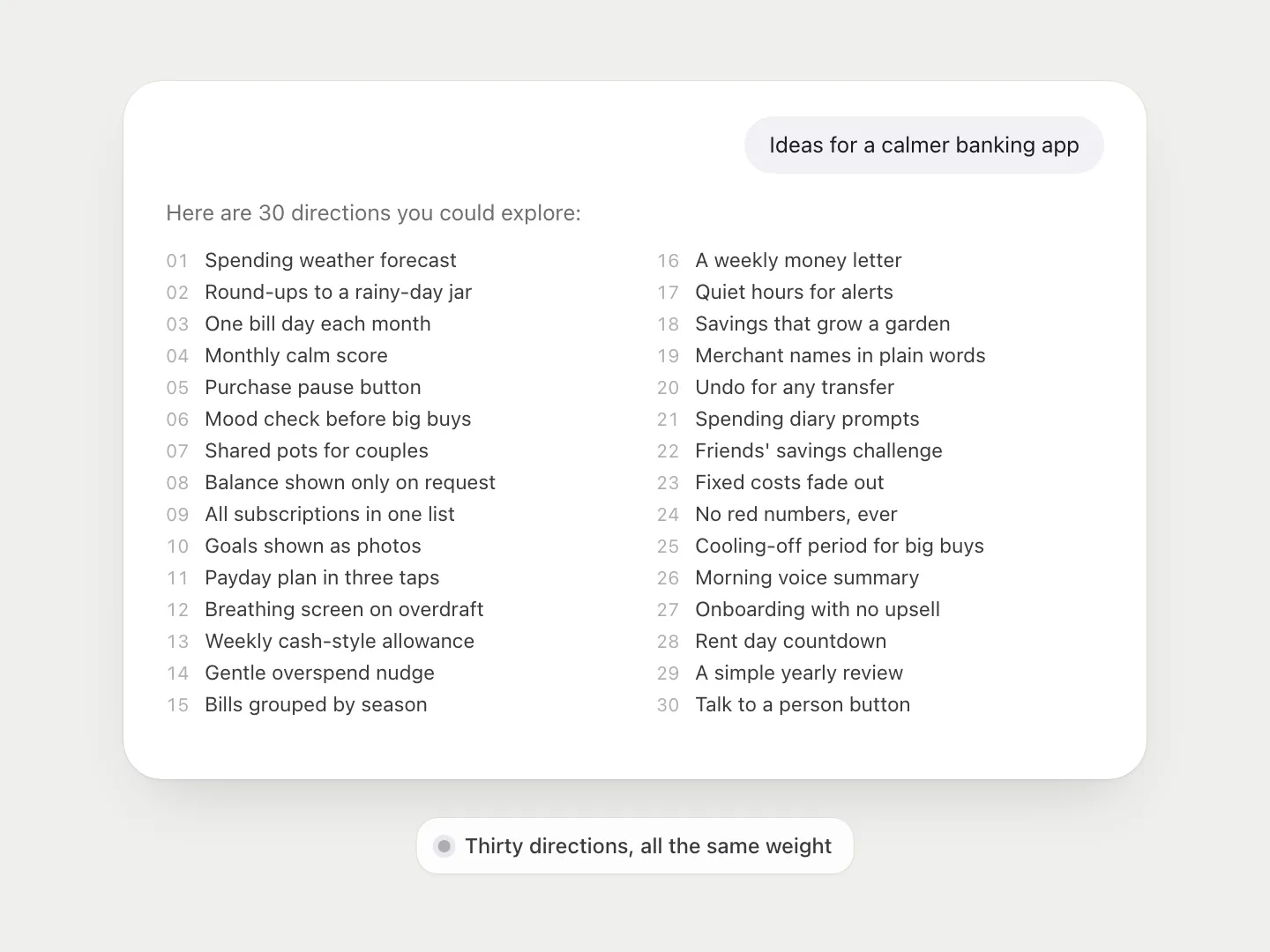
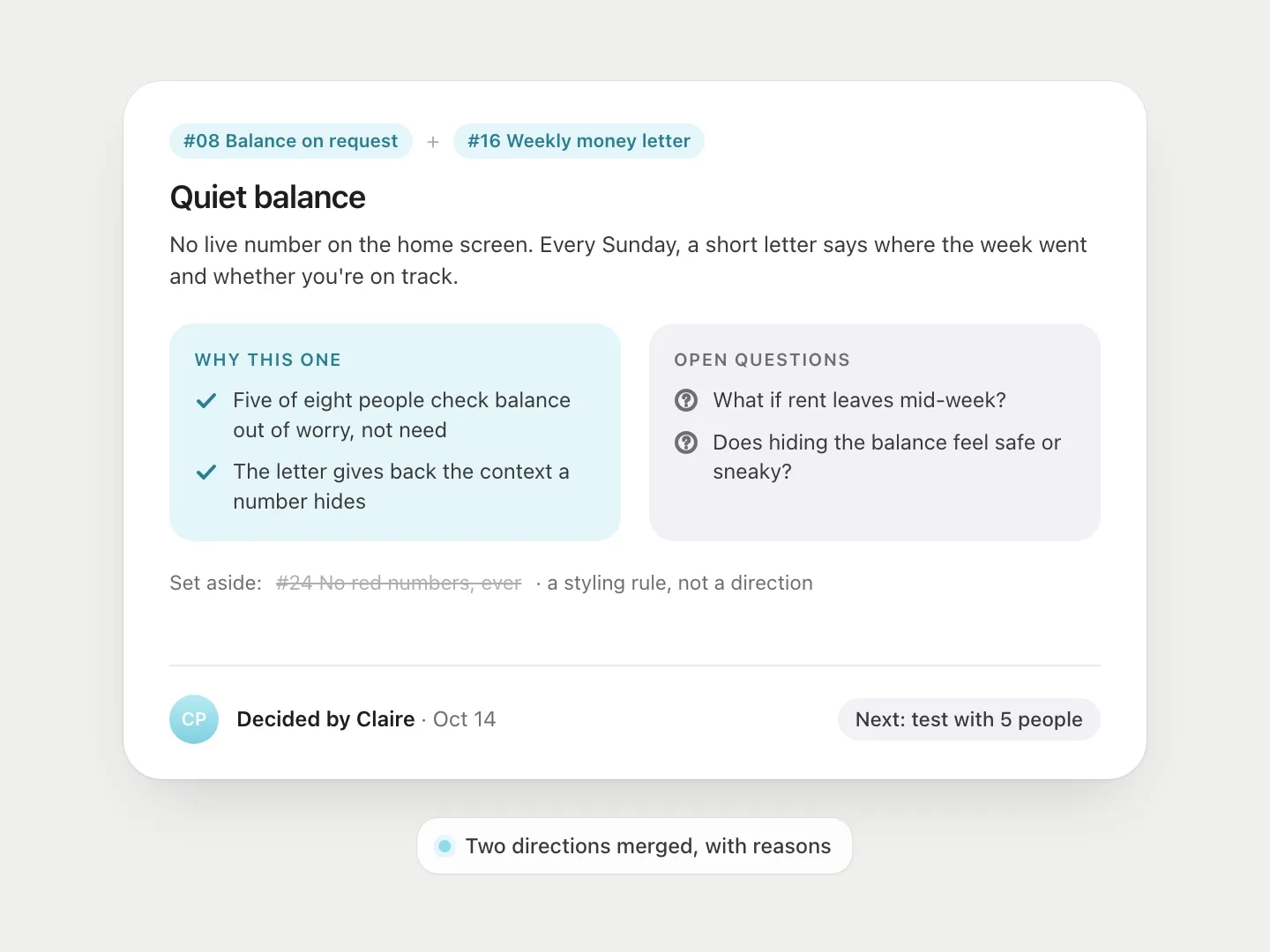
A scene a lot of designers will recognise by now: you write a question, an AI tool returns thirty possible directions, and you spend the next hour reading, discarding, combining and arguing with them. At the end there’s a concept worth getting excited about. Some of its parts were in the list. Some weren’t. The way they fit together definitely wasn’t.
Is that concept yours? I keep coming back to this question, partly because it matters for how designers talk about their work, and partly because the usual answers feel wrong in both directions.
Two answers I don’t believe
The first is “the AI made it, so it isn’t really yours.” That treats generation as the only creative act. But designers have always worked from material they didn’t make: references, mood boards, competitor teardowns, a colleague’s throwaway comment in a crit. Nobody thinks a mood board makes the work less original.
The second is “you wrote the prompt, so it’s all yours.” That treats a question as if it were the whole answer. A good prompt matters, but typing “ten ideas for a calmer banking app” isn’t the same as designing a calmer banking app.
Both answers make the same mistake. They look for ownership in a single moment, either the moment of generation or the moment of asking. I think it lives somewhere else.
What the law currently says
In the US, the Copyright Office has been working through this in public. In 2023 it reviewed a comic book, Zarya of the Dawn, whose images were made with Midjourney. It decided the author could register the text she wrote and her selection and arrangement of the text and images, but not the images themselves.
Its 2025 report on copyrightability said much the same, more firmly. Using AI to assist human creativity, rather than to stand in for it, doesn’t remove protection. But given how current tools work, prompts alone don’t give a person enough control over the result to count as authorship. What can be protected is human expression that is visible in the output, the creative selection and arrangement of material, and creative changes made to it.
The courts have held the outer line. In Thaler v. Perlmutter, someone tried to register an image listing an AI system as its only author. The federal appeals court in Washington, D.C. ruled in 2025 that US copyright law requires a human author, and in March 2026 the Supreme Court declined to hear the case. That ruling was about a work with no human author claimed at all. How much human involvement is enough is still being decided case by case, and other countries are taking different approaches.
I’m not a lawyer, and the law is still moving. But I find the line useful even outside copyright, because it points at where the human contribution actually sits. Not in the asking. In the choosing, arranging and changing.
Why it can feel like it isn’t yours
There’s a second kind of ownership that the law doesn’t cover: whether the work feels like yours. That matters more than it sounds, because people care for, defend and keep improving the things they feel are theirs.
Jon Pierce, Tatiana Kostova and Kurt Dirks describe three routes by which people come to feel something is theirs: having control over it, knowing it intimately, and investing themselves in it. Michael Norton, Daniel Mochon and Dan Ariely showed a version of the third in what they called the IKEA effect: people valued things more after building them, but the effect disappeared when they didn’t finish the job. Effort only creates attachment when it leads somewhere.
Generative tools can short-circuit all three routes. You didn’t control the details, you don’t know why each part is there, and you didn’t put much of yourself in. The research is starting to show this. Fiona Draxler and colleagues found what they call the AI ghostwriter effect: people didn’t feel they owned text an AI had written for them, yet usually didn’t declare the AI as an author either. The more influence they had over the text, the more ownership they felt. In a study by Barrett Anderson, Jash Shah and Max Kreminski, people who brainstormed with ChatGPT came up with more ideas, but felt less responsible for the ideas they generated.
I find that gap between feeling and claiming more interesting than the legal question. It suggests that the honest answer to “is this yours?” depends less on which tool was open and more on how much of the work passed through your own judgement.
Originality as a chain of judgements
When I look back at how a concept came together, the creative work is mostly in a series of decisions:
- Framing. Which question was worth asking in the first place. This is often the most original step, and no tool did it.
- Selection. Which of the thirty directions has something in it, and why. Taste is a form of authorship.
- Combination. Joining two ideas that didn’t know about each other.
- Rejection. Knowing what to throw away, including ideas that are good but wrong for this problem.
- Development. Taking a rough direction through sketches, testing and revision until it works for real people.
Generation is one step in that chain, and it’s getting cheaper every month. The judgement steps aren’t. They also happen to be the steps that build control, intimate knowledge and investment, which is why work that passes through them tends to feel owned.
When ideas are cheap to produce, the valuable skill is knowing which one is worth the next hour.
The list isn’t neutral
There’s a catch in all this, and it’s one I didn’t take seriously enough at first. If authorship lives in selection, then it matters a lot what you are selecting from. And a list of thirty generated ideas is not a neutral menu.
Designers have known about design fixation since David Jansson and Steven Smith’s work in 1991. When they showed designers an example solution before a task, the designers’ ideas repeated features of the example, even features that were clearly poor. Seeing an answer narrows the space you search in, and it happens without you noticing.
Generative tools seem to make this stronger, not weaker. Samangi Wadinambiarachchi and colleagues ran an experiment in which people generated ideas for a visual design task, some of them with help from an AI image generator. Compared with a baseline group, the people using AI fixated more on the initial example they had been shown, and produced fewer ideas, with less variety and lower originality.
There’s also a collective version of the problem. Anil Doshi and Oliver Hauser gave some writers story ideas from a language model. Those writers’ stories were rated as more creative and better written, especially for the writers who were least creative to begin with. But the stories also ended up more similar to each other. Anderson, Shah and Kreminski found the same pattern with brainstorming: ideas from different people using ChatGPT were less distinct from each other than ideas from people using another tool.
I think this tension is real and worth stating plainly. For an individual, the tool can genuinely help, and it helps most the people who were struggling. For a field, it can quietly pull everyone’s work towards the same middle. Your thirty directions and my thirty directions may be drawn from a very similar well. If the judgement steps are where originality lives, they now carry more weight, because the material they work on is more alike than it looks.
Showing your judgement
This has a practical effect on how I document work. If authorship lives in judgement, then a portfolio should show the judgement: what was considered, what was rejected, and why the final direction won. In my case studies I try to show the options I didn’t pick and the reason each one lost. That’s true whether an option came from a sketchbook, a workshop or a tool.
It also suggests a better way to use AI. Asking it to argue against a direction is often more useful than asking it for more directions. More output makes selection harder. Pushback makes my judgement sharper.
And the fixation research suggests an order of operations. I try to do my own framing and a first round of rough ideas before I ask a tool for anything, so that what it gives me is something to compare against rather than a starting point to drift from. Steven Dow and colleagues found that designers who made several prototypes in parallel, rather than one after another, produced better and more varied work and grew more confident. I read that as a reason to keep several of my own directions alive at once, so that no single suggestion gets to anchor everything.
For anyone designing these tools, I think the same research points to some useful defaults: invite the person’s own idea before showing generated ones, make the output easy to take apart and recombine rather than a finished answer, and treat variety as something to design for, not a side effect.
A test I use
Could I explain, without the tool in front of me, why this idea is the right one and what I changed to get it there? If yes, I think the work is mine in the way that matters. If the honest answer is “it was the third result and it looked good,” then I haven’t done the work yet. Not because a tool was involved, but because no judgement was.
The question of who owns an idea will keep changing as laws and tools change. The question of who is responsible for it is simpler. Whoever decided it was good enough to ship.
References
12
- Anderson, B. R., Shah, J. H. & Kreminski, M. (2024). Homogenization effects of large language models on human creative ideation. Proceedings of the 16th Conference on Creativity & Cognition, 413–425. doi.org/10.1145/3635636.3656204
- Doshi, A. R. & Hauser, O. P. (2024). Generative AI enhances individual creativity but reduces the collective diversity of novel content. Science Advances, 10(28), eadn5290. doi.org/10.1126/sciadv.adn5290
- Dow, S. P., Glassco, A., Kass, J., Schwarz, M., Schwartz, D. L. & Klemmer, S. R. (2010). Parallel prototyping leads to better design results, more divergence, and increased self-efficacy. ACM Transactions on Computer-Human Interaction, 17(4), 1–24. doi.org/10.1145/1879831.1879836
- Draxler, F., Werner, A., Lehmann, F., Hoppe, M., Schmidt, A., Buschek, D. & Welsch, R. (2024). The AI ghostwriter effect: When users do not perceive ownership of AI-generated text but self-declare as authors. ACM Transactions on Computer-Human Interaction, 31(2), 1–40. doi.org/10.1145/3637875
- Jansson, D. G. & Smith, S. M. (1991). Design fixation. Design Studies, 12(1), 3–11. doi.org/10.1016/0142-694X(91)90003-F
- Norton, M. I., Mochon, D. & Ariely, D. (2012). The IKEA effect: When labor leads to love. Journal of Consumer Psychology, 22(3), 453–460. doi.org/10.1016/j.jcps.2011.08.002
- Pierce, J. L., Kostova, T. & Dirks, K. T. (2001). Toward a theory of psychological ownership in organizations. Academy of Management Review, 26(2), 298–310. doi.org/10.2307/259124
- Wadinambiarachchi, S., Kelly, R. M., Pareek, S., Zhou, Q. & Velloso, E. (2024). The effects of generative AI on design fixation and divergent thinking. Proceedings of the 2024 CHI Conference on Human Factors in Computing Systems, 1–18. doi.org/10.1145/3613904.3642919
- U.S. Copyright Office (2023, February 21). Letter re: Zarya of the Dawn (Registration # VAu001480196). copyright.gov/docs/zarya-of-the-dawn.pdf
- U.S. Copyright Office (2025, January). Copyright and Artificial Intelligence, Part 2: Copyrightability. copyright.gov/ai/Copyright-and-Artificial-Intelligence-Part-2-Copyrightability-Report.pdf
- Thaler v. Perlmutter, No. 23-5233 (D.C. Cir. March 18, 2025). media.cadc.uscourts.gov/opinions/docs/2025/03/23-5233.pdf
- Thaler v. Perlmutter, No. 25-449, Supreme Court of the United States, petition for a writ of certiorari denied March 2, 2026. supremecourt.gov/docket/docketfiles/html/public/25-449.html