What happens to a language your phone can’t spell?
Languages rarely die when the last speaker does. They fade when a family decides it isn’t worth passing on, and more and more, our devices help make that decision.
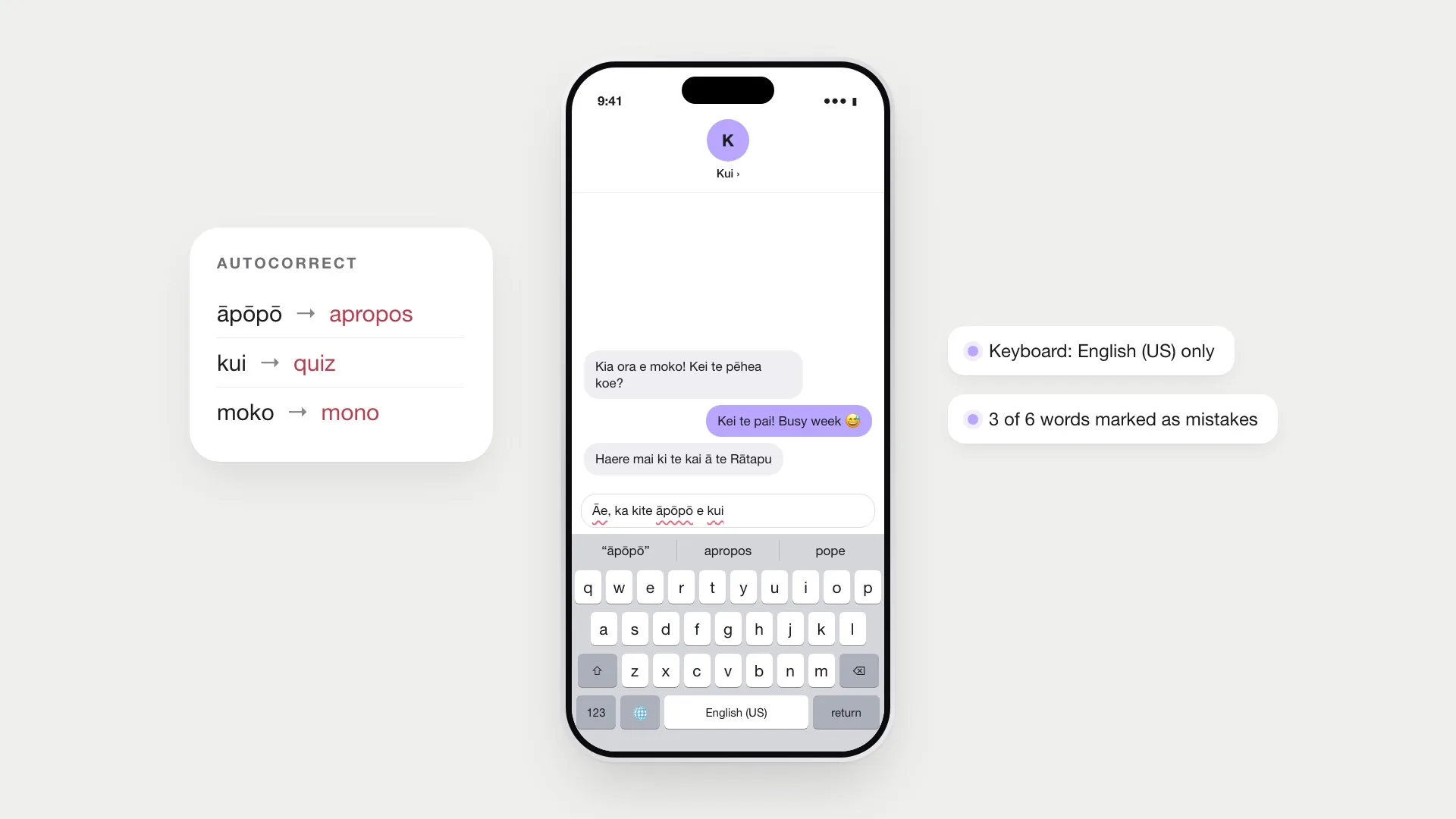
A teenager in New Zealand texts her grandmother. Her grandmother writes in te reo Māori, so she tries to reply in it too: Āe, ka kite āpōpō e kui. Yes, see you tomorrow, Nan. Half the words come back with a red line under them. The keyboard offers “apropos”. The English half of her message goes through without a mark.
It’s a small moment, and nobody designed it to hurt. But think about what it teaches a fourteen-year-old, a few dozen times a day, for years: one of her languages is normal and the other is a mistake.
I keep coming back to this because it shows how technology affects some of the biggest things happening in the world. Not through one dramatic decision, but through thousands of small defaults that tell people what’s normal.
How a language actually disappears
There are around 7,000 living languages, and nearly half are considered endangered. In one of the largest studies yet, the evolutionary biologist Lindell Bromham and her colleagues looked at 6,511 spoken languages and found that 37% were already losing first-language speakers, or worse. In 1992 the linguist Michael Krauss warned that as many as 90% of the world’s languages could be gone or doomed within a century. Bromham’s team is more cautious, but their model still predicts that, without intervention, loss will at least triple in the next 40 years, to at least one language a month.
The cause is usually not a ban or a disaster. It’s a quieter thing linguists call a break in transmission. Parents speak the language to each other but answer their children in the dominant one, because that’s the language of school, work and getting on in the world. Within a generation or two, it becomes the language grandparents use to talk about the old days.
Bromham’s study is useful for what it rules out. Contact with other languages isn’t the problem. Languages that border many others are actually less endangered: people can live in several languages without giving any of them up. What does predict loss is fewer first-language speakers, denser roads, which make it easier to move away, and, most uncomfortably, more years of schooling. Bilingual education laws alone didn’t change that. These are associations, not proof of cause, but they point one way: a language fades when the places that fill a child’s day run in another one.
So the question that decides whether a language survives is personal: is this worth giving to my child? For most of history, that answer was shaped by schools, cities, radio and jobs. Now it’s also shaped by the device every child holds for several hours a day, and the device has an opinion.
The answer matters for more than heritage. Youth suicide rates vary widely between First Nations communities in British Columbia. The psychologists Darcy Hallett, Michael Chandler and Christopher Lalonde found that in the few where at least half of members could hold a conversation in their own language, youth suicide effectively dropped to zero. It’s a correlation from a small number of communities, and language is probably one part of a wider sense of cultural continuity, not a cause on its own. But it suggests what’s at stake is wellbeing, not nostalgia.
A language doesn’t need to be banned to disappear. It only needs to keep feeling slightly out of place.
It starts with your name
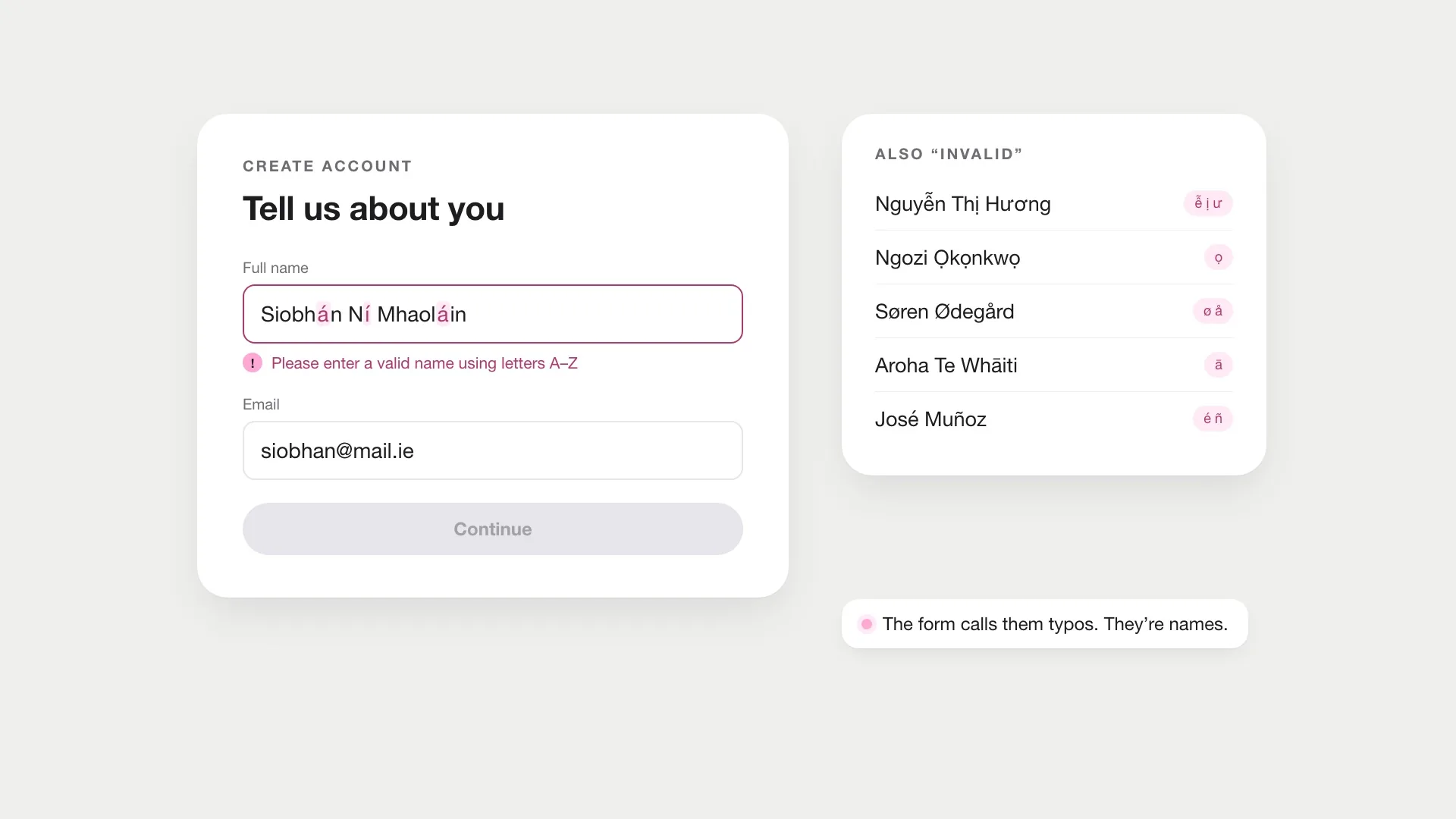
The most personal word in any language is your name, and it’s often the first thing software gets wrong. Forms that only accept the letters A to Z turn Siobhán into a validation error. Nguyễn loses its tone marks. Booking systems print a Māori surname without its macron, which in te reo can change the word.
Each of these looks like a technical detail. Together they send a clear message: the system was built for someone else, and you’re welcome as long as you adapt. People do adapt. They drop the accent, use an English nickname, or stop using the language online at all. Each adjustment is small, but they add up over a lifetime, and over a population.
Names are where it starts. Typing is where it compounds. If a keyboard has no easy way to add a macron, a tone mark or a letter your language needs, every message in it costs more effort than the same message in English. When one language takes a long-press on every other word, the easier one tends to win, in exactly the quick messages that keep a language alive between a teenager and her grandmother.
The internet is a small country
Online, the gap is even wider than it is offline. When the researcher Pratik Joshi and his colleagues sorted nearly 2,500 languages by how much data exists for them, 88% landed in the bottom group, with almost no digital resources at all, despite around 1.2 billion speakers between them. At the top sat seven, English among them.
In 2013 the mathematician András Kornai estimated that fewer than 5% of the world’s languages can still make it online in any meaningful way. He called what happens to the rest “digital language death”. It’s a stark estimate, built from signals like Wikipedia activity and spellcheckers, and it had to leave out mobile phones for lack of data. But even if it’s wrong by a wide margin, the scale is hard to ignore.
It helps to think of digital support as a ladder, and Kornai uses something close to one. Can the language be displayed? Can you type it? Will spellcheck recognise it? Is the interface available in it? Can you speak to your phone in it and be understood? Most of the world’s languages stop on the first or second rung. Every missing rung tells a parent something about which language their child will need.
Each rung also opens what linguists call a domain: a part of life where a language gets used, like home, church or school. Revitalisation work holds that every new domain makes a language stronger. Te Taka Keegan, Paora Mato and Stacey Ruru took that idea to Twitter and found te reo Māori tweets rising over time. A language you can joke, argue and gossip in online feels like a language for now, not just for the past.
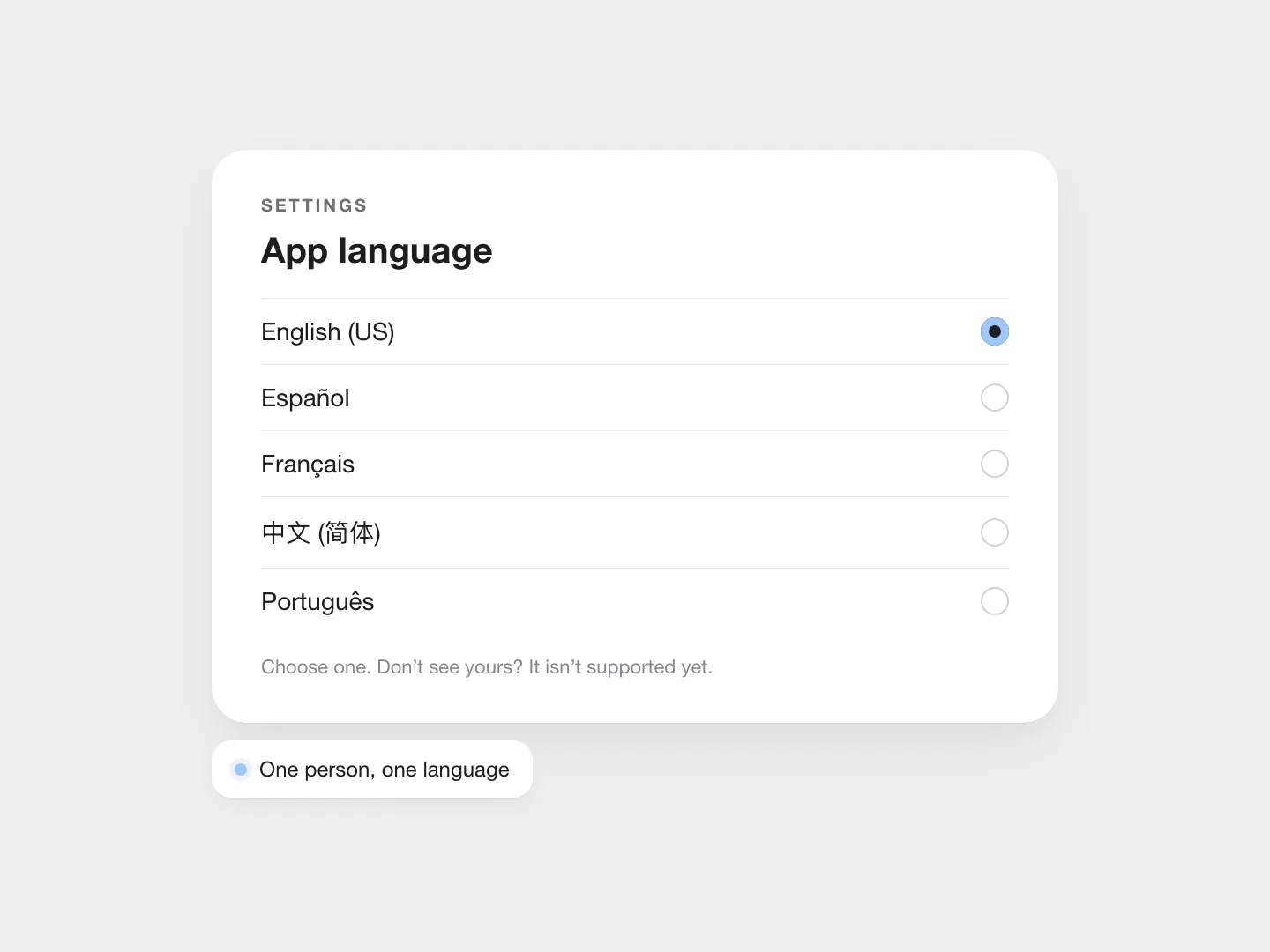
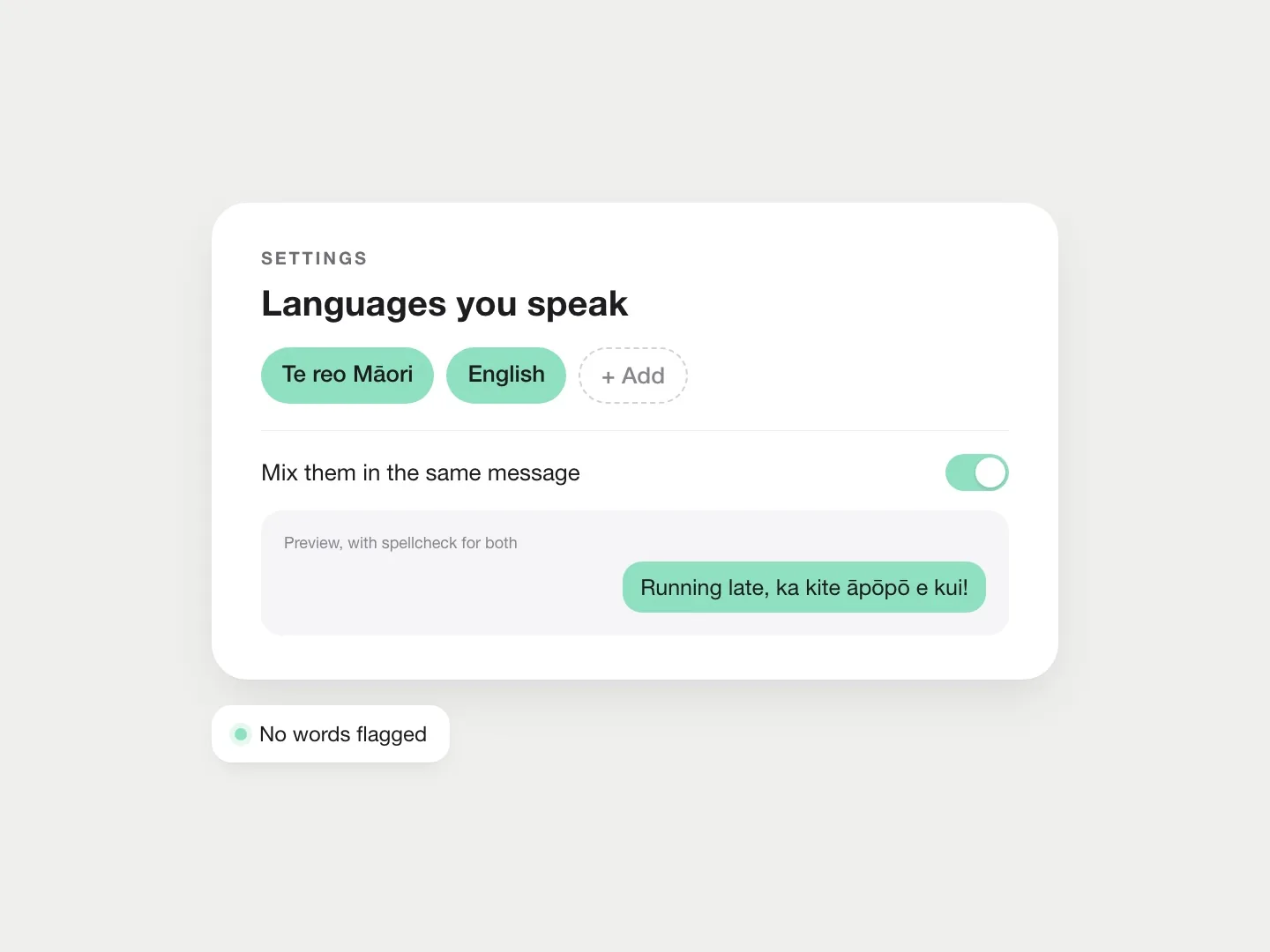
Products make it worse by assuming one person has one language. Settings ask you to pick one, from a short list. But most of humanity is multilingual, and people mix languages constantly, often in the same sentence. A grandmother’s greeting in Māori and a complaint about traffic in English is a completely normal text message. Most software still treats it as an error.
AI raises the stakes in both directions
Language models learn from the text people have already put online. Languages with lots of text get fluent, helpful models. Languages with little text get clumsy ones, so fewer people use them with these tools, so even less text gets written. It’s a loop, and it runs in favour of the languages that were already winning. Joshi’s team put it bluntly: for the languages at the bottom, methods that learn from raw text only make “the poor poorer”, because there is almost no text to learn from.
The text that does exist is often not what it seems. Julia Kreutzer and a large team audited 205 web-crawled datasets used to train multilingual models. At least 15 collections had no usable text at all, many were less than half acceptable sentences, and many were mislabelled. Brian Thompson and colleagues later found that a large fraction of web content in lower-resource languages appears to be machine translated, often low-quality English content translated in bulk. That text becomes training data for the next model, which learns a broken version of the language and produces more of it.
But the same technology also offers something new. Building a keyboard, a spellchecker or a speech model for a language used to take a large team and years of work. Now a community with a few hundred hours of recordings can build tools that would have been impossible a decade ago. For the first time, a language with 20,000 speakers could feel as at home on a phone as one with 200 million. Whether that happens depends on who builds those tools and who owns what goes into them.
Who owns a voice
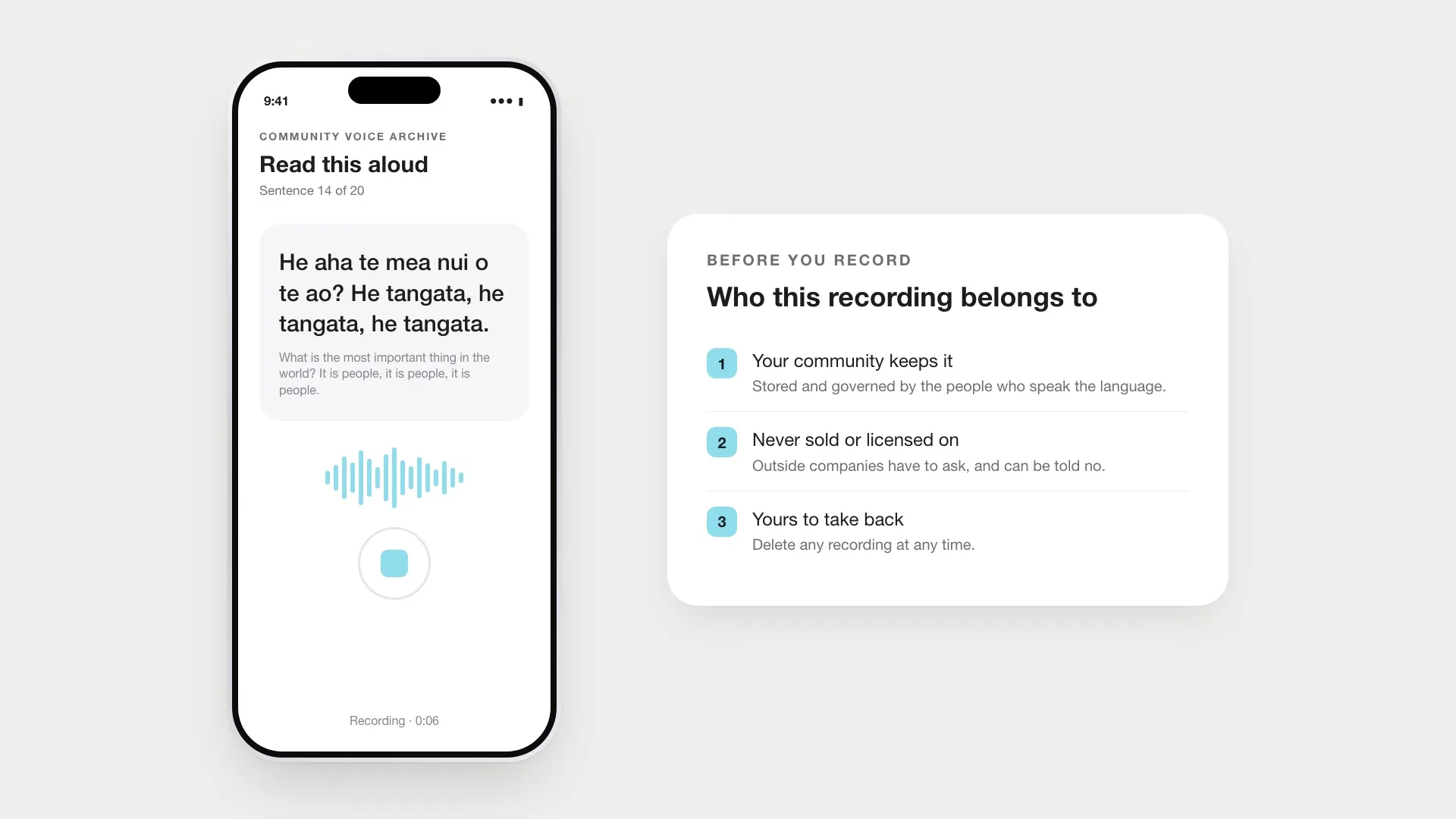
In 2018 Te Hiku Media, a Māori broadcaster in the far north of New Zealand, asked people to record themselves reading sentences in te reo. In about ten days, the community contributed more than 300 hours of speech. Te Hiku used it to build speech recognition for the language, then made an unusual choice: they kept control of the data, refused to hand it to large tech companies, and wrote a licence based on kaitiakitanga, guardianship, that sets out who may use it and for what.
That matters because language data isn’t just data. It’s grandparents telling stories, songs, prayers and place names. Collected carelessly, it becomes one more resource taken from a community and sold back to it. Collected with consent and kept under the community’s control, it becomes an archive and a tool at the same time.
The computational linguist Steven Bird, who works with Indigenous communities in Australia, warns that after generations of exploitation, Indigenous people often reject the idea that their languages are “data ready for the taking”, and that technologists who treat them that way risk repeating the causes of endangerment. He also argues that a local language does different jobs from a national one, and may need different tools, not a scaled-down copy of everything built for English.
There’s a real tension here. Recording a language and reviving it are different goals. An archive serves researchers and the future; a community project serves the next speaker. They need each other. Bromham’s team found that a third of the 1,500 or more languages that could stop being spoken this century have little or no documentation, and that window closes with the last fluent speakers. But a dictionary nobody uses doesn’t keep a language alive. Children speaking it does.
Then there’s who decides. Communities often disagree about spelling, about which dialect becomes the standard, and about whether some material should be recorded at all. A team that picks the first spelling system it finds has quietly settled that argument for everyone. The design question isn’t only can we support this language? It’s who gets to say what supporting it means?
What designers can actually do
Most of us won’t build a speech model. But nearly every product team makes decisions that move a language up or down that ladder. A few I try to hold myself to:
- Accept people’s real names. Any Unicode letter, any length, any order. If a name breaks your database, the database is the bug.
- Let people speak more than one language. Ask which languages someone uses, not which one, and never flag one of them as a mistake.
- Climb the ladder in order. Before translating the whole interface, make sure people can type, read and search in their language. Those rungs matter more and cost less.
- Make every character one tap away. If a language needs macrons, tone marks or its own letters, they belong on the keyboard, not behind a long-press.
- Treat English-only as a decision. It usually isn’t one. It’s the default nobody revisited, and like most defaults, it decides for millions of people.
- Don’t ship translation nobody has checked. Unreviewed machine translation isn’t support. It teaches people, and the next model, a broken version of their language.
- Build with communities, not from them. When language data is involved, ask who owns it, who benefits, and whether they can say no. Let speakers make the spelling and dialect choices.
No app has ever killed a language. But every interface casts a small vote on which languages belong in modern life. It casts that vote many times a day, in the hands of children who are working out who they want to be, and that’s a reason to take the small decisions seriously.
Somewhere right now, a teenager is typing a word her grandmother taught her and watching it turn red. What the phone does next is a design decision.
References
10
- Bird, S. (2020). Decolonising speech and language technology. In Proceedings of the 28th International Conference on Computational Linguistics (pp. 3504–3519). doi.org/10.18653/v1/2020.coling-main.313
- Bird, S. (2022). Local languages, third spaces, and other high-resource scenarios. In Proceedings of the 60th Annual Meeting of the Association for Computational Linguistics (pp. 7817–7829). doi.org/10.18653/v1/2022.acl-long.539
- Bromham, L., Dinnage, R., Skirgård, H., Ritchie, A., Cardillo, M., Meakins, F., Greenhill, S. & Hua, X. (2022). Global predictors of language endangerment and the future of linguistic diversity. Nature Ecology & Evolution, 6(2), 163–173. doi.org/10.1038/s41559-021-01604-y
- Hallett, D., Chandler, M. J. & Lalonde, C. E. (2007). Aboriginal language knowledge and youth suicide. Cognitive Development, 22(3), 392–399. doi.org/10.1016/j.cogdev.2007.02.001
- Joshi, P., Santy, S., Budhiraja, A., Bali, K. & Choudhury, M. (2020). The state and fate of linguistic diversity and inclusion in the NLP world. In Proceedings of the 58th Annual Meeting of the Association for Computational Linguistics (pp. 6282–6293). doi.org/10.18653/v1/2020.acl-main.560
- Keegan, T. T., Mato, P. & Ruru, S. (2015). Using Twitter in an Indigenous language: An analysis of te reo Māori tweets. AlterNative: An International Journal of Indigenous Peoples, 11(1), 59–75. doi.org/10.1177/117718011501100105
- Kornai, A. (2013). Digital language death. PLOS ONE, 8(10), e77056. doi.org/10.1371/journal.pone.0077056
- Krauss, M. (1992). The world’s languages in crisis. Language, 68(1), 4–10. doi.org/10.1353/lan.1992.0075
- Kreutzer, J., Caswell, I., Wang, L., et al. (2022). Quality at a glance: An audit of web-crawled multilingual datasets. Transactions of the Association for Computational Linguistics, 10, 50–72. doi.org/10.1162/tacl_a_00447
- Thompson, B., Dhaliwal, M., Frisch, P., Domhan, T. & Federico, M. (2024). A shocking amount of the web is machine translated: Insights from multi-way parallelism. In Findings of the Association for Computational Linguistics: ACL 2024 (pp. 1763–1775). doi.org/10.18653/v1/2024.findings-acl.103