The next social network might not have a feed
What if social platforms were designed around the relationships they strengthen, rather than the content they distribute?
When Facebook launched News Feed in 2006, a lot of its users hated it. Before then, you found out what friends were doing by visiting their profiles. Suddenly every update was collected, ranked and pushed to you. Protest groups formed within days. Then, within a few years, the feed became so normal that almost every social product since has been built around one.
I think it’s worth remembering that the feed was a design choice, not a law of nature. So were profiles, follower counts, likes and recommendations. They’re very good at one job: distributing content to as many people as possible. That isn’t the same job as helping people build and keep relationships, and I don’t think one interface does both well.
In Why social platforms want us to perform I looked at what feeds reward. This post asks the next question. If you started with relationships, what would you build instead?
Friendship is made of time, not content
Jeffrey Hall asked adults who had recently moved how much time they’d spent with new acquaintances, and followed how those relationships developed. His estimate is one I keep coming back to: roughly 50 hours together to go from acquaintance to casual friend, about 90 hours to friend, and more than 200 hours to close friend. Friendship is built in hours spent together. A feed is built for minutes spent alone, scrolling.
The kind of use matters too. Moira Burke and Robert Kraut followed Facebook users over several months, combining their survey answers with server logs. Well-being went up when people received targeted, composed messages from people they were close to. One-click feedback, like a like, and posts broadcast to everyone didn’t show the same benefit. Philippe Verduyn and colleagues found something similar from the other direction: passive Facebook use, scrolling without interacting, predicted people feeling worse over the course of a day.
Platforms have noticed. In 2018, Facebook announced that it would rank posts that start conversations between people above posts from pages and publishers, calling the goal “meaningful social interactions”. But in 2021, internal documents reported by the Wall Street Journal suggested that weighting comments and reshares had also rewarded posts that made people angry, because an argument counts as interaction too. The lesson I take from that isn’t that Facebook failed. It’s that you can’t rank your way to better relationships when the thing you rank is still content. The unit has to change.
What could replace the infinite feed
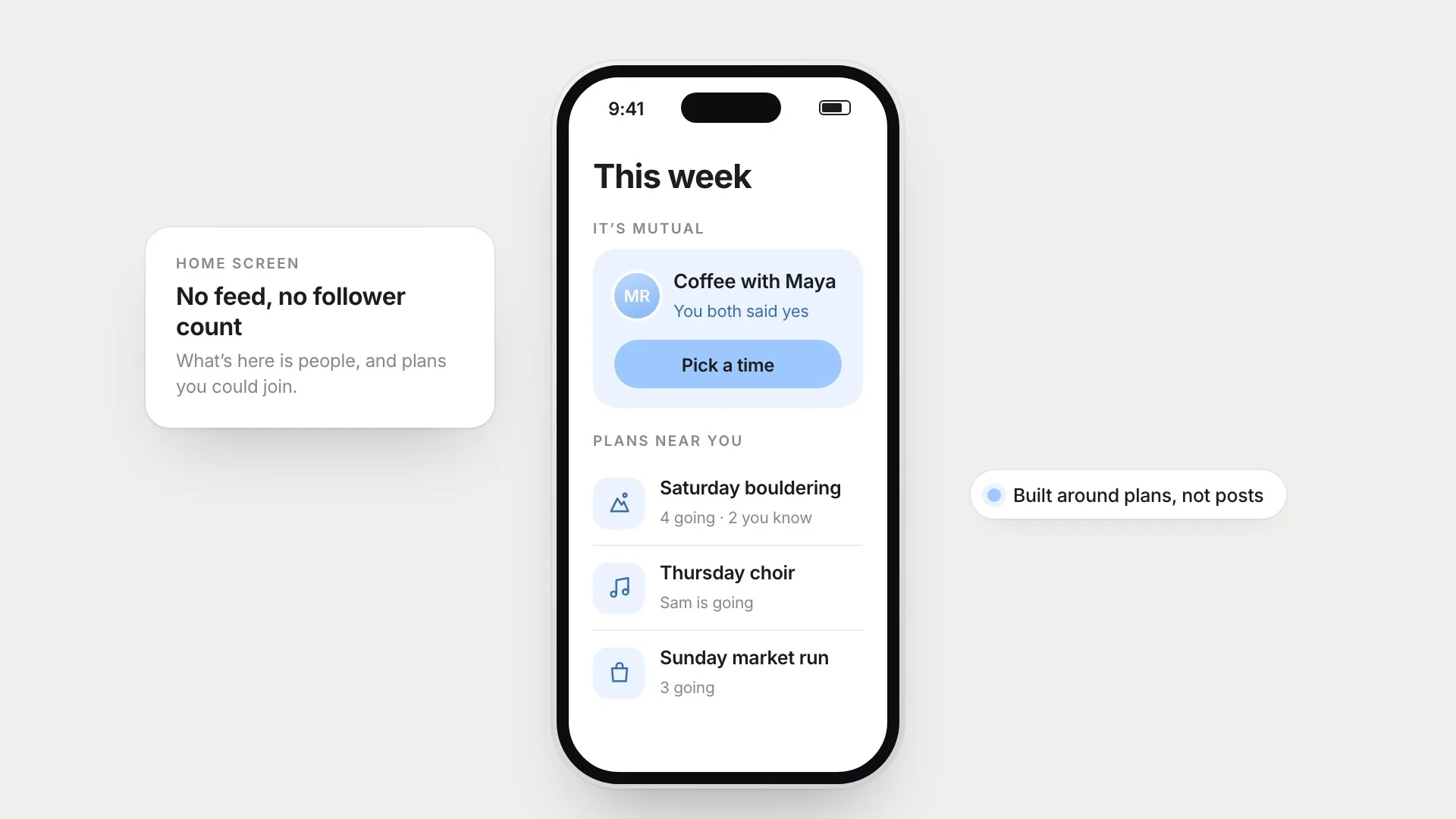
If the goal is time together, I think the home screen of a social product could be built from very different pieces:
- Plans instead of posts. The main object is something you could do with someone: a coffee, a climb, a choir rehearsal. Shared activity gives people something to talk about besides themselves, which is a lot less exposing than a profile.
- Small groups with a ceiling. A group of eight behaves differently from an audience of eight hundred. Small groups make it normal to show up rather than to perform.
- Surfaces that end. A list of this week’s plans has a bottom. When you reach it, the app has done its job and you can close it.
- Introductions, not suggestions. “You and Lena both go to the Saturday market” is more useful than “People you may know”, because it gives you a reason and a place.
My own most important online friendship grew this way. My pen pal in Sudan and I couldn’t speak each other’s language, so we started a game: one of us would send an emoji with its word in our language, and the other would send it back in theirs. Later we swapped pictures of the games we played as children. None of it was content in the feed sense. It was a shared activity, repeated over years, and that’s what made it a friendship.
Taking the risk out of the first move
One of the biggest reasons adult friendships stall isn’t a lack of interest. It’s that nobody wants to ask first. Erica Boothby and colleagues found that after a conversation, people consistently underestimate how much the other person liked them. They called it the liking gap. Nicholas Epley and Juliana Schroeder found that commuters expected to prefer sitting alone, but enjoyed their journey more when they talked to a stranger. Put two people with those biases together, and both of them wait.
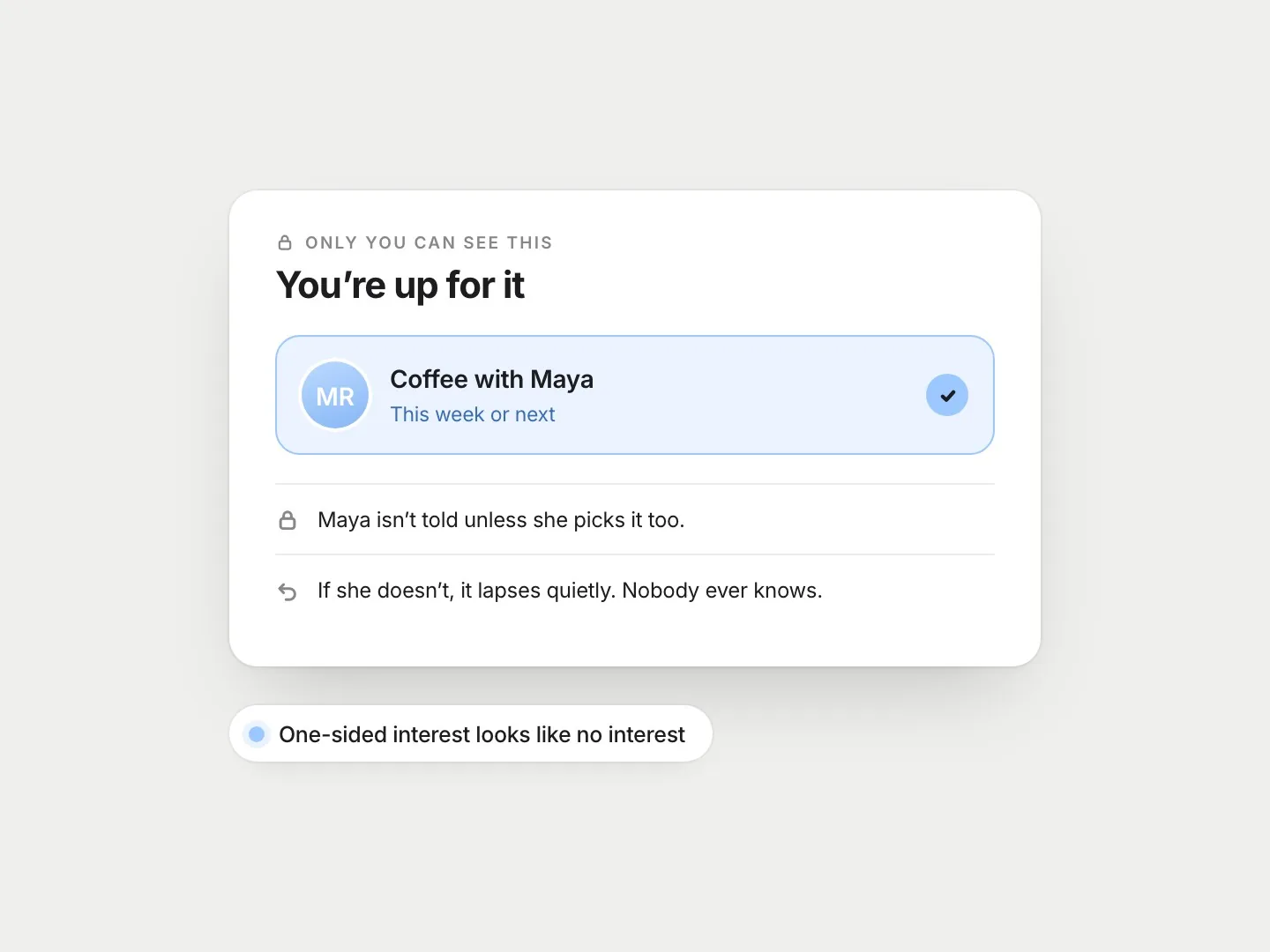
I designed Ditto around that moment. You privately mark a specific plan you’d be up for, like coffee with Maya. If Maya marks the same plan, you both find out at the same time. If she doesn’t, nobody ever knows, and your interest quietly lapses. One-sided interest looks exactly like no interest, so there’s nothing to be rejected from.
The research made the case for it. In a two-week diary study, participants logged 39 “we should hang out” moments, and only 7 turned into plans. In a within-subjects test, 7 of 8 people suggested coffee to a new coworker with Ditto, against 3 of 8 by text. The same test also showed where the idea stops working: with close friends, a text still won. People don’t need a mutual reveal to ask someone they already see every week. That limit turned out to be useful. It told me Ditto is for the people you almost know, not for everyone.
Can AI help without building a bubble?
The obvious role for AI in a product like this is matching: suggesting groups, plans and people you might get on with. The obvious risk is that it only ever suggests people like you. Sociologists call the tendency to connect with similar people homophily, and Miller McPherson, Lynn Smith-Lovin and James Cook showed how deep it runs, across age, class, education and beliefs. A recommender optimised for “likely to click” will lean into it, because similarity is the easiest thing to predict.
It’s worth being honest that this isn’t only the algorithm’s fault. When Eytan Bakshy, Solomon Messing and Lada Adamic studied how Facebook users encountered news from the other side of politics, people’s own choices about who to friend and what to click limited that exposure more than the ranking algorithm did. So a less biased algorithm alone won’t pop anyone’s bubble. People have to want something different, and the interface has to make that easy.
A few patterns I think help:
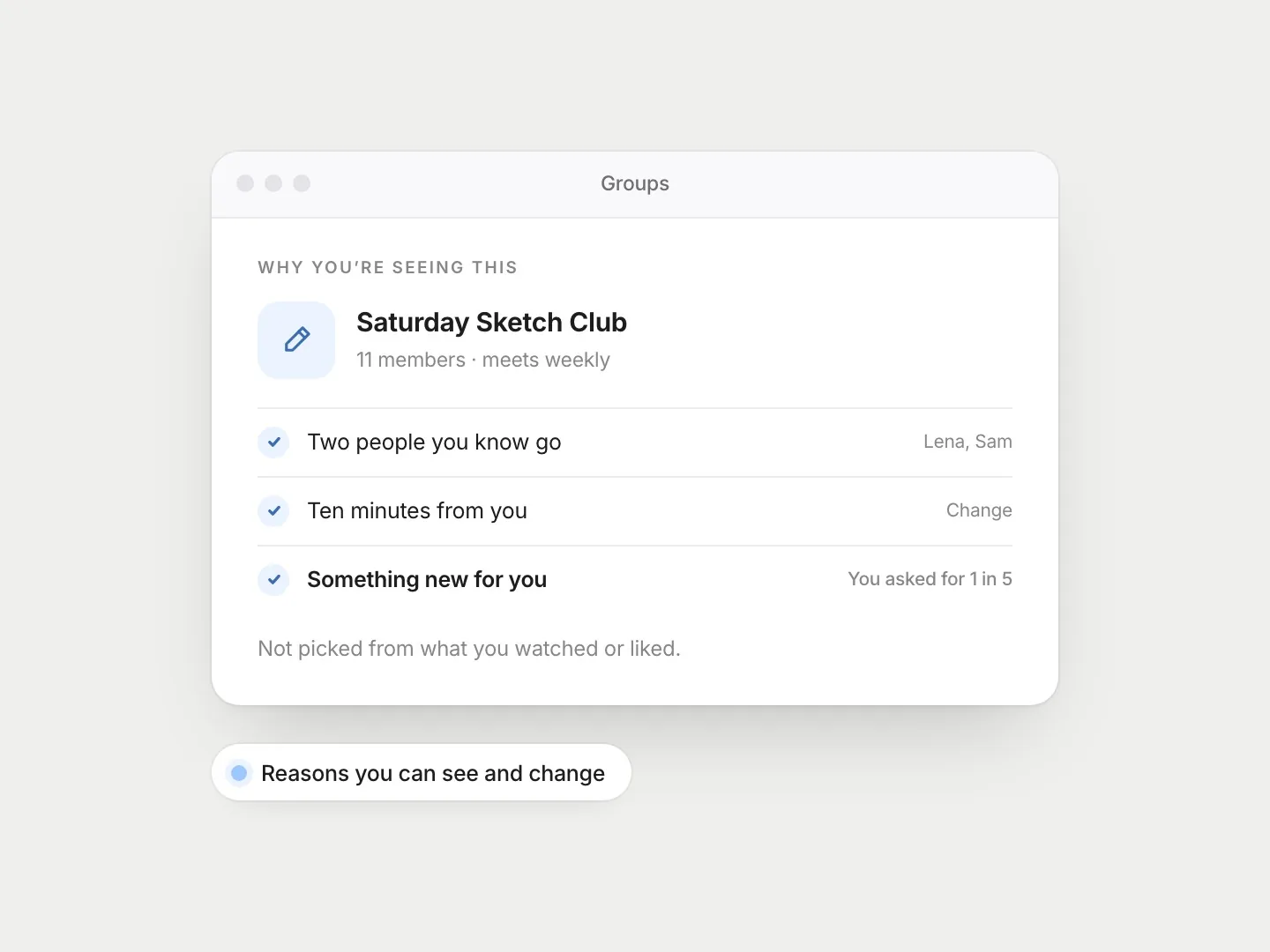
- Match on place and people, not watch history. “Ten minutes from you, and two people you know go” is a better reason to try a group than “because you watched climbing videos”.
- Make novelty a setting. Let people choose how often they want something outside their usual, say one suggestion in five, and label it when it appears.
- Always show the reason. Every suggestion explains why it’s there, and every reason can be changed.
Measuring relationships, not engagement
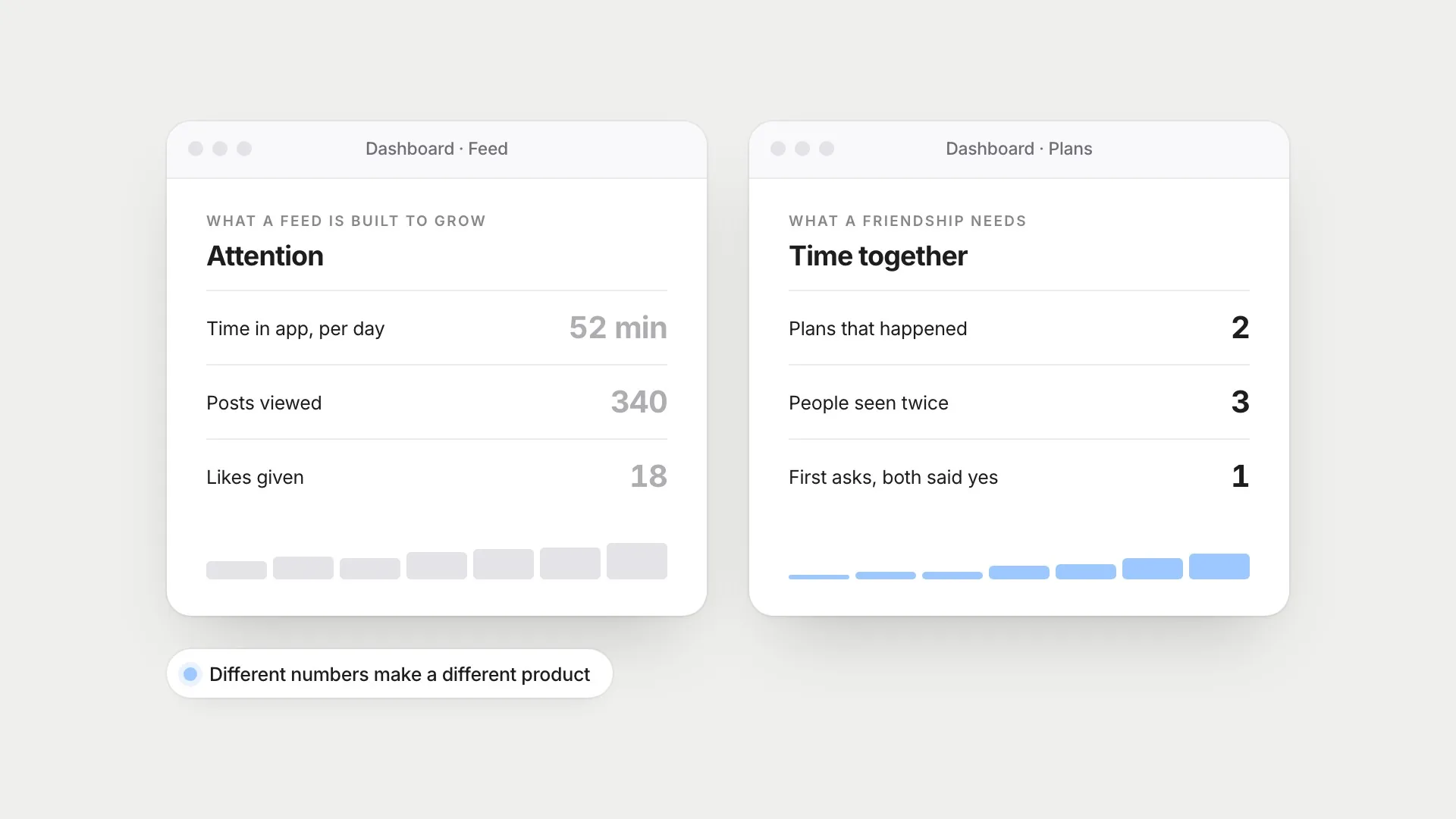
What a product measures decides what it becomes. Time spent, daily active users and posts viewed are easy to count, and they all reward a feed. A product built around relationships would need different numbers:
- Plans that actually happened, not plans created.
- People who met a second time.
- First asks where both people said yes.
- Time from “we should hang out” to a date on the calendar.
These are harder to measure. They’re slower, and they happen mostly offline. They also raise privacy questions, so I would only ever use them in aggregate and never show anyone a score for their friendships. But they point the product in the right direction. In Ditto, the main thing I measured was whether someone suggested a plan, not how long they spent in the app. A good session might last fifteen seconds.
A social product should count the time people spend together, not the time they spend in the app.
Not the end of feeds
I don’t think feeds are going away, and they shouldn’t. They’re a good way to follow news, creators and interests. But I don’t think the next important social product will be a better feed. I think it will start from a different question. Not “what should this person see next?”, but “who should this person spend time with, and how do we make that easier?” The interface that comes out of that question might not scroll at all.
References
9
- Bakshy, E., Messing, S. & Adamic, L. A. (2015). Exposure to ideologically diverse news and opinion on Facebook. Science, 348(6239), 1130–1132. doi.org/10.1126/science.aaa1160
- Boothby, E. J., Cooney, G., Sandstrom, G. M. & Clark, M. S. (2018). The liking gap in conversations: Do people like us more than we think? Psychological Science, 29(11), 1742–1756. doi.org/10.1177/0956797618783714
- Burke, M. & Kraut, R. E. (2016). The relationship between Facebook use and well-being depends on communication type and tie strength. Journal of Computer-Mediated Communication, 21(4), 265–281. doi.org/10.1111/jcc4.12162
- Epley, N. & Schroeder, J. (2014). Mistakenly seeking solitude. Journal of Experimental Psychology: General, 143(5), 1980–1999. doi.org/10.1037/a0037323
- Hagey, K. & Horwitz, J. (2021, September 15). Facebook tried to make its platform a healthier place. It got angrier instead. The Wall Street Journal. wsj.com
- Hall, J. A. (2019). How many hours does it take to make a friend? Journal of Social and Personal Relationships, 36(4), 1278–1296. doi.org/10.1177/0265407518761225
- McPherson, M., Smith-Lovin, L. & Cook, J. M. (2001). Birds of a feather: Homophily in social networks. Annual Review of Sociology, 27, 415–444. doi.org/10.1146/annurev.soc.27.1.415
- Mosseri, A. (2018, January 11). News Feed FYI: Bringing people closer together. Meta Newsroom. about.fb.com/news
- Verduyn, P., Lee, D. S., Park, J., Shablack, H., Orvell, A., Bayer, J., Ybarra, O., Jonides, J. & Kross, E. (2015). Passive Facebook usage undermines affective well-being: Experimental and longitudinal evidence. Journal of Experimental Psychology: General, 144(2), 480–488. doi.org/10.1037/xge0000057