The missing UX of changing your mind
Every platform has a button for agreeing. Almost none has a good way to say: “You’ve convinced me.”
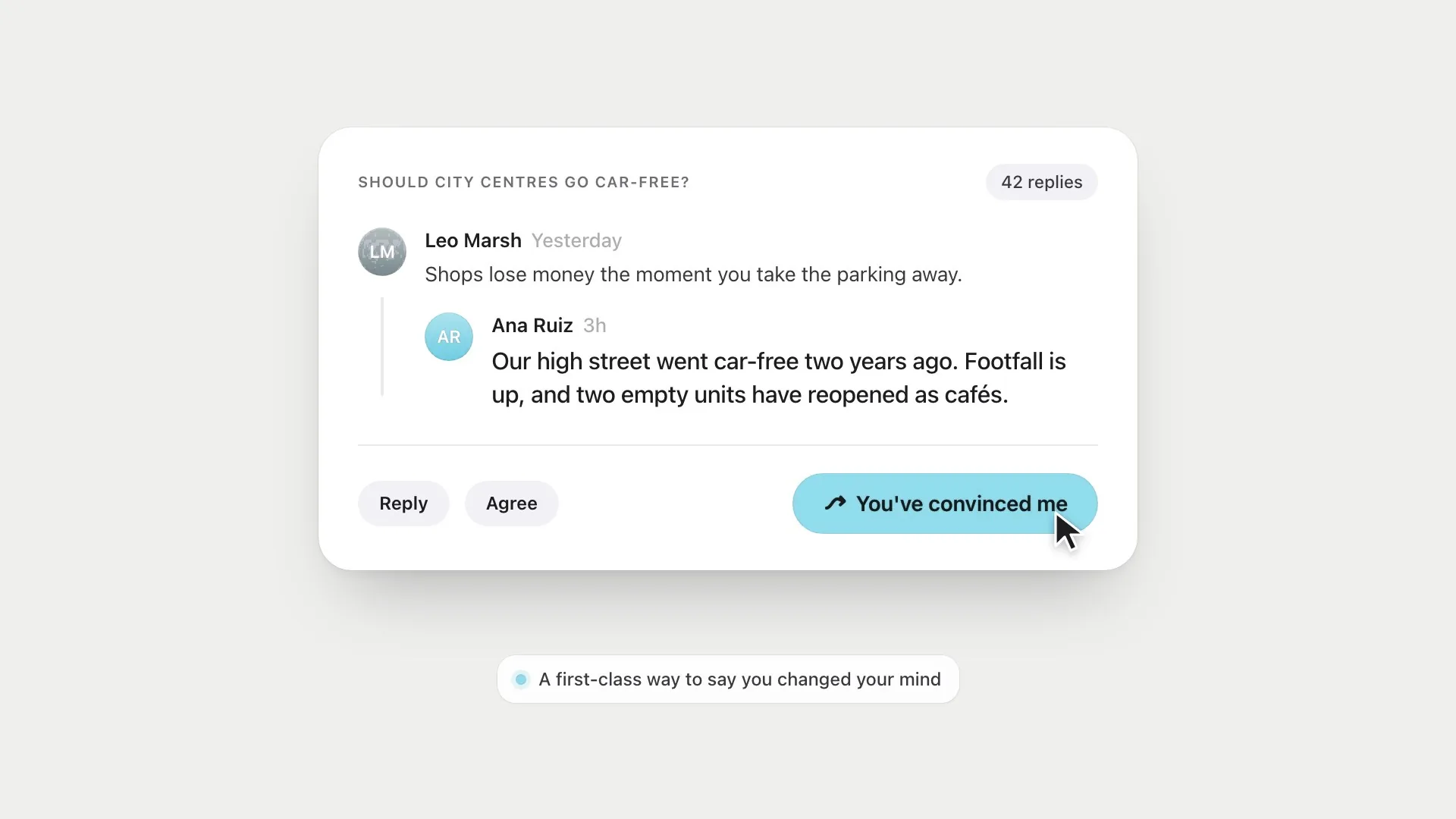
Think about what happens when you change your mind in an online conversation. You can delete your old comment, which looks like you’re hiding something. You can edit it, which can make the replies underneath look strange. You can post a new comment saying you were wrong, which takes courage and often attracts people who want to make a point of it. Or you can just go quiet, which is what most people do.
None of these options is designed. Changing your mind is one of the most valuable things a person can do in a conversation, and the interfaces we use treat it as an edge case.
Why it’s socially hard
People have a strong drive to appear consistent. Once we’ve said something publicly, backing down can feel like losing, even when we’ve learned something. Online, this gets worse. The original statement stays on the record, often in front of a large audience, and the format of most threads turns conversations into contests with winners and losers.
The most useful research I’ve found on why this happens is about accountability. Jennifer Lerner and Philip Tetlock reviewed decades of studies on what happens when people know they’ll have to justify their views to others, and found that it depends heavily on timing. If people learn before they’ve formed an opinion that they’ll have to explain it to an audience whose views they don’t know, they tend to think harder and criticise their own reasoning in advance. If they’re held to account after they’ve committed to a position, the same pressure mostly goes into defending what they’ve already said.
Now look at the shape of a comment thread. You post first. The audience arrives afterwards, and its views are usually all too clear. It’s close to the exact conditions under which accountability makes people dig in rather than think. That isn’t a flaw in the people. It’s a property of the sequence.
There’s some evidence that we also overestimate the price of admitting a mistake. Adam Fetterman and Kai Sassenberg asked 281 published scientists to imagine one of their findings failing to replicate. The scientists expected the damage to their reputation to be worse than it was, and admitting they were wrong was judged less harmful than refusing to. These were scenarios, and scientists are a particular group with particular norms, so I wouldn’t stretch it too far. But it hints at something designers can work with: part of what stops people revising is a forecast, and forecasts can be wrong.
Psychologists who study intellectual humility, the willingness to recognise the limits of your own views, find that it’s linked to better judgement and more open conversations. Mark Leary and colleagues found that people higher in intellectual humility paid closer attention to whether an argument was actually strong, and were less likely to see a politician who changed position as “flip-flopping”. Tenelle Porter and Karina Schumann found that people higher in it were more open to learning about opposing views, and chose to read a larger share of opposing political perspectives.
For design, Porter and Schumann’s fourth study matters most. Reminding people that intelligence can grow, rather than being fixed, increased their intellectual humility, which in turn made them more open to the other side. It’s one study and I wouldn’t build a product on it alone. But it suggests humility isn’t only a trait you either have or don’t. It responds to context. And a trait like that is easier to show in a setting that respects it. Most comment sections don’t.
Exposure isn’t the same as persuasion
A common answer to all this is: show people more of the other side. If minds stay closed because people live in echo chambers, open the chambers.
The evidence is not kind to that idea. Christopher Bail and colleagues paid Democrats and Republicans on Twitter to follow a bot that shared messages from politicians, media and opinion leaders on the other side, for a month. Republicans who followed a liberal bot became substantially more conservative. Democrats who followed a conservative bot became slightly more liberal, although that change wasn’t statistically significant. The authors are careful about the study’s limits: one platform, one month, people who were paid to take part. But nobody came out more moderate.
You might read this as proof of the famous backfire effect, the idea that correcting people makes them believe the wrong thing more. That idea came largely from Brendan Nyhan and Jason Reifler, whose experiments found that corrections sometimes strengthened misperceptions among the people most motivated to hold them. It became one of the most quoted findings in the field. It also hasn’t held up well. When Thomas Wood and Ethan Porter tested it in five experiments covering 52 issues and more than 10,100 participants, none of their corrections triggered backfire. People generally moved toward the facts, even when the facts were politically awkward for them. Nyhan himself later wrote that the effect had been overstated, and that the emerging consensus is that corrections usually work at least a little. The real problem, he argued, is that the effect fades, and gets drowned out by cues from the people and groups we identify with.
I think these two findings fit together, and the fit is what matters for design. People can update on a fact quite readily when it’s put to them plainly. What resists change is the part of a belief that’s tied to who we are and who we stand with. Bail’s participants weren’t shown neutral facts. They were shown the other team, all month long. That’s my interpretation rather than something either study proves. But if it’s right, the design problem isn’t how much opposing content to show. It’s how to make updating something a person can do without feeling they’ve switched sides.
A place that rewards it
There’s one well-known example. The Reddit community r/ChangeMyView asks people to post an opinion they hold and invite others to challenge it. If someone changes your mind, even a little, you award them a “delta”. Chenhao Tan and colleagues at Cornell studied thousands of these conversations to understand what kinds of arguments persuade people.
Some of what they found is about timing and stamina. Challengers who replied early did much better: in posts with at least ten challengers, the first two were about three times as likely to win a delta as the tenth. Some back-and-forth helped, but after about five rounds of it, the challenger had almost no chance. Long exchanges look like persistence. In practice, they look like positions hardening.
Some of it is about language. Persuasive replies tended to use different words from the original post, bringing a new frame rather than echoing the old one, and they were more likely to include hedges, the small words that signal uncertainty. And one detail I keep thinking about: people who wrote their original view with more “I” were more likely to be persuadable, while more “we” went with resistance. That’s a correlation, and the authors don’t claim to know why, but it fits the idea that beliefs held on behalf of a group are harder to put down.
Two caveats. The community is self-selected: people who post there have already said they’re open to being challenged. And even in that friendly setting, predicting whose mind would change was hard. This is a best case, not a typical one.
What I find interesting is the design, not just the data. The delta turns changing your mind into a normal, expected part of the conversation. It’s a small piece of interface that gives the act a name, a symbol and a bit of status. The person who changes and the person who persuaded both come out looking good. In Lerner and Tetlock’s terms, it rewrites what the audience is expecting from you. In most threads, the audience is waiting to see whether you’ll defend yourself. On ChangeMyView, it’s waiting to see whether you’ll move.
When changing your mind has a visible place in the interface, it stops looking like losing.
Patterns worth trying
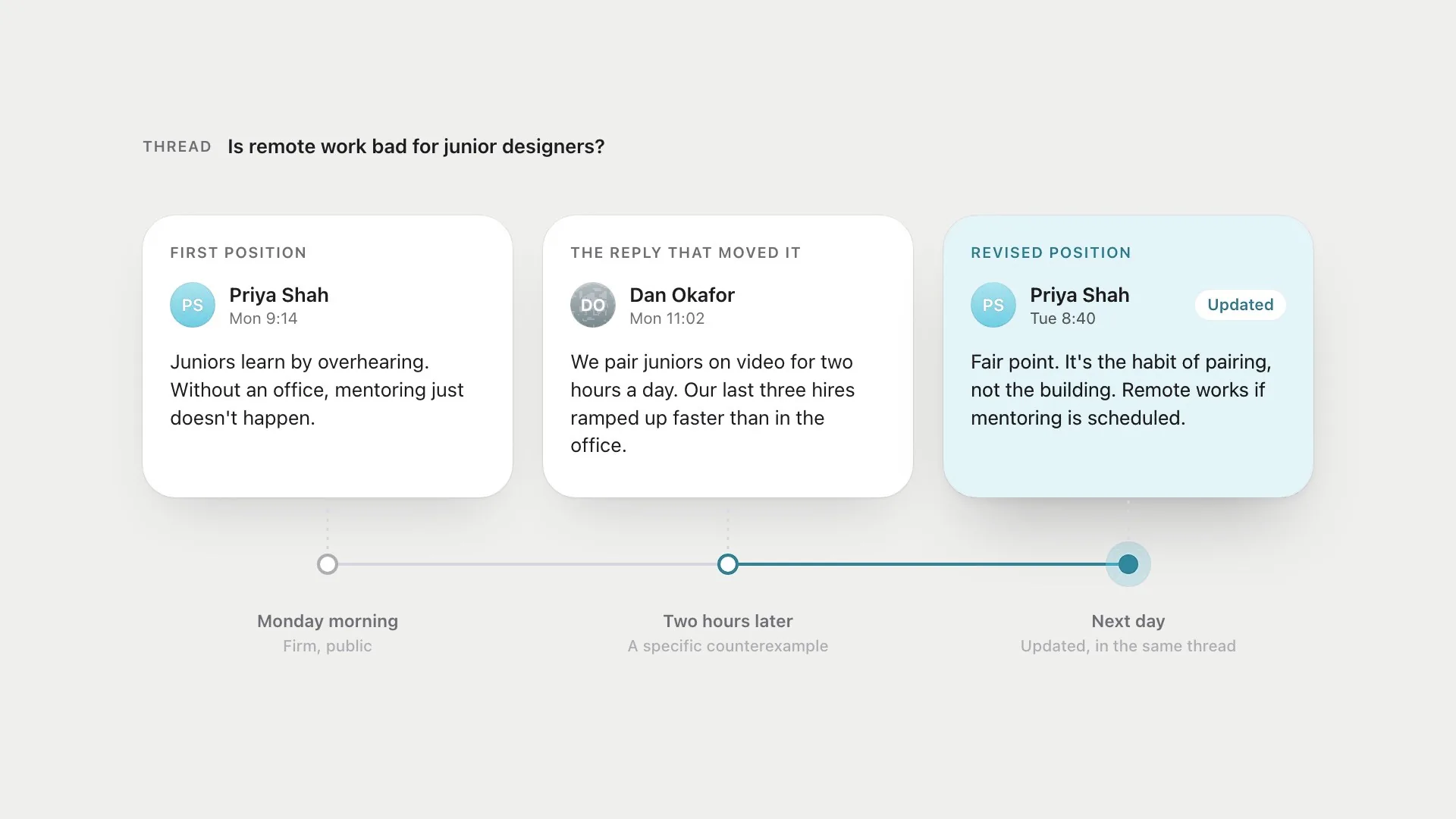
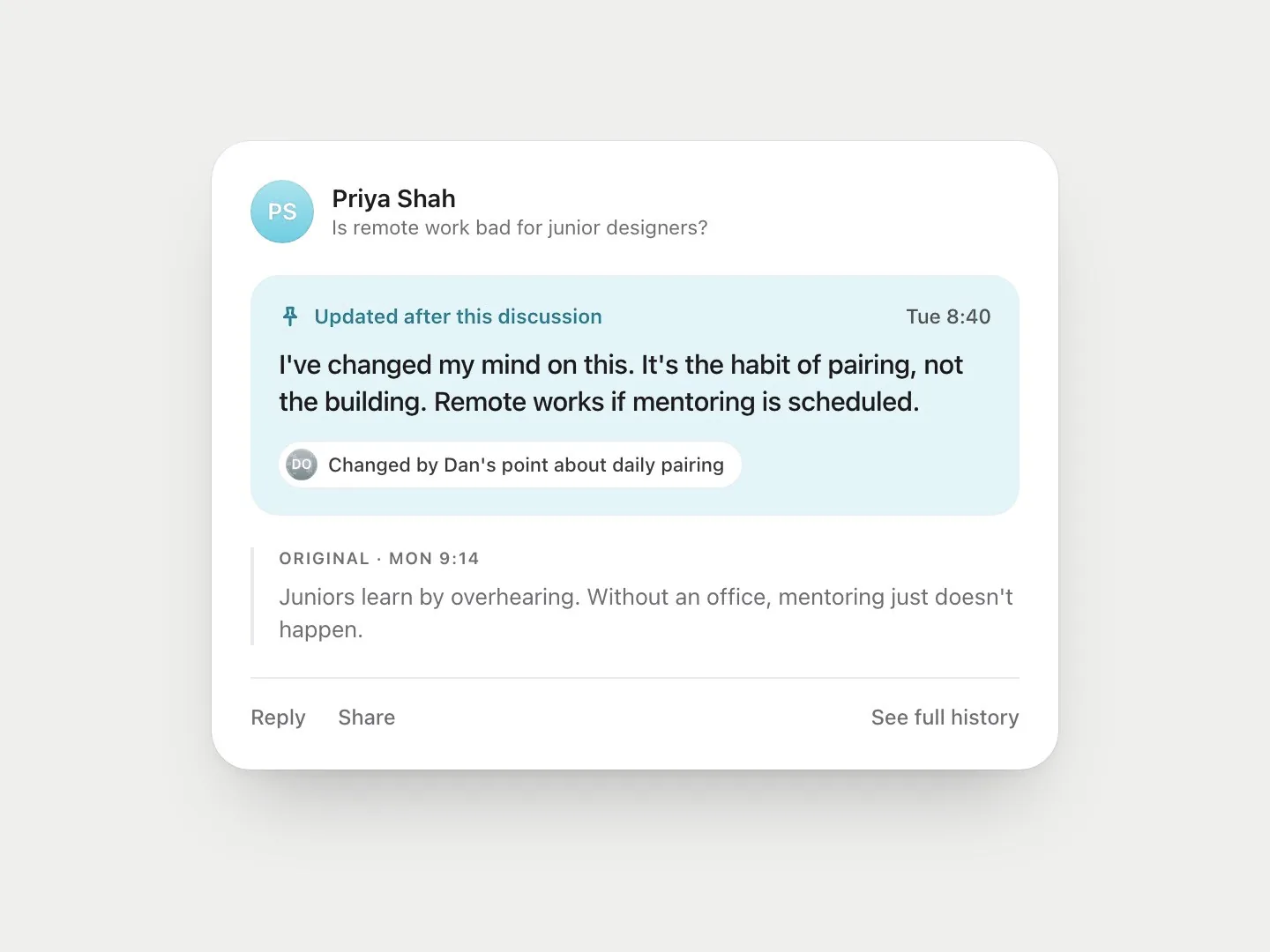
Versioned opinions. Instead of editing or deleting, let people post an update to their own view that sits visibly on top of the original. “Updated after this discussion.” The history stays honest, and the change looks like growth.
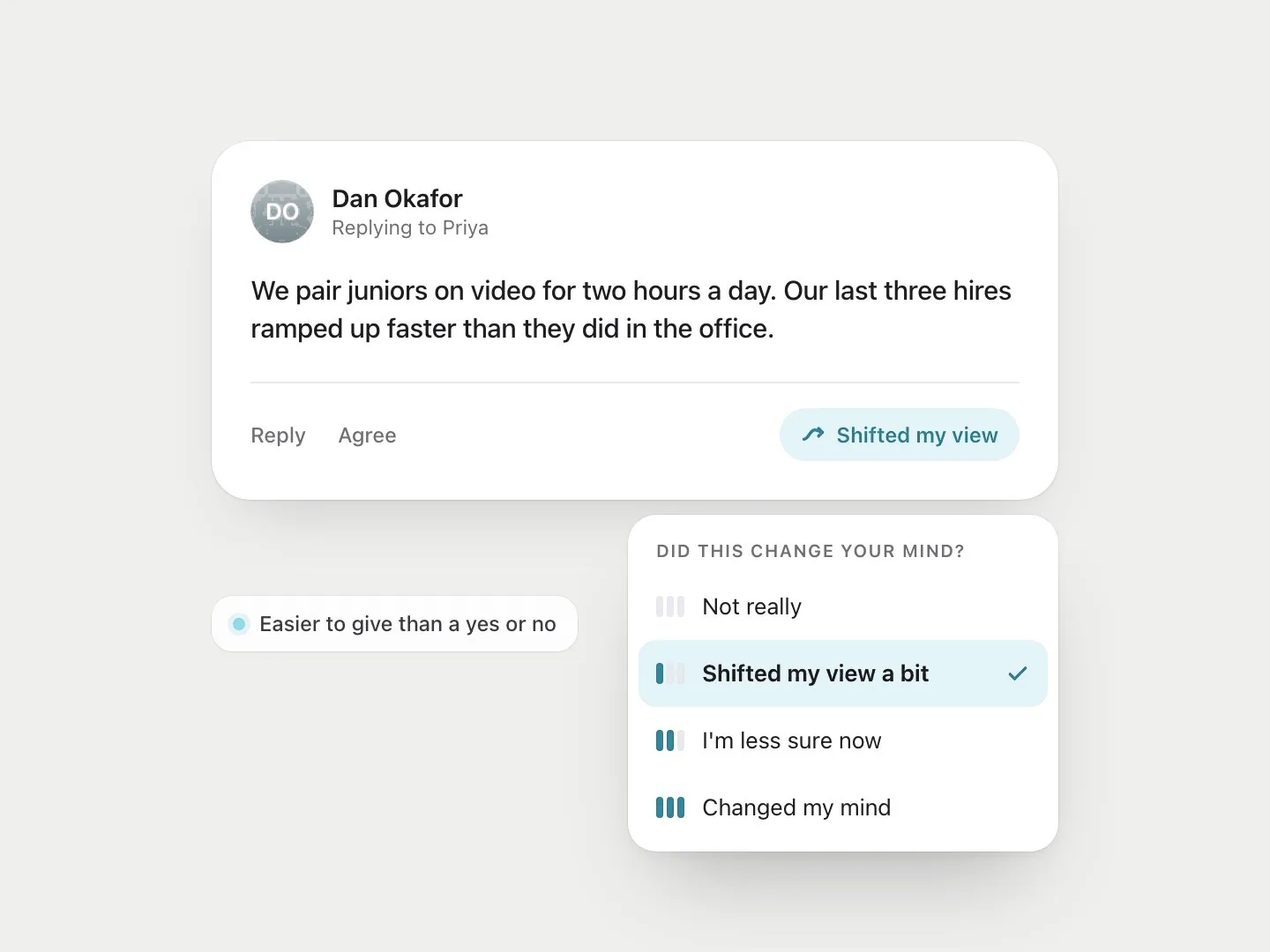
Partial movement. Minds rarely flip completely. A way to say “this changed my mind a bit” or “I’m less sure now” is more realistic than agree or disagree, and much easier to give. It also separates updating from switching sides, which is the step that seems to cost people the most.
Credit the reason, not the winner. Highlight the specific point that shifted someone’s thinking. That rewards good arguments rather than the person who won.
Private first. Let people mark that something changed their mind privately before deciding whether to share it. Reflection is easier without an audience, and it gives people a chance to check their forecast of what admitting it would cost.
Confidence, not just stance. If people can show how sure they are when they post, changing later is less dramatic. Going from 70% to 50% is easier to admit than going from right to wrong. Asking for confidence at the moment of posting also moves a little of the self-criticism to before the commitment, which is where the accountability research says it does the most good.
Notice when a thread has stopped working. If persuasion has nearly vanished after five rounds of back-and-forth, the interface could gently say so, and offer a different move: summarise the other person’s view, or step away and come back.
What could go wrong
Each of these patterns can fail in its own way.
Anything that gives status can be performed. If changing your mind earns visible credit, some people will start awarding small, safe concessions to look open-minded while holding on to everything that matters. A delta count can turn into a reputation score like any other.
A visible history of updates is honest, but it’s also a record. In a hostile space, “they admitted they were wrong in March” is ammunition. Versioning needs some control over who sees what, or it punishes exactly the people it was meant to protect.
And changing your mind is not always the right thing to do. Some views should be held firmly, and a system that rewards movement for its own sake would reward whoever argues longest. The goal isn’t more mind-changing. It’s making the cost of changing match the strength of the reason, instead of the size of the audience.
Where Parallax fits
This question shaped Parallax, an AI I designed to test opinions rather than agree with them. The last stage of a Parallax conversation asks a simple question: what changed? The answer isn’t judged. You can say “nothing”, “I’m less certain”, or “I think I was wrong about one part”. The argument map shows which parts of your reasoning held and which didn’t, so the change is tied to something specific.
Working on it made me think that the private version of this problem is easier to solve than the public one. With nobody watching, people revise quite easily. The hard design problem is bringing that same ease into conversations with other people.
Designing for flexibility
A lot of what goes wrong in online discussion comes from people defending positions they no longer fully hold, because backing down feels too costly. If interfaces made changing your mind visible, gradual and even a little admirable, I think conversations would get better without anyone having to be a saint.
We already design for agreeing, sharing and reacting. Changing your mind deserves a design too.
References
9
- Bail, C. A., Argyle, L. P., Brown, T. W., Bumpus, J. P., Chen, H., Hunzaker, M. B. F., Lee, J., Mann, M., Merhout, F. & Volfovsky, A. (2018). Exposure to opposing views on social media can increase political polarization. Proceedings of the National Academy of Sciences, 115(37), 9216–9221. doi.org/10.1073/pnas.1804840115
- Fetterman, A. K. & Sassenberg, K. (2015). The reputational consequences of failed replications and wrongness admission among scientists. PLOS ONE, 10(12), e0143723. doi.org/10.1371/journal.pone.0143723
- Leary, M. R., Diebels, K. J., Davisson, E. K., Jongman-Sereno, K. P., Isherwood, J. C., Raimi, K. T., Deffler, S. A. & Hoyle, R. H. (2017). Cognitive and interpersonal features of intellectual humility. Personality and Social Psychology Bulletin, 43(6), 793–813. doi.org/10.1177/0146167217697695
- Lerner, J. S. & Tetlock, P. E. (1999). Accounting for the effects of accountability. Psychological Bulletin, 125(2), 255–275. doi.org/10.1037/0033-2909.125.2.255
- Nyhan, B. (2021). Why the backfire effect does not explain the durability of political misperceptions. Proceedings of the National Academy of Sciences, 118(15), e1912440117. doi.org/10.1073/pnas.1912440117
- Nyhan, B. & Reifler, J. (2010). When corrections fail: The persistence of political misperceptions. Political Behavior, 32(2), 303–330. doi.org/10.1007/s11109-010-9112-2
- Porter, T. & Schumann, K. (2018). Intellectual humility and openness to the opposing view. Self and Identity, 17(2), 139–162. doi.org/10.1080/15298868.2017.1361861
- Tan, C., Niculae, V., Danescu-Niculescu-Mizil, C. & Lee, L. (2016). Winning arguments: Interaction dynamics and persuasion strategies in good-faith online discussions. In Proceedings of the 25th International Conference on World Wide Web (pp. 613–624). doi.org/10.1145/2872427.2883081
- Wood, T. & Porter, E. (2019). The elusive backfire effect: Mass attitudes’ steadfast factual adherence. Political Behavior, 41(1), 135–163. doi.org/10.1007/s11109-018-9443-y