LayerYour phone can name any building, but not why it matters.
Layer is an iOS camera app for the places you walk past. Point it at a building for a three-sentence answer to the question you’d actually ask, then put the phone away and listen as you walk.
Field observation, intercept interviews, trip diary, expert interview, within-subjects test (n = 8), RITE round
Platform
iOS, 33 screens and states
01
Overview
Your phone can name any building. It still can't tell you why to care, and it makes you look away to find out.
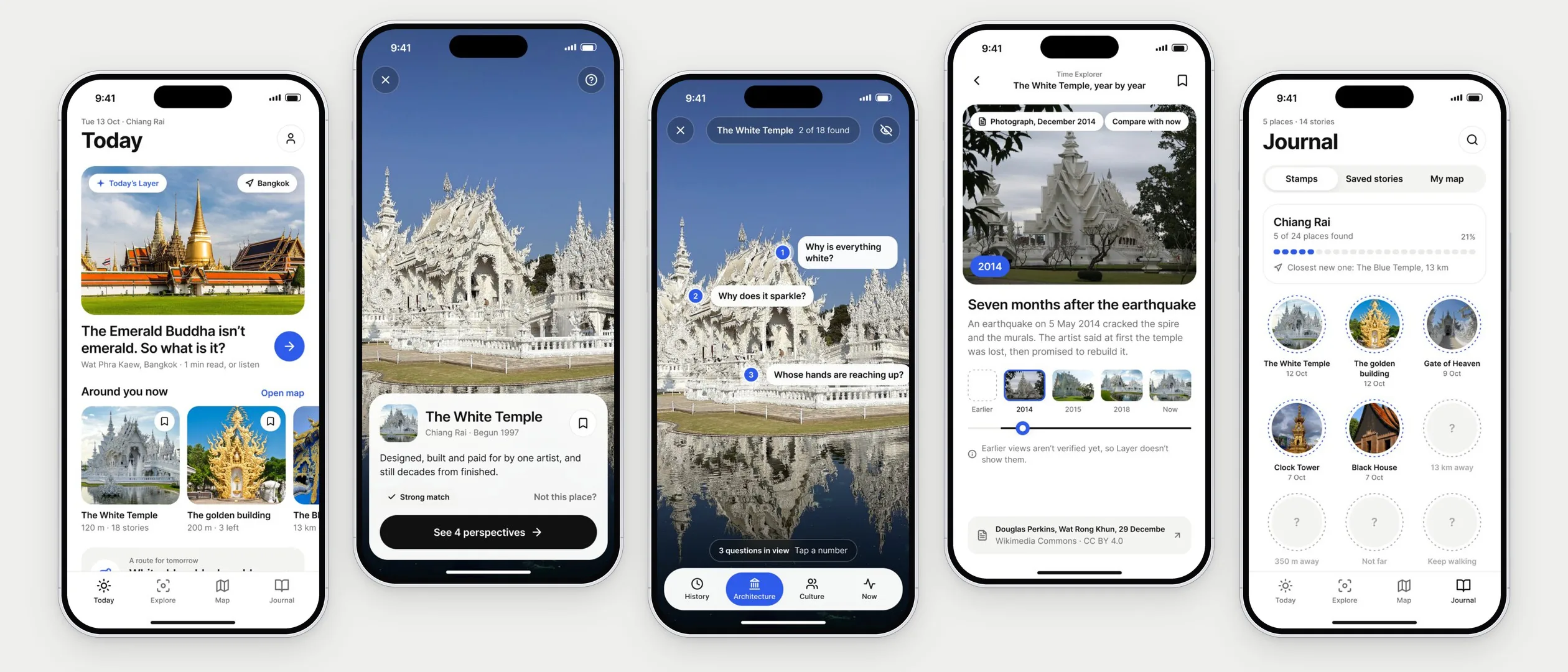
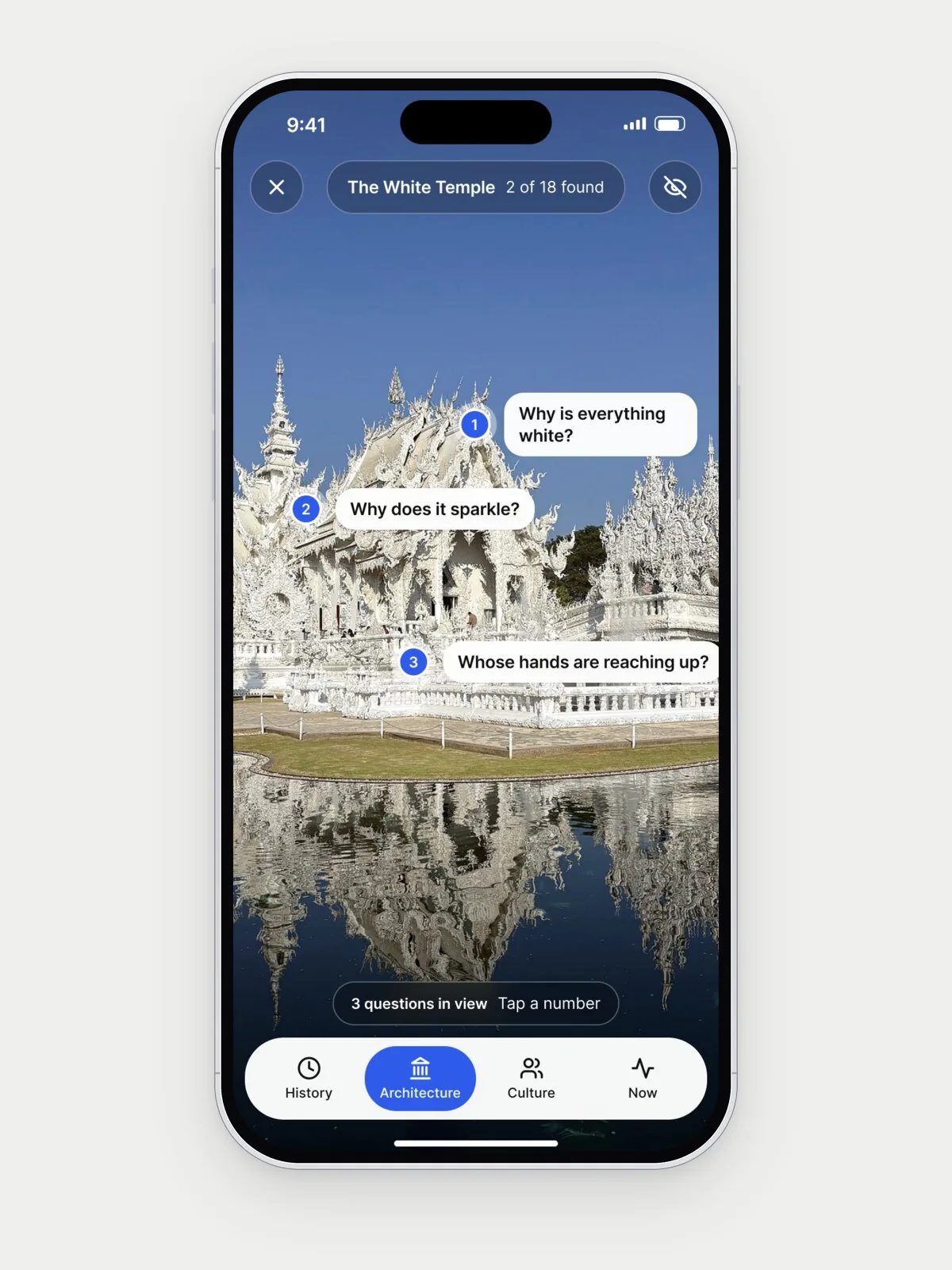
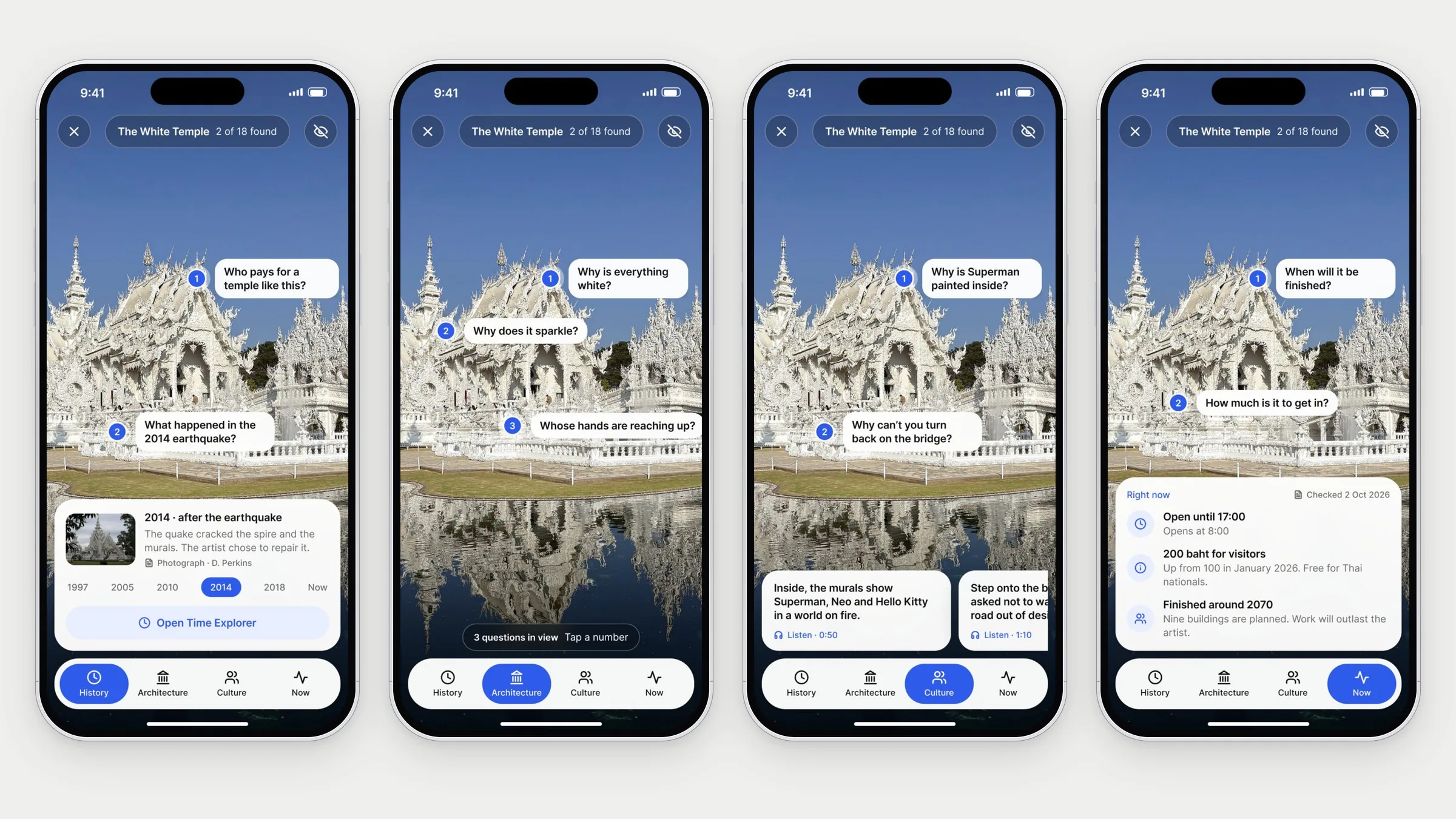
Layer is an iOS camera app for the places you walk past. Point it at a building and it offers three questions worth asking, in one of four perspectives: History, Architecture, Culture or Now. Each answer is three sentences. When you start walking, it goes to your pocket and speaks.
I designed 33 screens and states around one fully worked place, the White Temple in Chiang Rai, with real facts, dated photographs and stated sources. The same model runs in the city you live in.
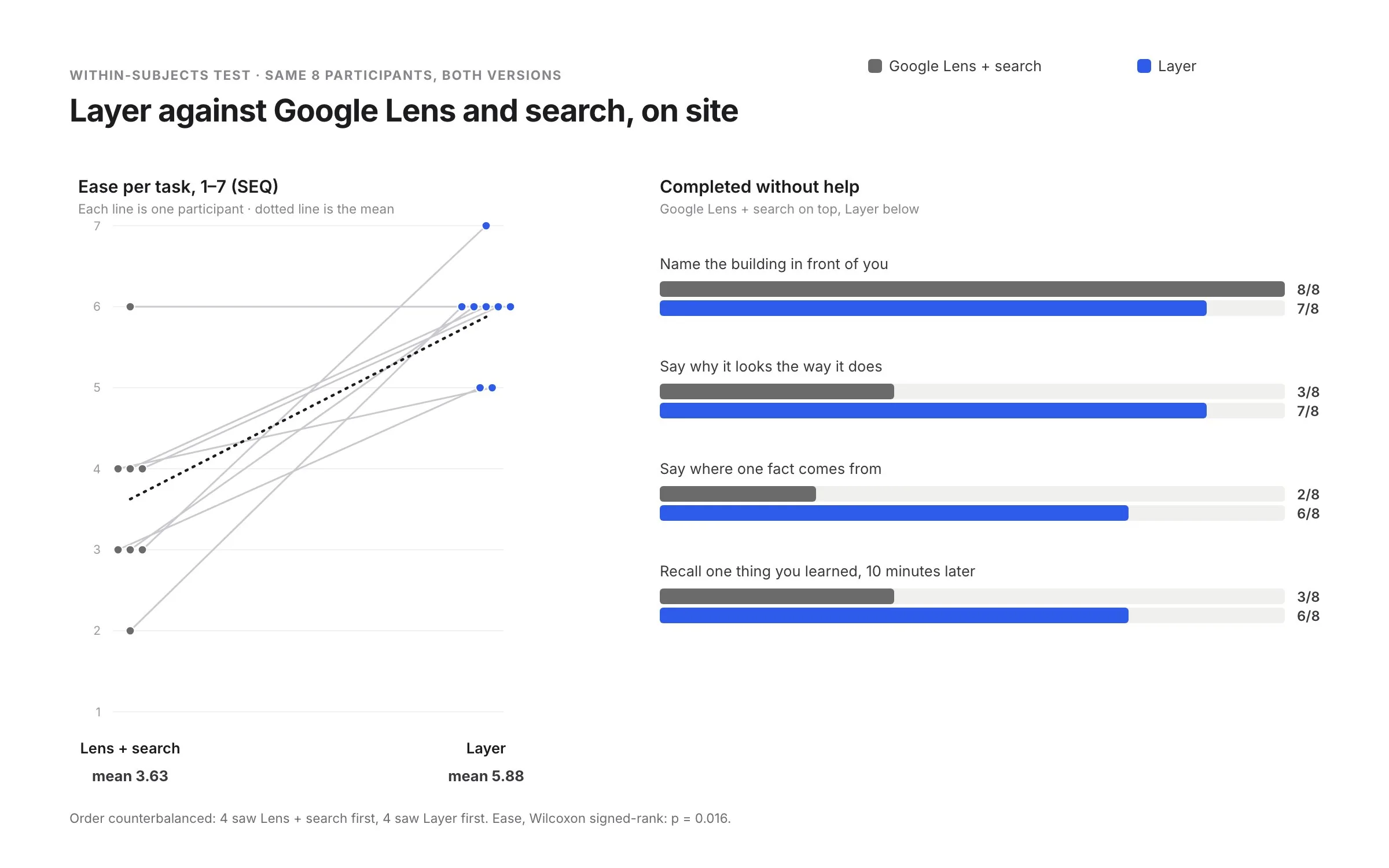
Headline result: on site, 6 of 8 people could recall something they learned with Layer 10 minutes later, against 3 of 8 with Google Lens and search.
02
The problem
~20 billion
Visual searches people run through Google Lens every month. Pointing a camera at the world to ask about it is already ordinary.
Google, reported October 2024
27 seconds
Average time a museum visitor spends with one artwork, label included. It was 28.6 seconds when the study was repeated sixteen years later.
Smith & Smith, 2001; Smith, Smith & Tinio, 2017
25% vs 51%
Pedestrians who noticed a clown on a unicycle riding past them: those on a phone call, against those walking alone without one.
Hyman et al., 2010
14 crashes
Road crashes that news reports attributed to Pokémon Go in ten days of July 2016, the first time AR reached a mass audience.
Ayers et al., JAMA Internal Medicine, 2016
Different settings and decades. Read them as a pattern, not one dataset.
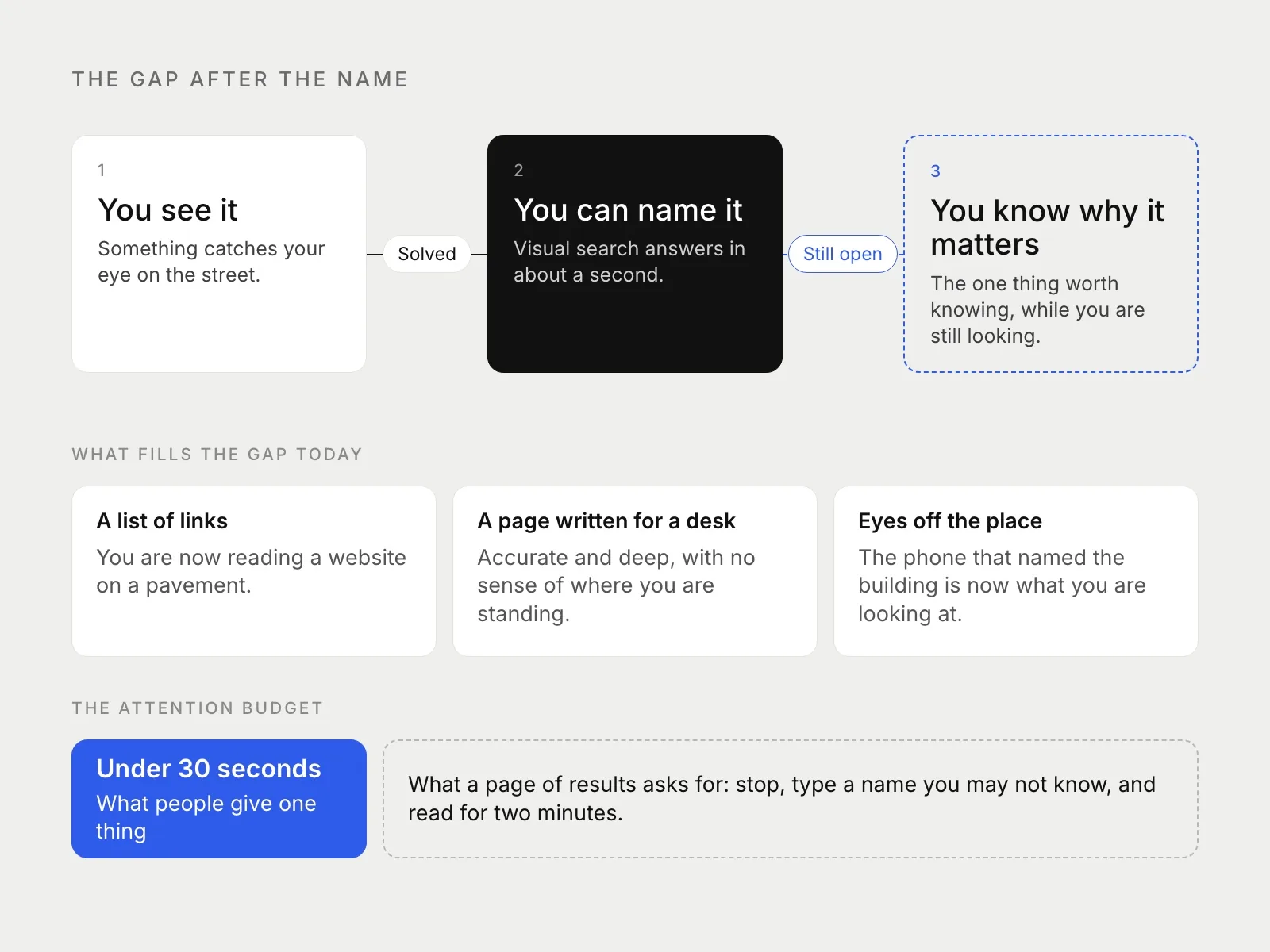
Visual search closed the gap between seeing a place and naming it. It left the gap between naming and caring, and it fills that gap with a page of links you read on a pavement. Attention is the real budget: about half a minute, and less with a phone in your hand.
How might I help someone understand the place in front of them in under a minute, without competing with the place for their attention?
03
Research
What do people do when a place makes them curious, and what would let them find out without looking away?
Study plan
Hypothesis
A few questions about the place, answered briefly, beat search on understanding and recall, with less time on the screen.
Objective
Learn what people do the moment a place catches them, and where the phone gets in the way.
Generative method
Field observation and intercept interviews at three sites in Chiang Rai, a 5-day trip diary, and an interview with a licensed guide.
Evaluative method
Within-subjects test on site against Google Lens and search, then a RITE round of 5.
Participants
6 visitors and residents, including one with low vision, plus 1 guide. 8 for the test, 5 for the round after.
Non-objectives
Tickets, queues and opening hours. Maps already serve them.
What already explains places well
Before going out, I read what interpretation and curiosity research say works.
Heritage interpretation · 1957
Provoke, don't instruct
What it says
Freeman Tilden: “The chief aim of interpretation is not instruction, but provocation.”
What I took
Every marker in Layer is a question, not a label.
Curiosity research · 1994
Curiosity is a gap you can see
What it says
Loewenstein: curiosity is the gap between what you know and want to know. It needs a handle first.
What I took
Recognition gives the handle. The answer must close the gap before attention moves on.
The audio guide
Eyes free, but on rails
How it works
Your eyes stay on the object. The script and order are fixed.
What I took
Audio doesn't compete with looking. Pocket mode lets the listener choose the question.
The human guide
The standard to beat
How it works
A good guide picks the one story that will land, points, and stops talking.
What I took
The skill is editing. Layer shows three questions, never fifteen.
From notes to themes
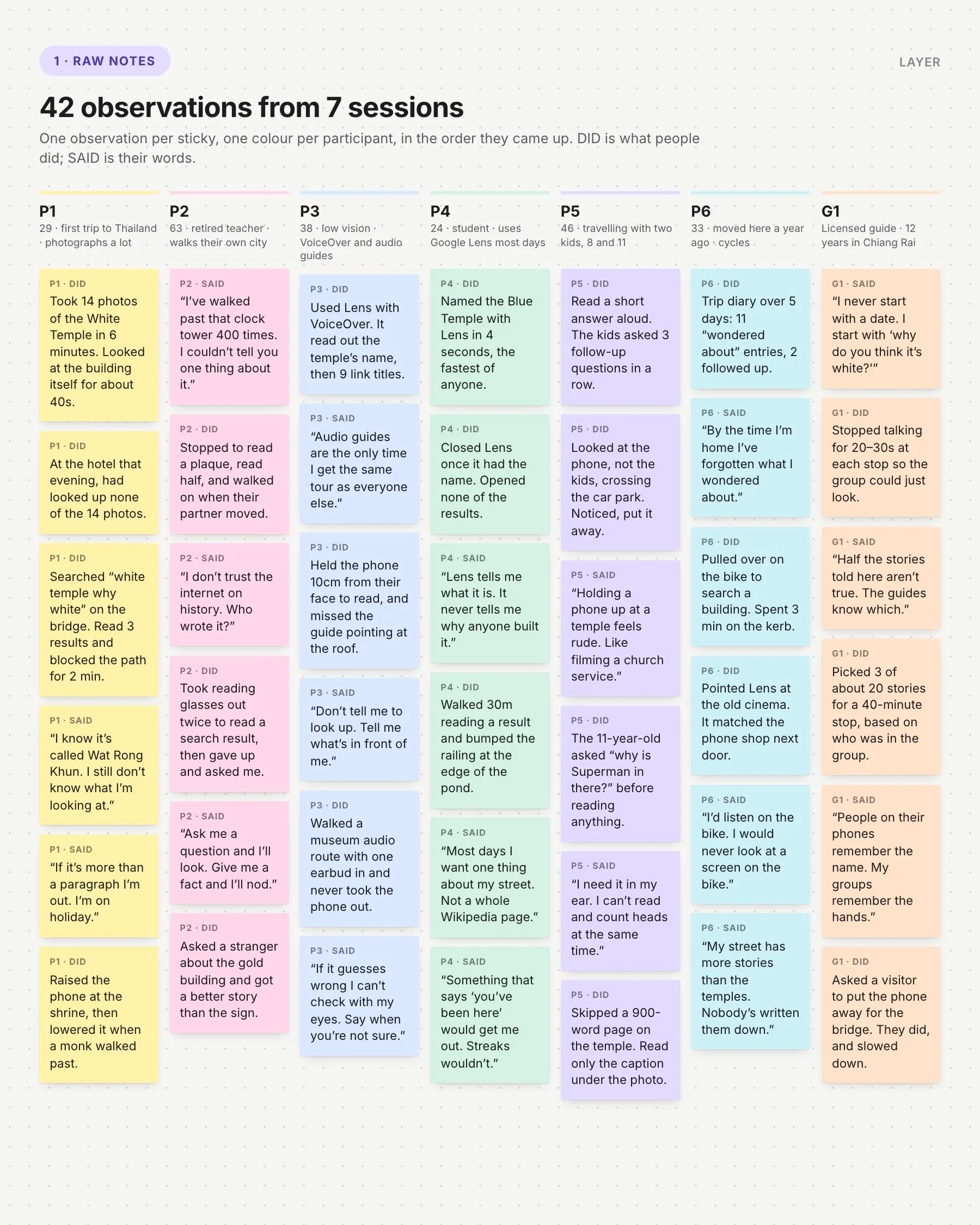
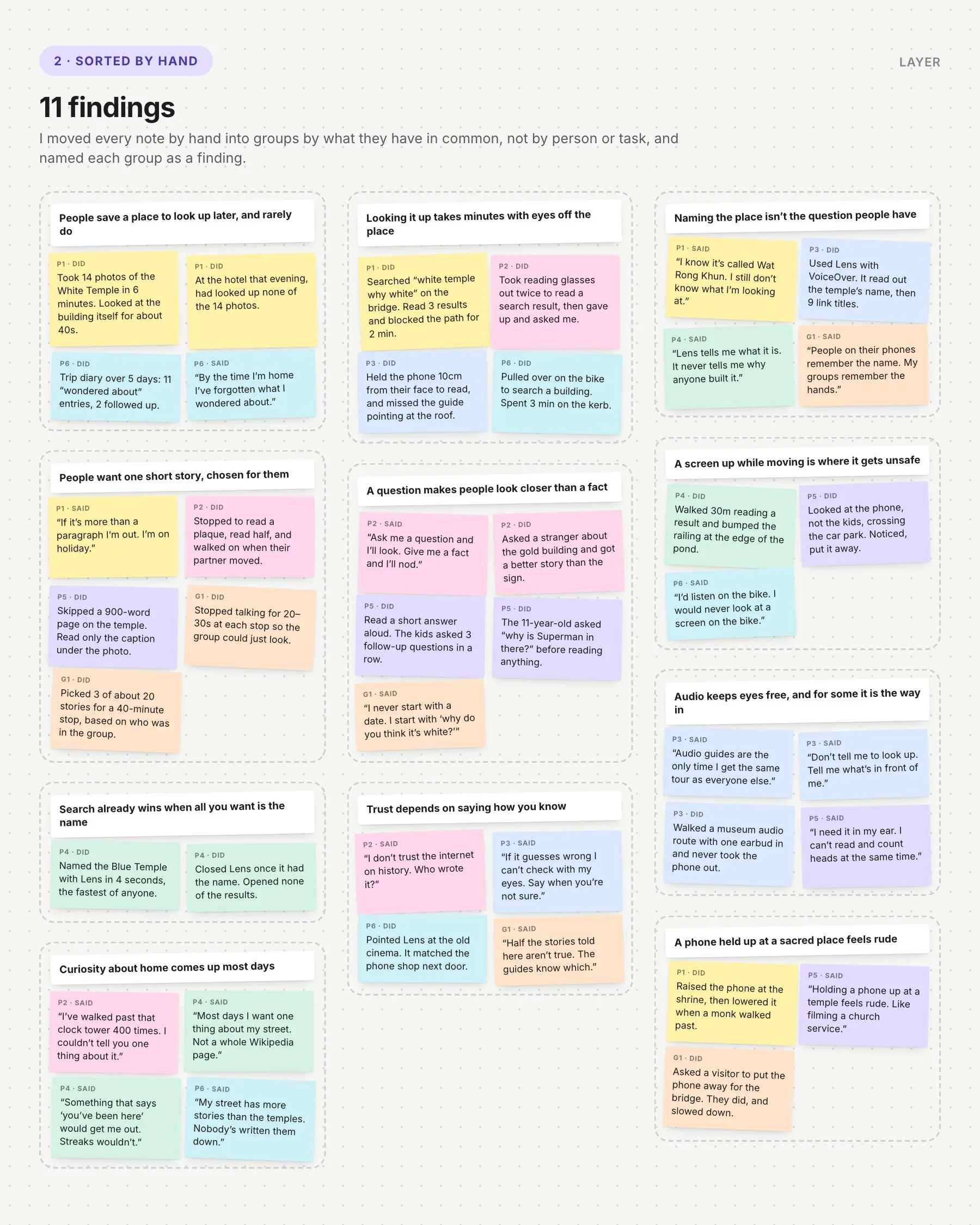
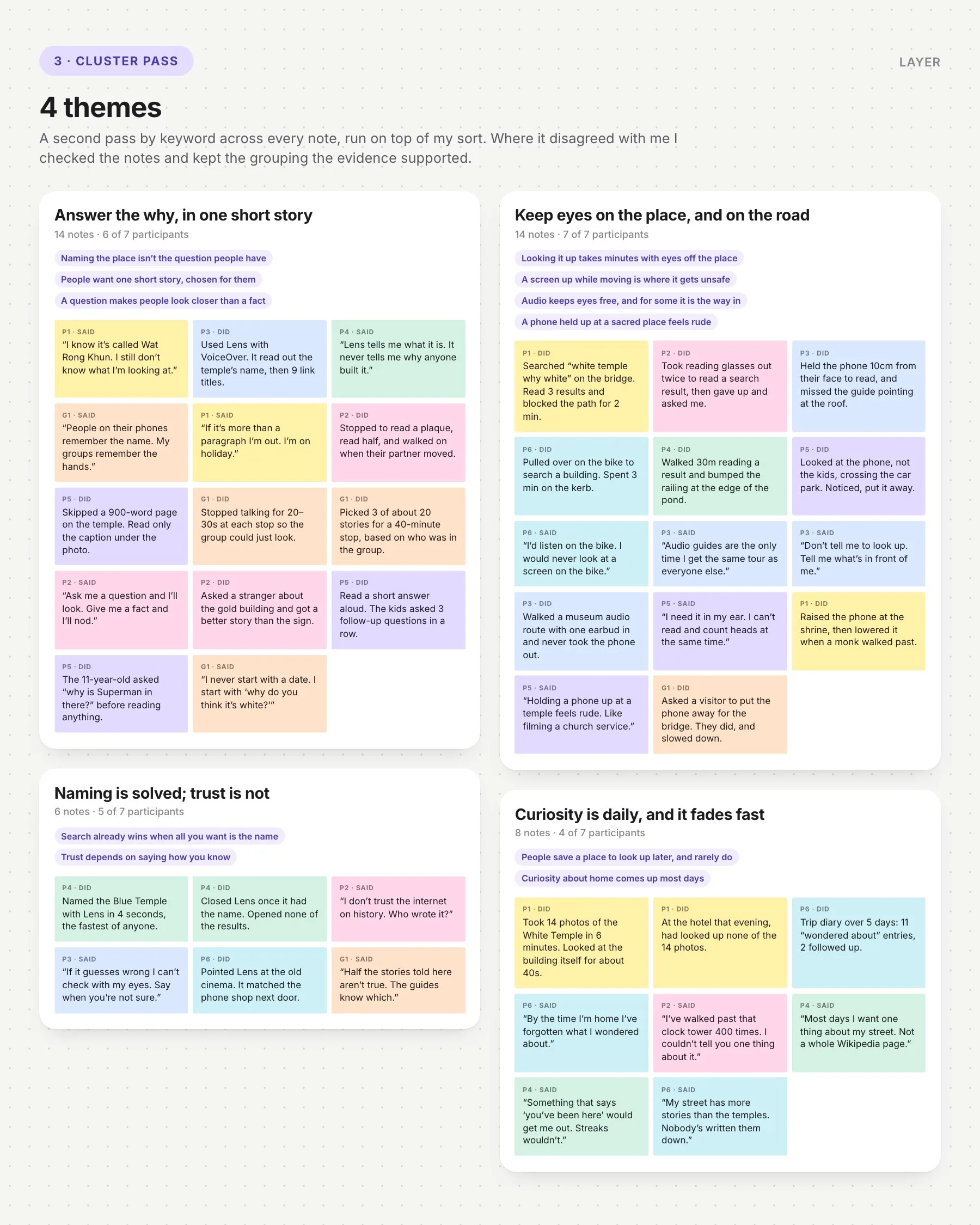
One observation per sticky, one colour per person. I sorted all 42 by hand first, then ran a cluster pass over the sort.
1. Raw notes. 42 observations, 23 of them things people did.
2. Sorted by hand. 11 findings, each named as a sentence.
3. Cluster pass. A keyword pass that settled 4 themes.
Findings
Need
Naming the place isn't the question people have
Evidence
“I know it’s called Wat Rong Khun. I still don’t know what I’m looking at.” 4 of 7 said or showed this. 3 of 7 gave up on a page of more than a paragraph.
So
Lead with why, in three sentences.
Behaviour
Looking it up costs minutes with eyes off the place
Evidence
One visitor blocked the bridge for 2 minutes reading 3 results. Another walked 30m reading and hit a railing. 6 of 7 lost the view or the path to the screen.
So
Answer in place, and switch to audio when people move.
Motivation
A question makes people look closer than a fact
Evidence
“Ask me a question and I’ll look. Give me a fact and I’ll nod.” The guide never starts with a date. 3 of 7 showed it, and so did one family's kids.
So
Markers are questions about things you can see from where you stand.
Against the concept
Search already wins when all you want is the name
Evidence
A daily Lens user named the Blue Temple in 4 seconds, then closed the app. And Lens matched the phone shop next to an old cinema. Trust came up with 4 of 7.
So
Don't compete on naming. Compete on why, and say how sure Layer is.
Recommendations
People want why, not what → three questions per perspective, answered in three sentences.
Eyes leave the place and the path → markers pause when you walk, and Pocket mode carries on in audio.
Audio is the way in for some → Pocket describes what is there, not only where to look.
Trust depends on how you know → evidence labels on every claim, and a weak match asks rather than guesses.
Curiosity at home fades by evening → one story a day, and stamps that never expire instead of streaks.
A phone up at a shrine feels rude → one tap hides everything, and every story works without the camera.
I shared these with the guide (G1) before designing. They changed one decision: I had drawn a Today perspective with opening hours. G1 pointed out that visitors ask “when will it be finished?” far more than “when does it close”, so Now carries that question.
04
Defining the opportunity
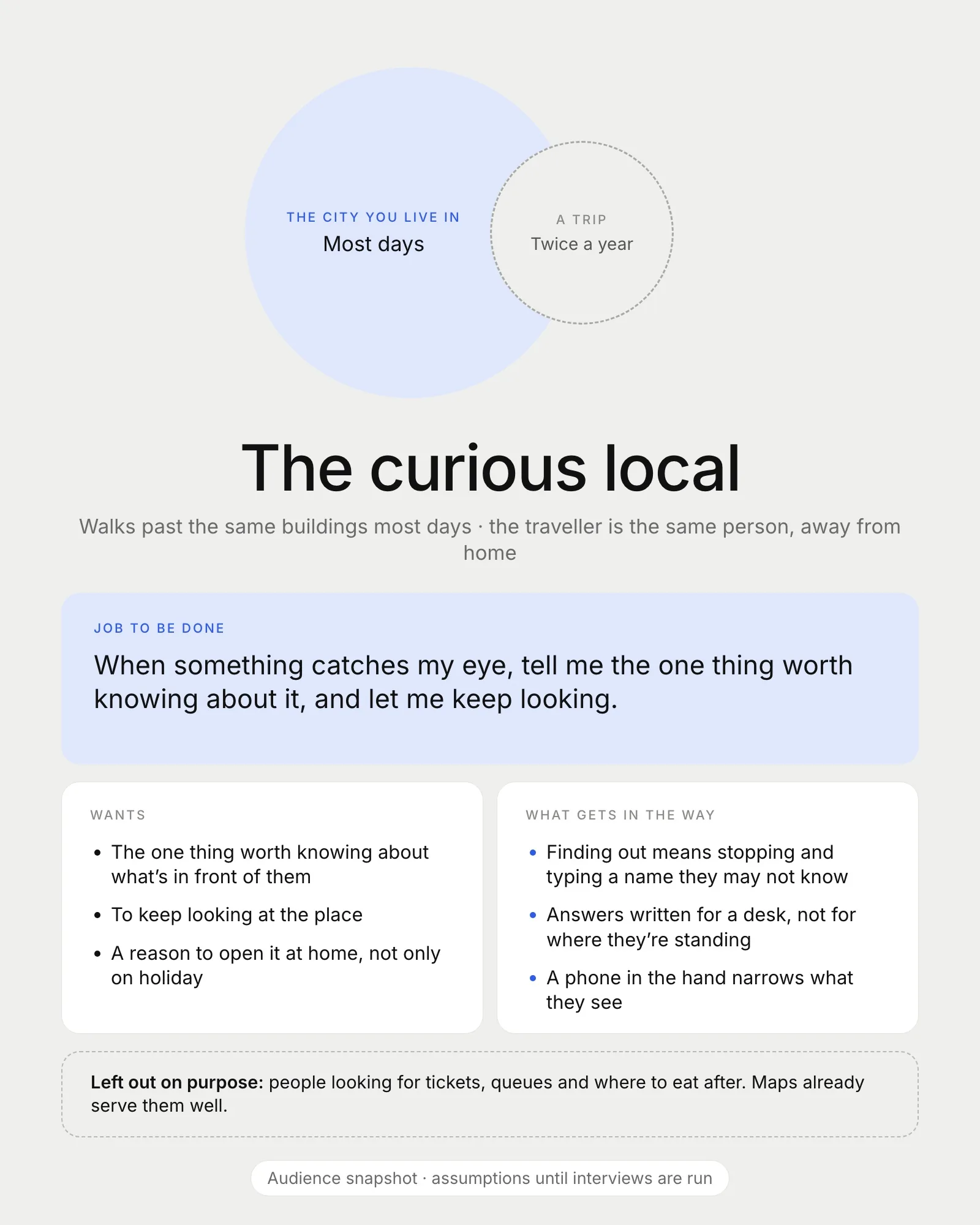
From twice a year to most days
The brief aimed at travellers, who would open the app on two trips a year. Residents in the study wondered about their own streets most days, so I widened the audience to people curious about the city they live in, with the tourist as a special case.
Job to be done: “When something catches my eye, tell me the one thing worth knowing about it, and let me keep looking.”
The measure of a good answer is that you look back up.
Four decisions that shaped the product
Markers
Questions, not labels
Considered
Naming every feature in view, like most AR demos.
Why not
Fifteen nouns over a roof is a vocabulary test. Three questions give you a reason to tap.
Scope
A curated set, not the whole world
Considered
Recognise anything and write an explanation on the spot.
Why not
A fluent wrong answer about a real place is worse than none. Layer says when it doesn't know.
Habit
Stamps, not streaks
Considered
Daily streaks and points.
Why not
A streak punishes a day off. A stamp stays collected.
Surface
Audio when you're moving
Considered
AR arrows that guide you along a walk.
Why not
That is a screen held up while crossing roads. Layer goes to the pocket instead.
05
Information architecture and flows
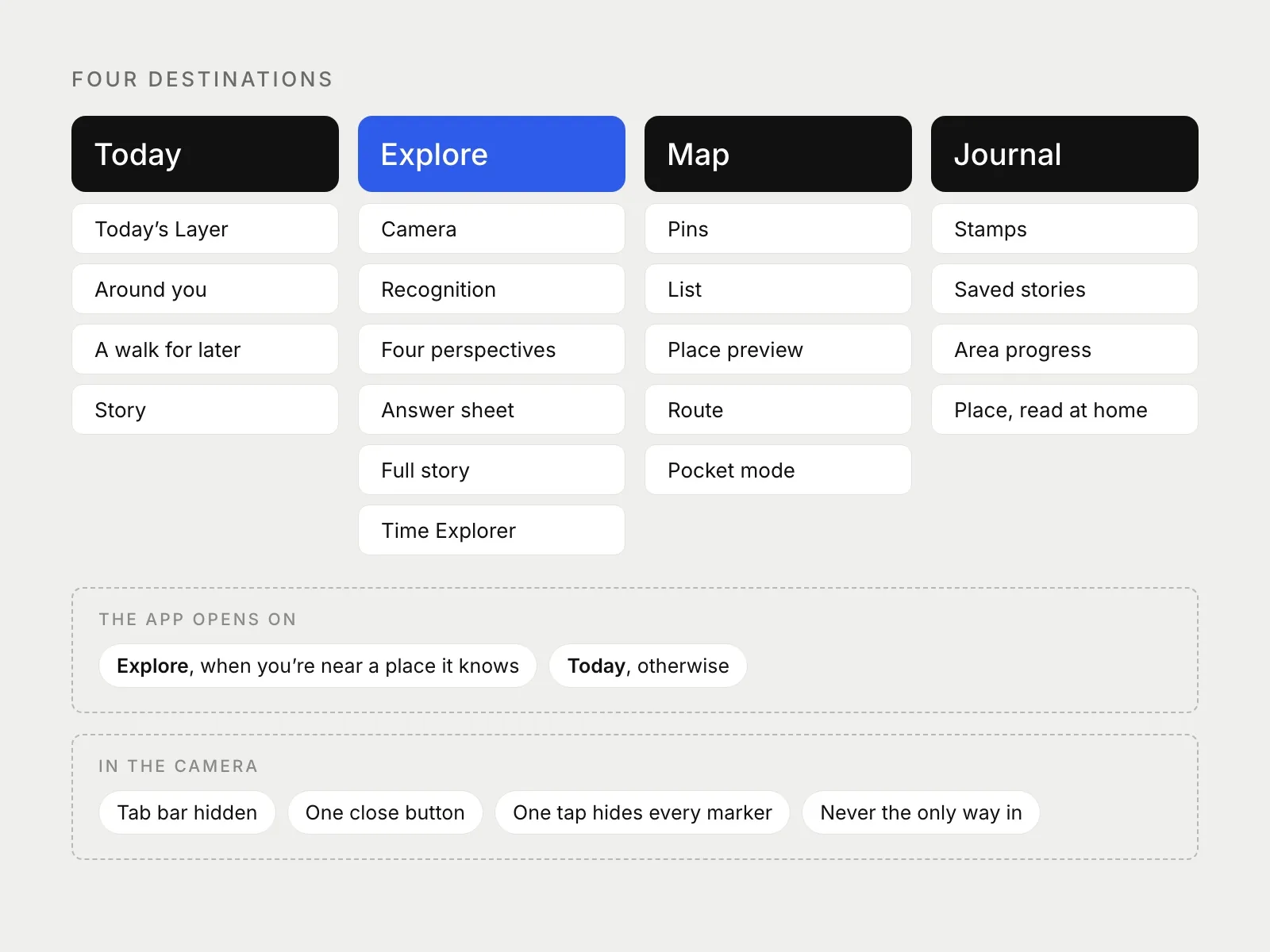
Four destinations: Today (one story a day), Explore (the camera), Map (places nearby) and Journal (stamps and saved stories).
The app opens on Explore when you're near a place it knows, and on Today otherwise. In the camera, the tab bar gives way to a single close button.
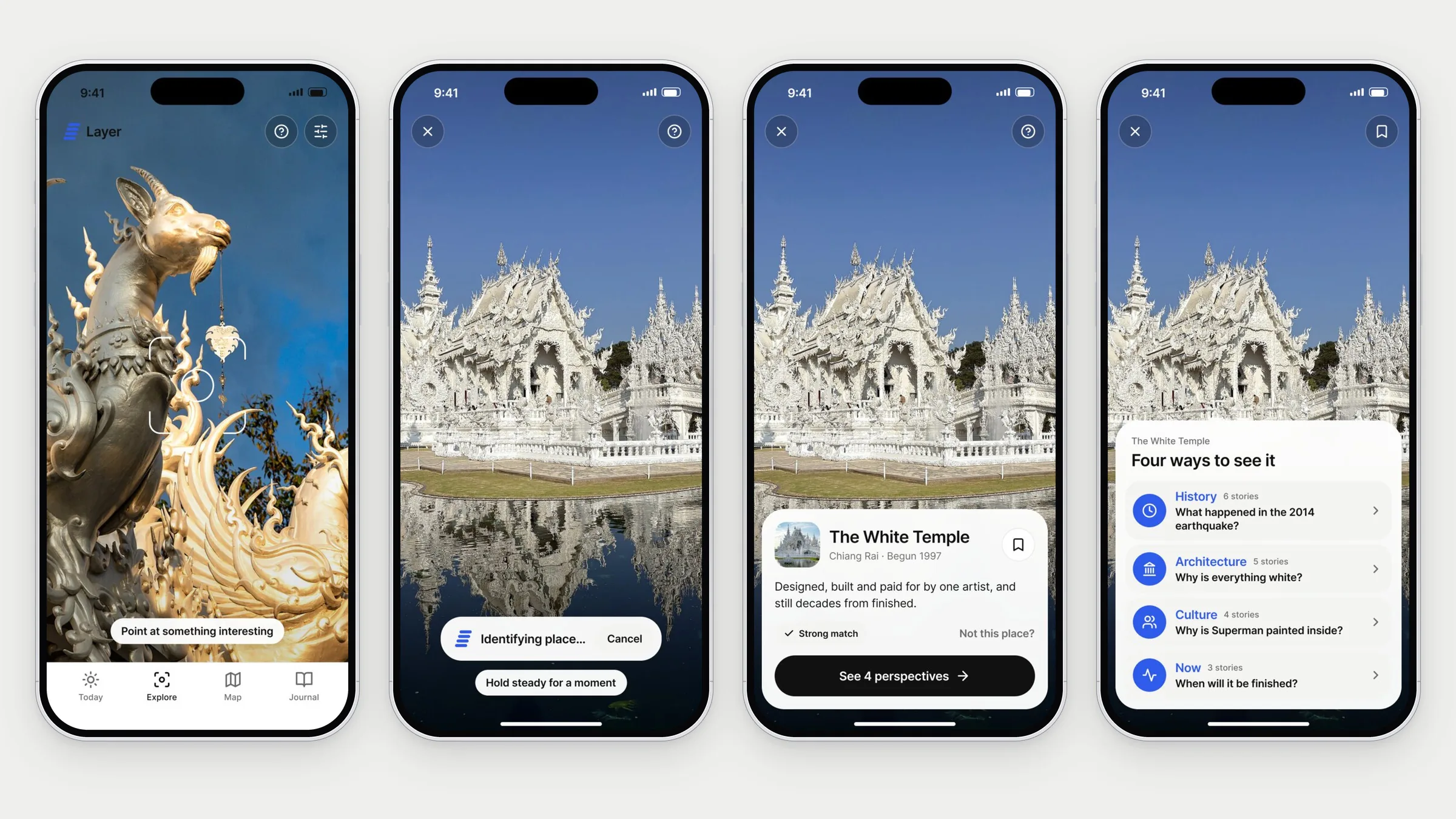
Camera, scanning, recognised, then four ways to see it.
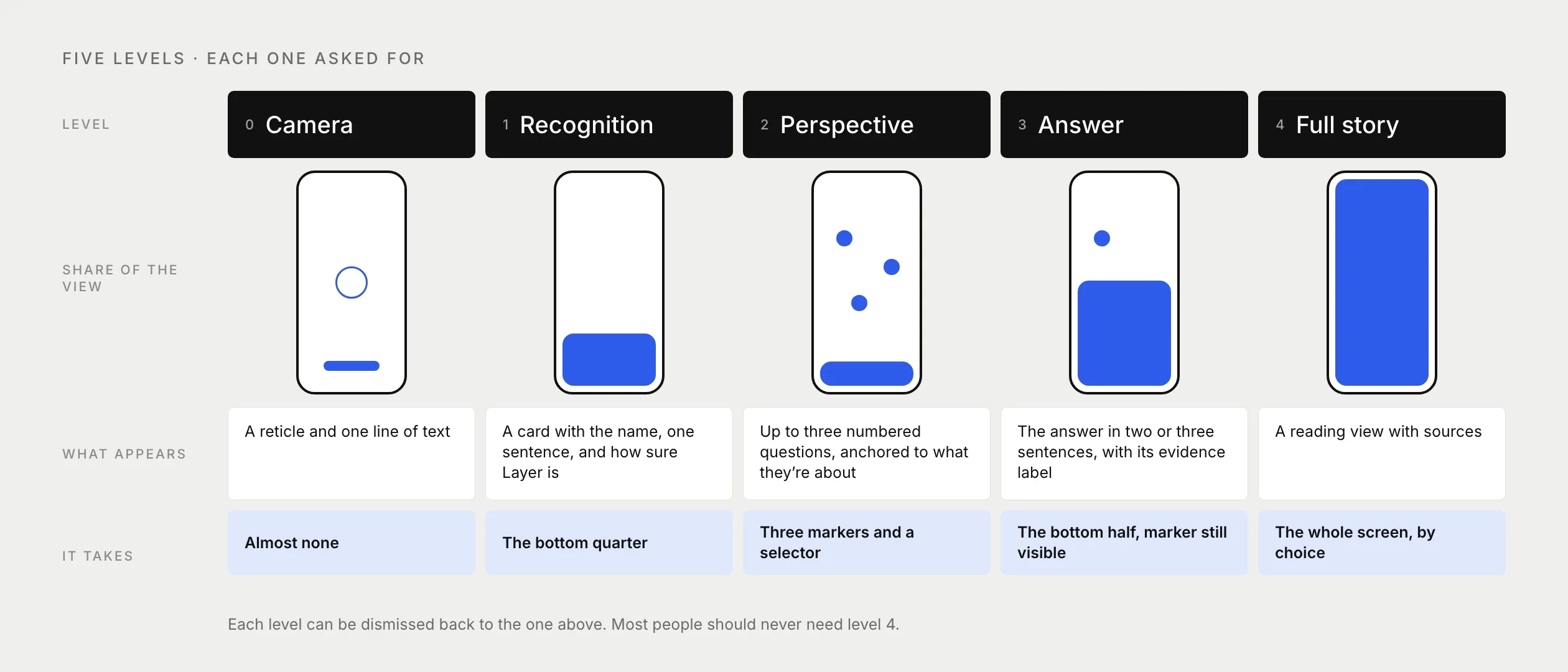
Five levels of disclosure. Each appears only when asked for.
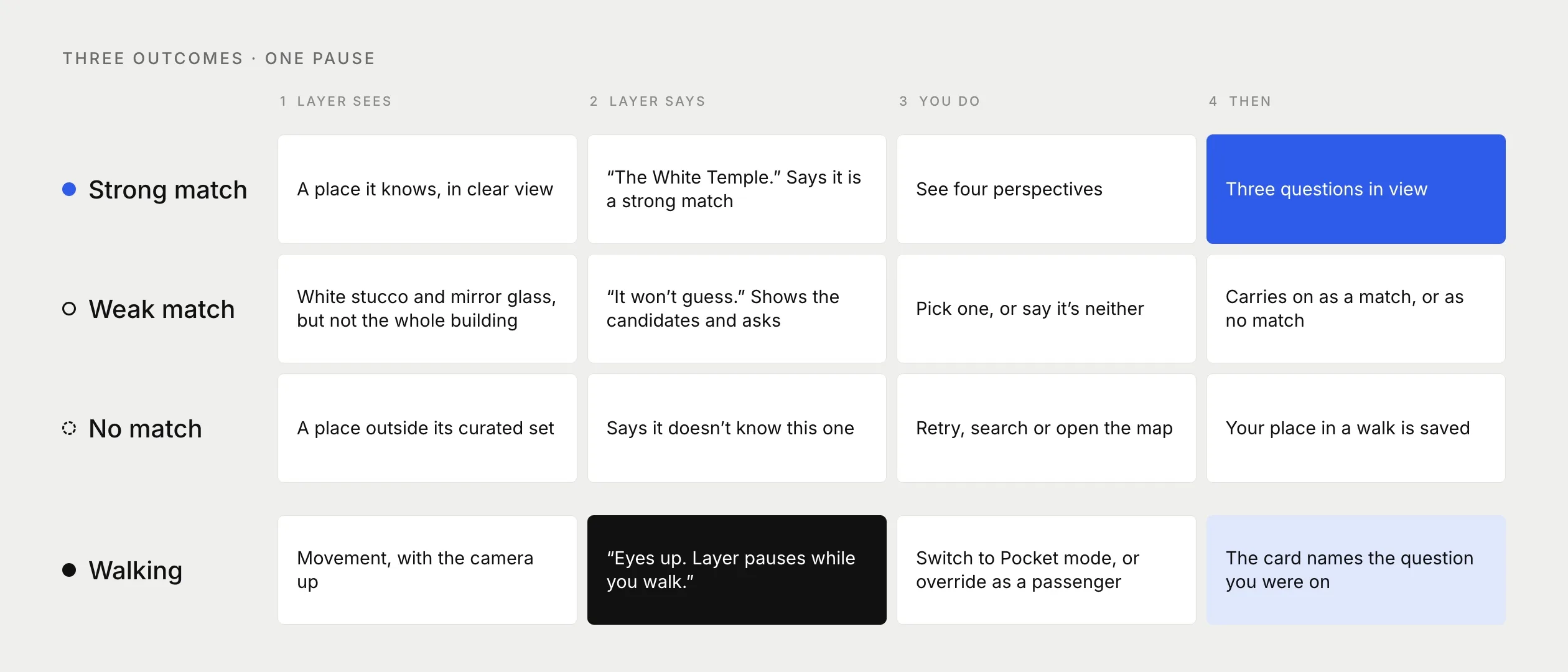
Strong match, weak match, no match, and walking.
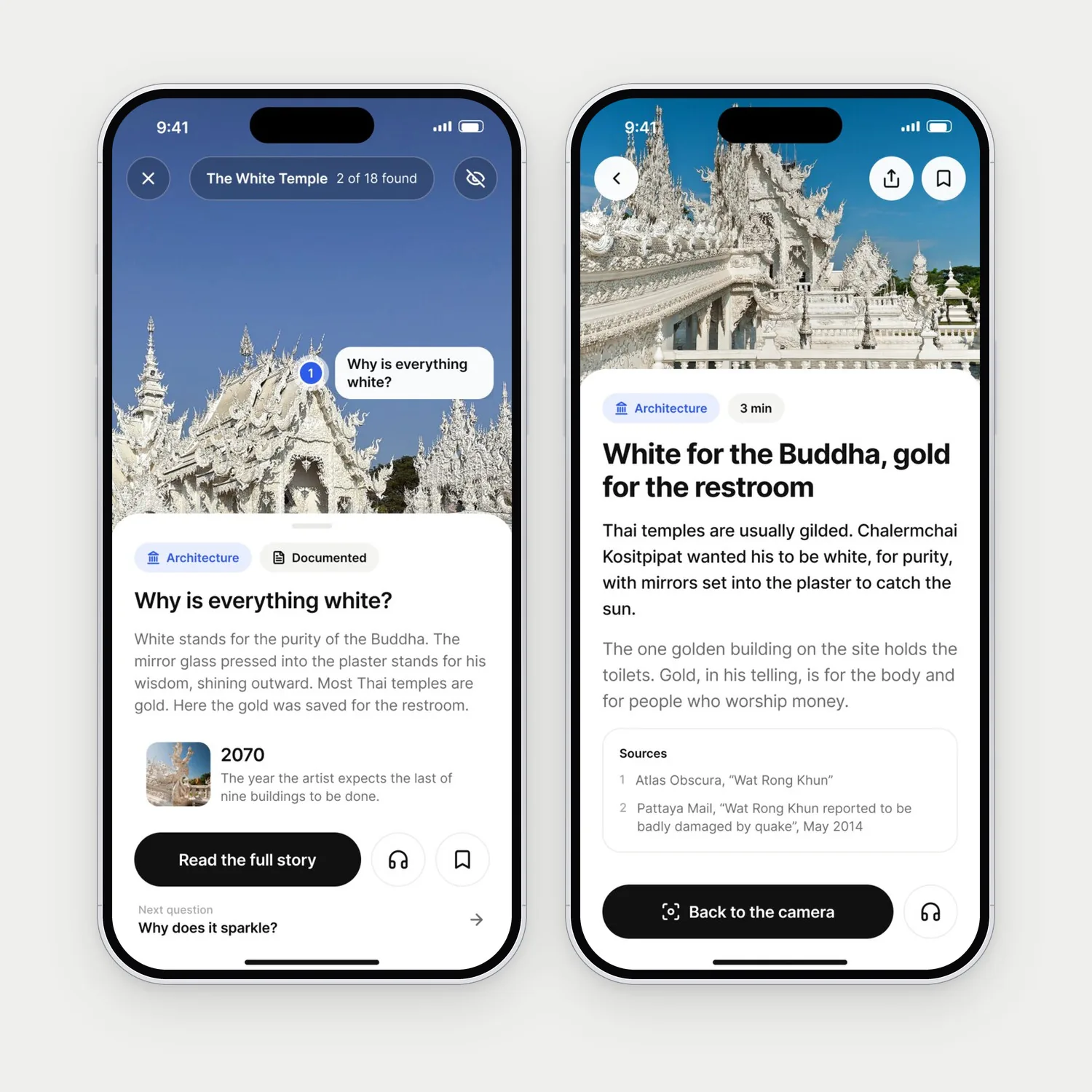
Three labels for how Layer knows something
Text placed on a real building borrows its authority, so Layer has to be clear about its own.
Label
What it means
Example in the prototype
Documented
A cited primary source or scholarship
The White Temple was begun in 1997, and nine buildings are planned
Told, not proven
A story the record doesn't settle
That the Emerald Buddha was carved in India around 43 BC
Checked, with a date
Practical facts that change
Entry is 200 baht, up from 100 in January 2026
06
Exploration and iteration
Three ways to handle the same moment: you've just stopped at the edge of the pond.
A. Information card. Accurate, but it covers half the view.
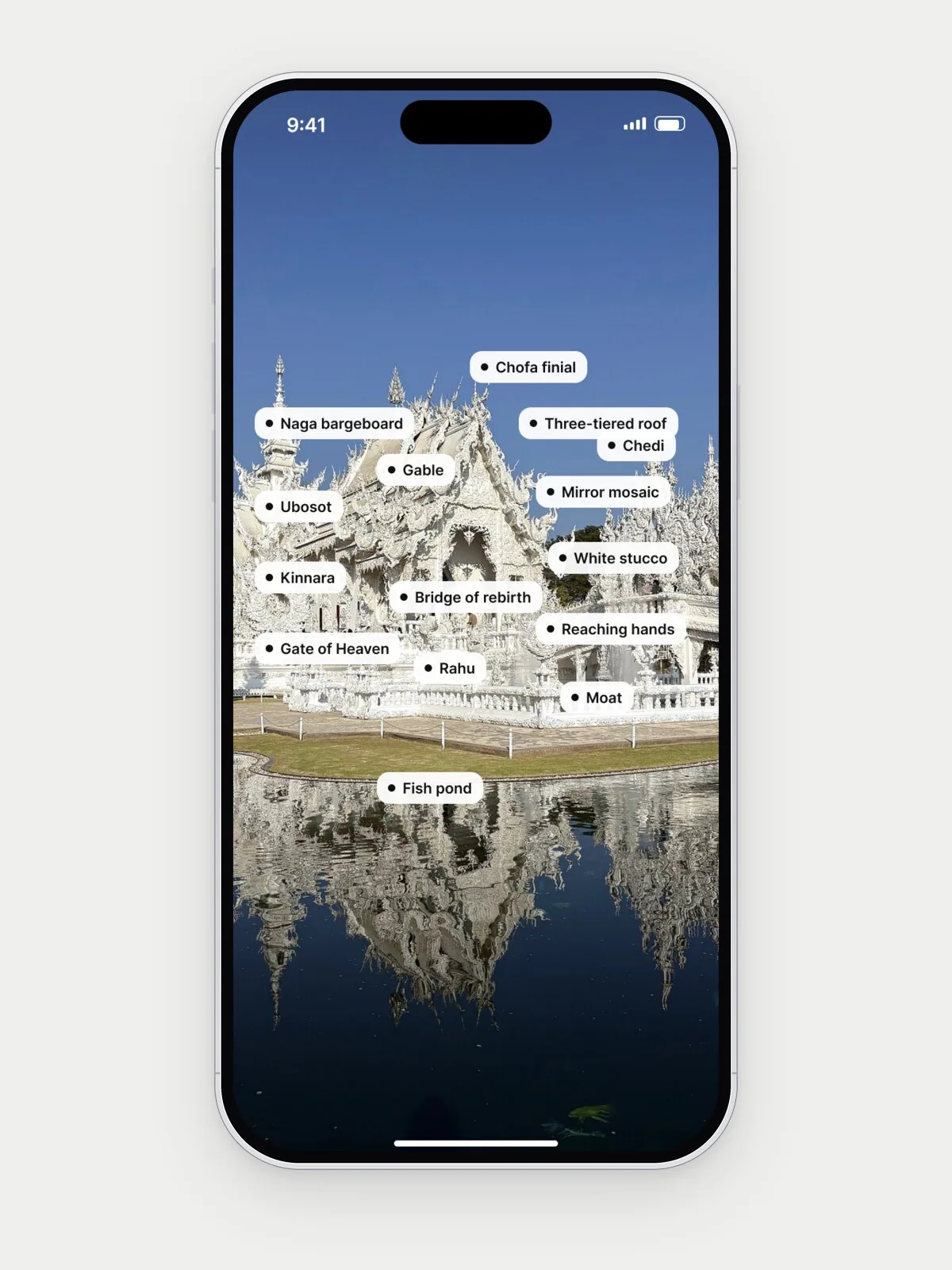
B. Label everything. Names compete with the building and explain nothing.
C. Perspective and questions. Least on screen. The one I took forward.
Writing the markers
Once markers became questions, the writing became the interface. Each had to be askable by a ten-year-old, about something visible, and answerable in three sentences.
Label version
Question version
Ubosot, white stucco
Why is everything white?
Mirror-glass mosaic
Why does it sparkle?
Damaged 5 May 2014
What happened in the 2014 earthquake?
Ubosot murals
Why is Superman painted inside?
07
The final experience
Three features carry it: questions instead of labels, short answers you can trust, and a mode that lets you put the phone away.
Explore
Three questions, four ways to see
Point the camera and Layer offers three questions about things you can see from where you stand, in History, Architecture, Culture or Now. Switching doesn't navigate: the view holds still while the questions change.
What research showed
“I know it's called Wat Rong Khun. I still don't know what I'm looking at.” 4 of 7 said or showed this, and the guide never starts with a date.
What I designed
Markers that ask, like “Why is everything white?”, never labels. Three per view, not fifteen. The place name stays pinned so a switch never reads as a new place.
What testing showed
7 of 8 could say why the temple looks the way it does, against 3 of 8 with Google Lens and search.
Answer
Three sentences, and how Layer knows
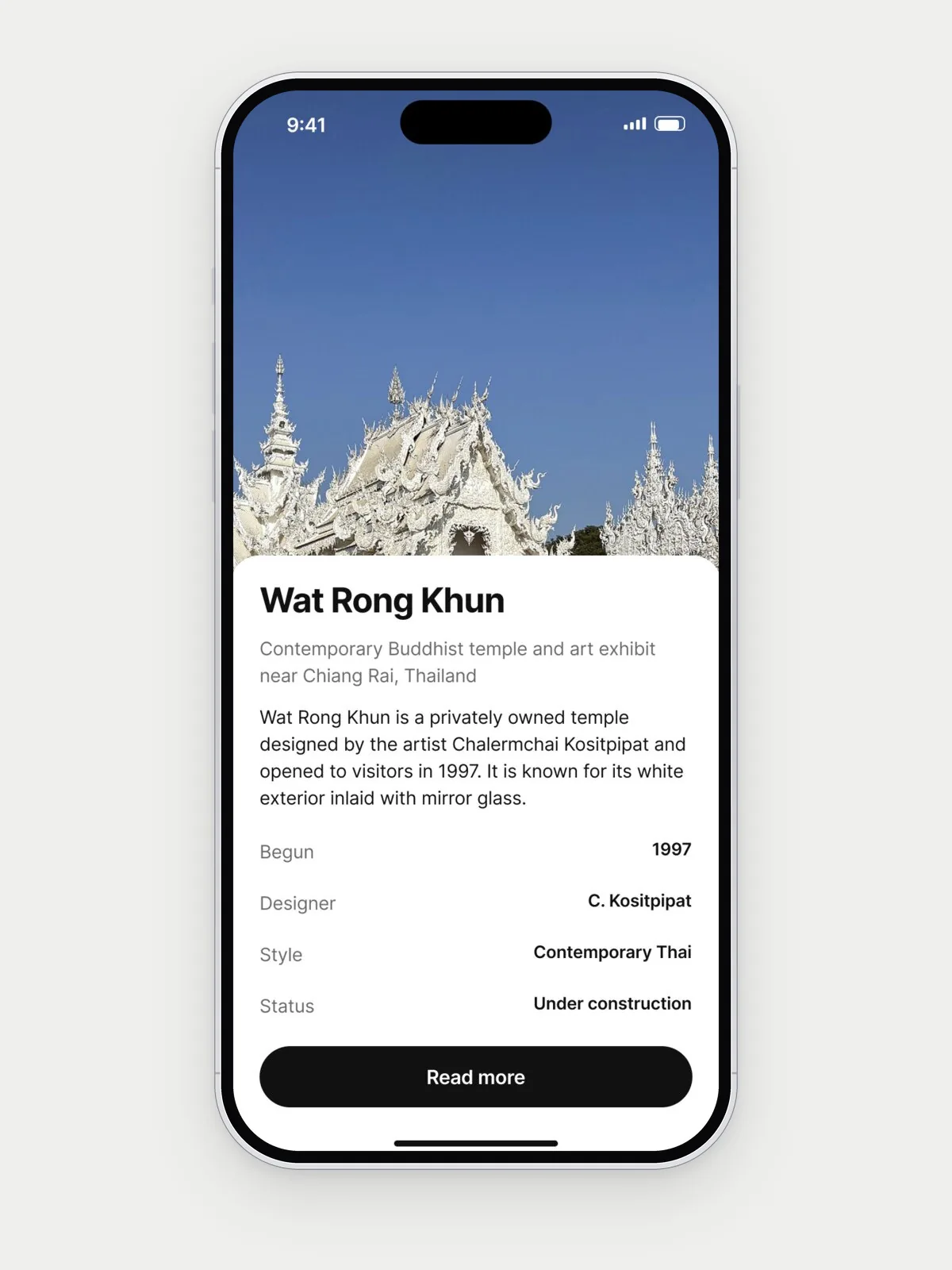
The answer sheet keeps the tapped marker in view. It leads with how Layer knows, then three sentences and one fact worth repeating. The full story lists its sources so the short answer can be trusted.
What research showed
3 of 7 gave up on a page of more than a paragraph. Trust came up with 4 of 7, after Lens matched a phone shop next to an old cinema.
What I designed
Three evidence labels: Documented, Told not proven, and Checked with a date. A weak match asks instead of guessing: “It won't guess.”
What testing showed
6 of 8 could say where a fact came from, against 2 of 8. Moving the label to the top of the answer took noticing it to 5 of 5.
Pocket
The best mode has no AR in it
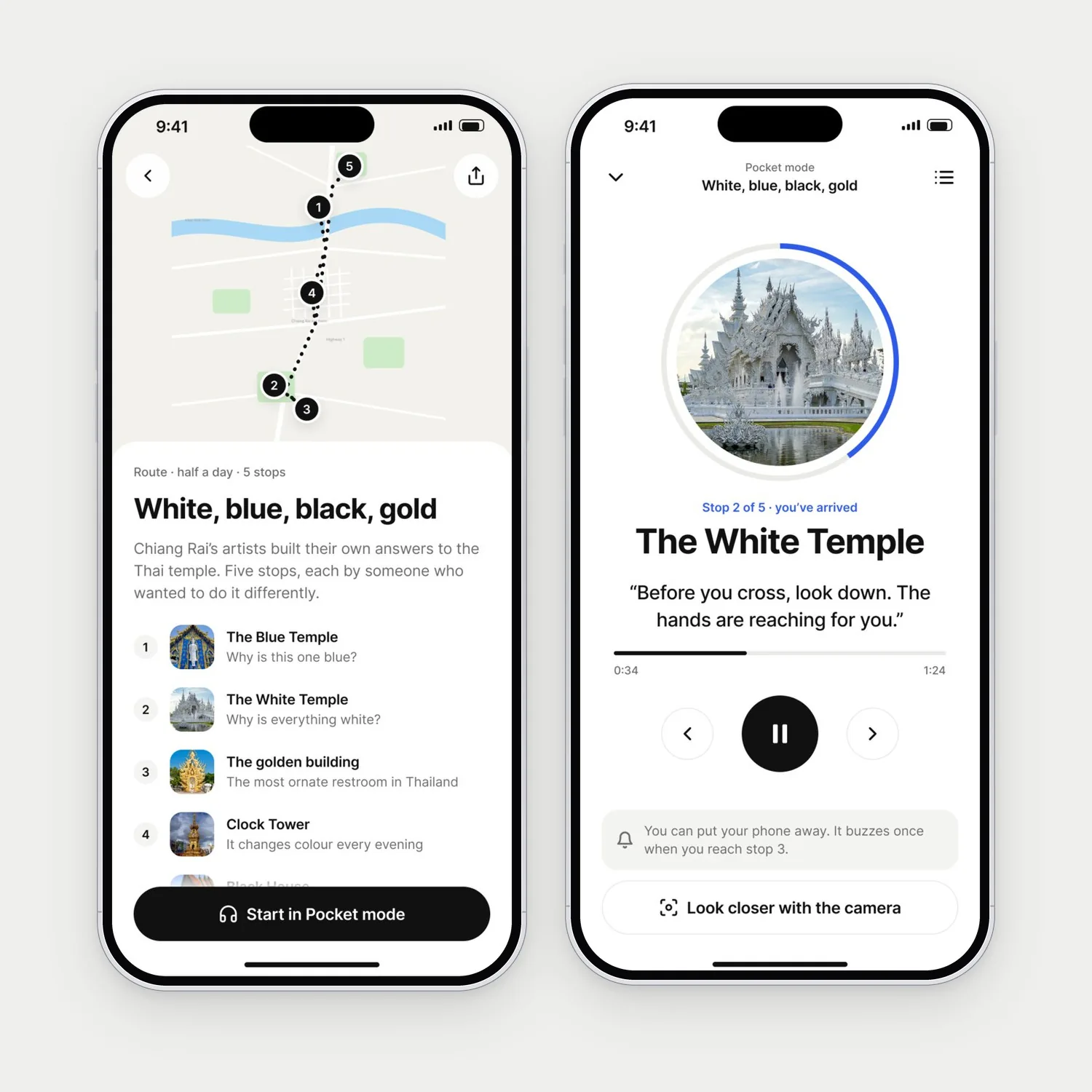
A route links five places around one idea. You put the phone away, it buzzes at each stop, and a voice tells you what's there. With the camera up while walking, Layer pauses: “Eyes up.”
What research showed
6 of 7 lost the view or the path to the screen. One visitor walked 30 metres reading and hit a railing.
What I designed
Audio when you move, written for listeners as much as walkers: each cue says what is there before where to look, so it works without sight.
What testing showed
22 sec median time on the screen per stop, down from 74 with search. The low-vision participant finished the route unaided.
Also in the product
Onboarding that shows the questions before it asks for the camera.
Time Explorer: dated photographs on a track, with a dashed gap before 2014 because earlier views aren't verified.
Today: one story a day, readable in a minute.
A journal of stamps that never expire. No streak, no score.
Everything works with the camera denied: map, list, journal and stories.
Accessibility settings with a live preview.
08
Validation and outcomes
I ran a within-subjects test on site at the White Temple and the clock tower. The same 8 people used Google Lens and search, the thing they use today, and a Layer prototype, half in each order. Tasks covered naming, understanding, sources and recall 10 minutes later. I measured SEQ ease (1–7), unaided completion, and time looking at the screen, coded from chest-camera video.
Mean ease 3.6 with Lens and search, 5.9 with Layer (p = 0.016).
Task
Lens + search
Layer
What I saw
Name the building in front of you
8 / 8
7 / 8
Lens was faster. Layer's one miss was a weak match at an angle.
Say why it looks the way it does
3 / 8
7 / 8
With Lens, most stopped at the name or a long page.
Say where one fact comes from
2 / 8
6 / 8
Two missed the evidence label in round one.
Recall one thing you learned, 10 minutes later
3 / 8
6 / 8
Recall with Layer was mostly the question, then the answer.
Median time on the screen per stop fell from 74 seconds with search to 22 with Layer. Ease rose for 7 of 8. The daily Lens user rated both a 6.
Iteration
The evidence label was missed by 2 of 8 → moved it from a corner chip to the first words of the answer → noticed by 5 of 5 in the RITE round.
3 of 8 thought switching perspective meant a new place → pinned the place name above the selector and kept the camera still → 5 of 5 described the switch correctly.
Pocket said “look down”, which assumes sight → every cue now says what is there before where to look → the low-vision participant finished the route unaided.
Still open: naming is slower than Lens and always will be. The pause card annoyed one passenger on a bus. And the content takes days of editorial work per place.
09
Reflection and next steps
What participants taught me
Naming is not the job. A daily Lens user beat Layer at it, then closed the app. Recall, not recognition, is where Layer earns its place.
The best mode has no screen. A low-vision participant called audio guides “the only time I get the same tour as everyone else”. Pocket mode had to be written for them, not only for walkers.
A question is the hook. People remembered the question first and the answer second, just as the guide said they would.
Showing a gap builds trust. Nobody asked for the missing pre-2014 photos. Two said the gap made them believe the rest.
What's next
One real landmark. Test anchored markers on white-on-white ornament, in crowds and hard sun.
The cost of content. Twenty-four places is a newsroom. It needs a partner such as a tourism board, and stories that stay unsponsored.
Local knowledge. Residents know things no archive does. Bringing them in needs a fourth kind of evidence label.
Sources
11
Google Lens usage, reported in “Google expands visual and audio search,” The Register, October 2024. Coverage
Smith, J. K. & Smith, L. F. “Spending Time on Art.” Empirical Studies of the Arts, 2001. Link
Smith, L. F., Smith, J. K. & Tinio, P. P. L. “Time Spent Viewing Art and Reading Labels.” Psychology of Aesthetics, Creativity, and the Arts, 2017. Link
Hyman, I. E. et al. “Did You See the Unicycling Clown? Inattentional Blindness While Walking and Talking on a Cell Phone.” Applied Cognitive Psychology, 2010. Link
Ayers, J. W. et al. “Pokémon GO: A New Distraction for Drivers and Pedestrians.” JAMA Internal Medicine, 2016. Link
Loewenstein, G. “The Psychology of Curiosity: A Review and Reinterpretation.” Psychological Bulletin, 1994. Link
Tilden, F. Interpreting Our Heritage. University of North Carolina Press, 1957.