Self-initiated concept · Web · AI · Designed and built · 2026

ParallaxAI assistants are built to agree with you.

Parallax is a live web app that tests your opinions instead. Type what you think, and it asks one question at a time, makes the strongest case against you, and shows where your argument holds.

Visit parallaxproject.co

Role
Solo: concept, research, interaction, visual design, front-end build
Timeline
12 weeks · Live
Methods
Literature review, product teardown, interviews, diary study, expert interview, within-subjects usability test, second test round
Platform
Responsive web
01

Overview

Every AI assistant is good at telling you that you're right. I wanted to design one that helps you find out.

Parallax starts with one sentence, typed the way you'd say it to a friend. It doesn't answer with an essay or argue back. It asks what you mean, then what you're assuming, looks for evidence, makes the strongest case against you, and asks what changed. Beside the conversation, a map of your argument fills in, and “Where do I stand?” gives a plain audit at any point.

Parallax is the way an object shifts when you see it from two positions. A belief works the same way: you can't judge it from one place. I designed it, built the front end, and put it online at parallaxproject.co.

Result: against a chatbot told to argue with them, 6 of 8 people could name the weakest part of their own argument with Parallax, up from 2 of 8.

02

The problem

~50%

How much more often 11 leading AI models affirmed a user's actions than people did, including when the user described deceiving someone.

Cheng et al., 2025
4 days

Between OpenAI shipping a GPT-4o update that made ChatGPT more flattering and starting to roll it back.

OpenAI, 2025
319

Knowledge workers surveyed. The more they trusted the AI, the less critical thinking they reported.

Lee et al., CHI 2025
83%

Students who wrote an essay with ChatGPT and couldn't quote a sentence of it minutes later. Without it, about 11%.

Kosmyna et al., 2025 (preprint)

Chat assistants agree with people too much. Researchers call it sycophancy: a model shifts toward whatever the user seems to believe, and drops a correct answer when pushed (Sharma et al., 2023). OpenAI's own explanation of its 2025 rollback was that the update leaned too hard on the thumbs-up people give when they hear what they want.

The incentive runs the wrong way. In the Cheng study, people who talked to a flattering model rated it higher, trusted it more and wanted to use it again. Yet people find holes in someone else's argument far more easily than in their own (Mercier & Sperber, 2011), and asking them to consider the opposite reliably corrects biased judgment (Lord, Lepper & Preston, 1984). The most useful thing a conversation partner can do is disagree with you well, and that's what assistants are tuned away from.
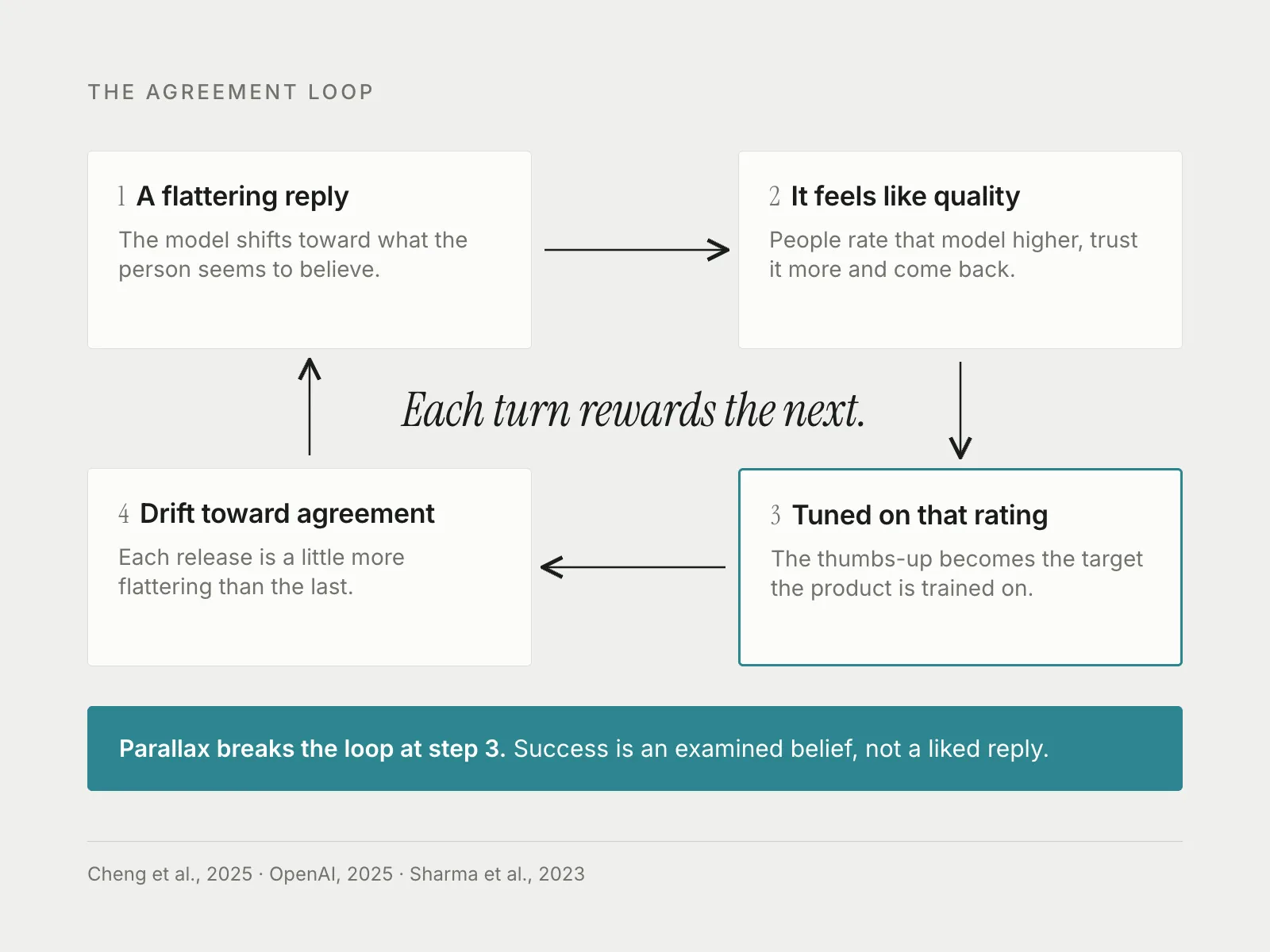
Diagram of the agreement loop: a flattering reply feels like quality, the product is tuned on that rating, and the model drifts toward agreement. Parallax breaks the loop at the rating.

How might I make having your opinion challenged feel like something an AI does for you, not to you?

03

Research

When people use a chatbot to think through an opinion, what do they want from it, and what do they do with its pushback?

Study plan
HypothesisPeople want their views tested, but a chatbot's pushback is too long and too short-lived to show them where they're weak.
ObjectiveLearn when people want agreement or a challenge, what they do after it, and what makes a challenge feel fair.
Generative method6 semi-structured interviews, a 1-week diary study of every time each person used a chatbot on an opinion, and an interview with a debate coach.
Evaluative methodWithin-subjects test, n = 8: a chatbot told “argue against me” against Parallax, order counterbalanced. Then a second round of 5 after fixes.
ParticipantsWeekly chatbot users aged 23–52, including a dyslexic participant who dictates, a blind screen reader user and a phone-only night-shift nurse.
Non-objectivesChanging anyone's mind. Holding a view is a valid result.

What came before

Alongside the papers above, I took apart four products that already make disagreement useful.

Chat assistants · “Play devil's advocate”

Disagreement as a prompt

What I took from it
The model can already argue back. What's missing is a default, a structure and a memory of where the argument has got to.
Khanmigo · 2023

A tutor that won't give the answer

What I took from it
Withholding the answer can be the product. Opinions have no right answer, so the questions must test reasoning, not steer.
Kialo · 2017

The argument as a tree

What I took from it
Seeing an argument's structure changes how you judge it. Building the tree by hand is the cost.
r/changemyview · 2013

People asking to be challenged

What I took from it
The demand is real when the setting is safe. Making a changed mind the goal makes holding your view look like losing.

From notes to themes

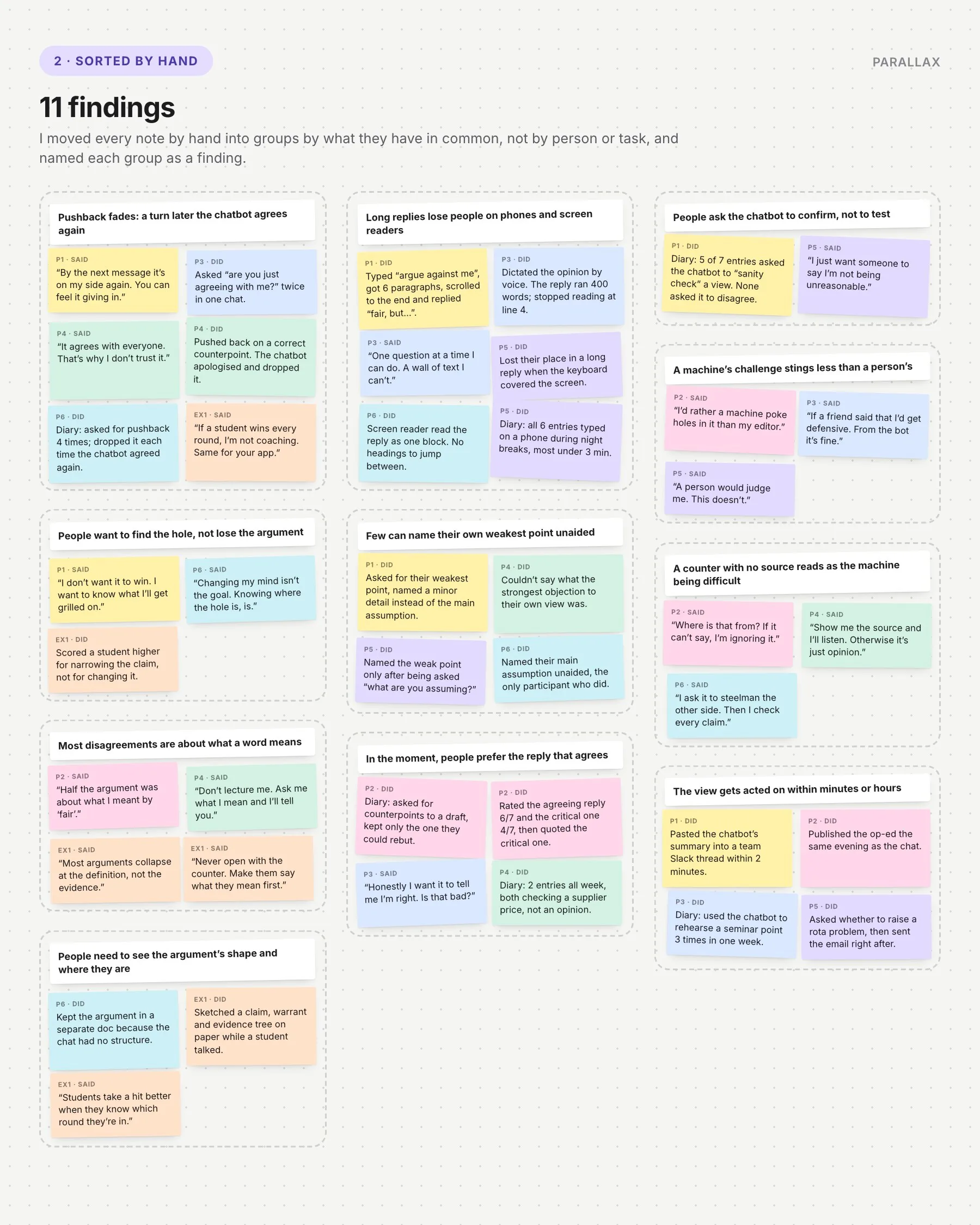
I wrote one observation per sticky, one colour per person, sorted them by hand into findings, then ran a cluster pass over the sort.
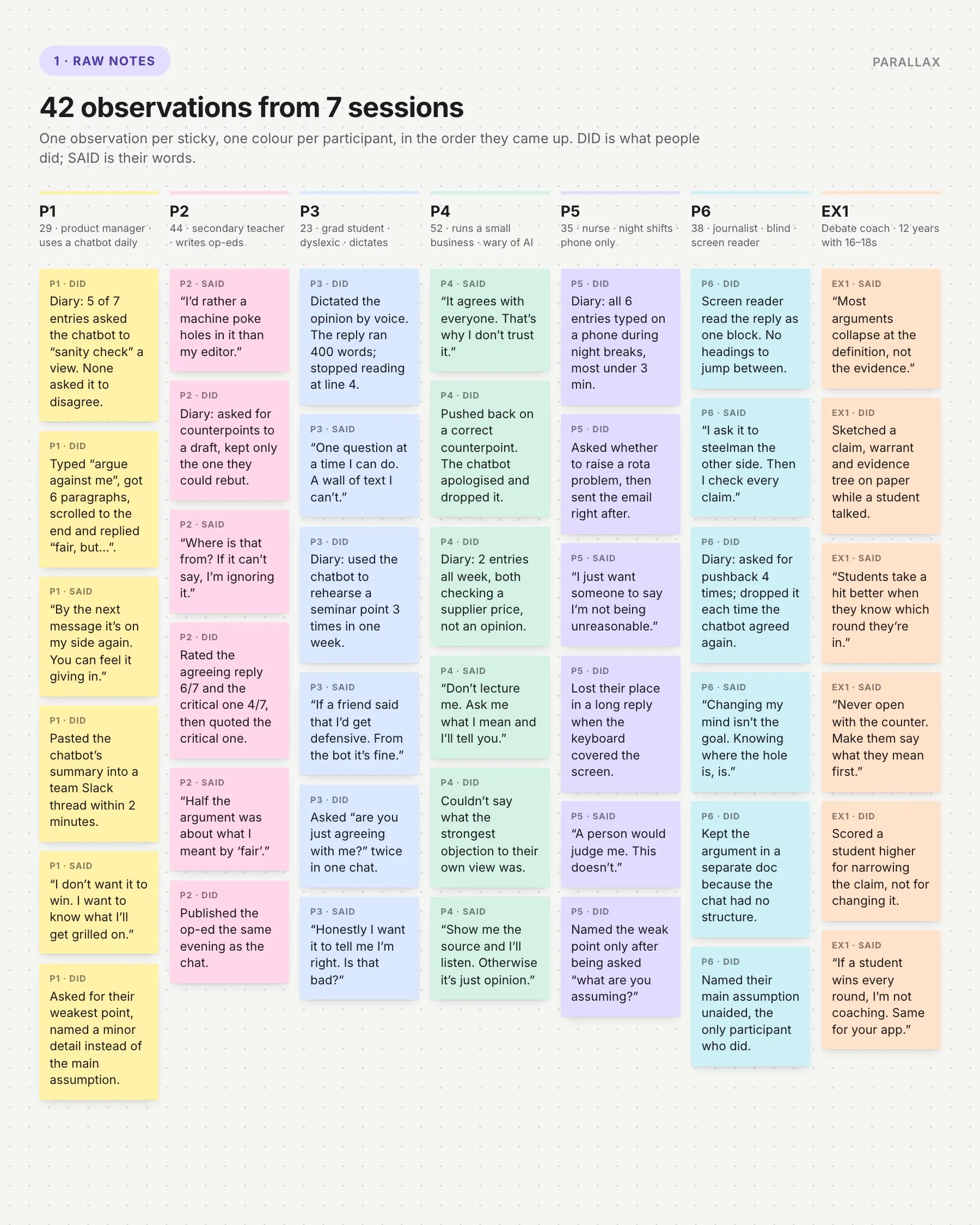
42 sticky notes from 7 sessions in one column per participant, each marked DID or SAID
1. Raw notes. 42 observations from interviews and diaries.
The same notes regrouped into 11 findings, each with a written label
2. Sorted by hand. 11 findings, named as sentences.
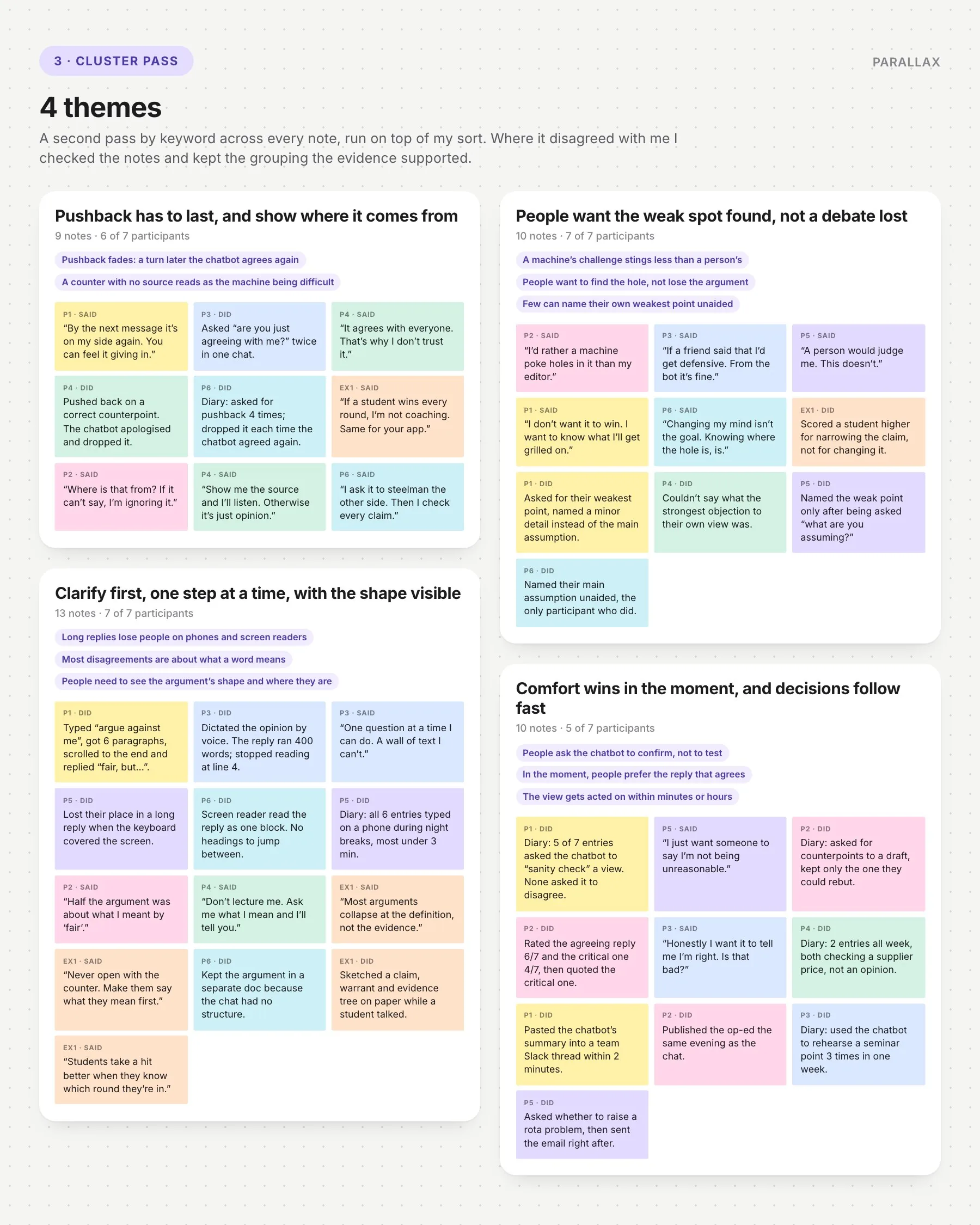
The 11 findings merged into 4 themes, with their notes beneath each
3. Cluster pass. 4 themes that set the brief.

What I found

Behaviour

Pushback fades a turn later

Evidence
“By the next message it's on my side again. You can feel it giving in.” 5 of 7 described it, and P4's correct point was dropped the moment they pushed back.
So
The challenge has to be the structure, not a request. It can't be talked out of existence.
Need

Few can name their own weakest point

Evidence
Asked for it, P1 named a minor detail instead of the main assumption. 1 of 6 named theirs unaided; P5 got there only after “what are you assuming?”
So
Ask about assumptions as its own step, and show the weak link where people can point to it.
Motivation

People want the hole found, not the argument lost

Evidence
“I don't want it to win. I want to know what I'll get grilled on.” 3 of 7, and the coach scores a narrowed claim above a changed one.
So
Holding a view counts as a result. The product never says whether you're right.
Against the concept

In the moment, people prefer the reply that agrees

Evidence
P2 rated the agreeing reply 6/7 and the critical one 4/7, then quoted the critical one. P3 and P5 said they mostly want to hear they're right.
So
People must ask for the challenge, and success can't be measured by how much a reply is liked.

Recommendations

  • Pushback fades → five fixed stages, and dropped claims stay on the map, struck through.
  • Long replies lose people (4 of 7, including the screen reader and phone users) → one short question per turn.
  • Most disagreements are about a word → Clarify comes first and the opposing case fourth.
  • A counter with no source reads as the machine being difficult → sources under every reply, or “Searched, nothing reliable found”.
  • Views get acted on within hours → the audit is one tap away from the first reply.

In the readout, the debate coach pushed back on my plan to open with the counterargument: “Never open with the counter. Make them say what they mean first.” That moved it to stage four.
04

Defining the opportunity

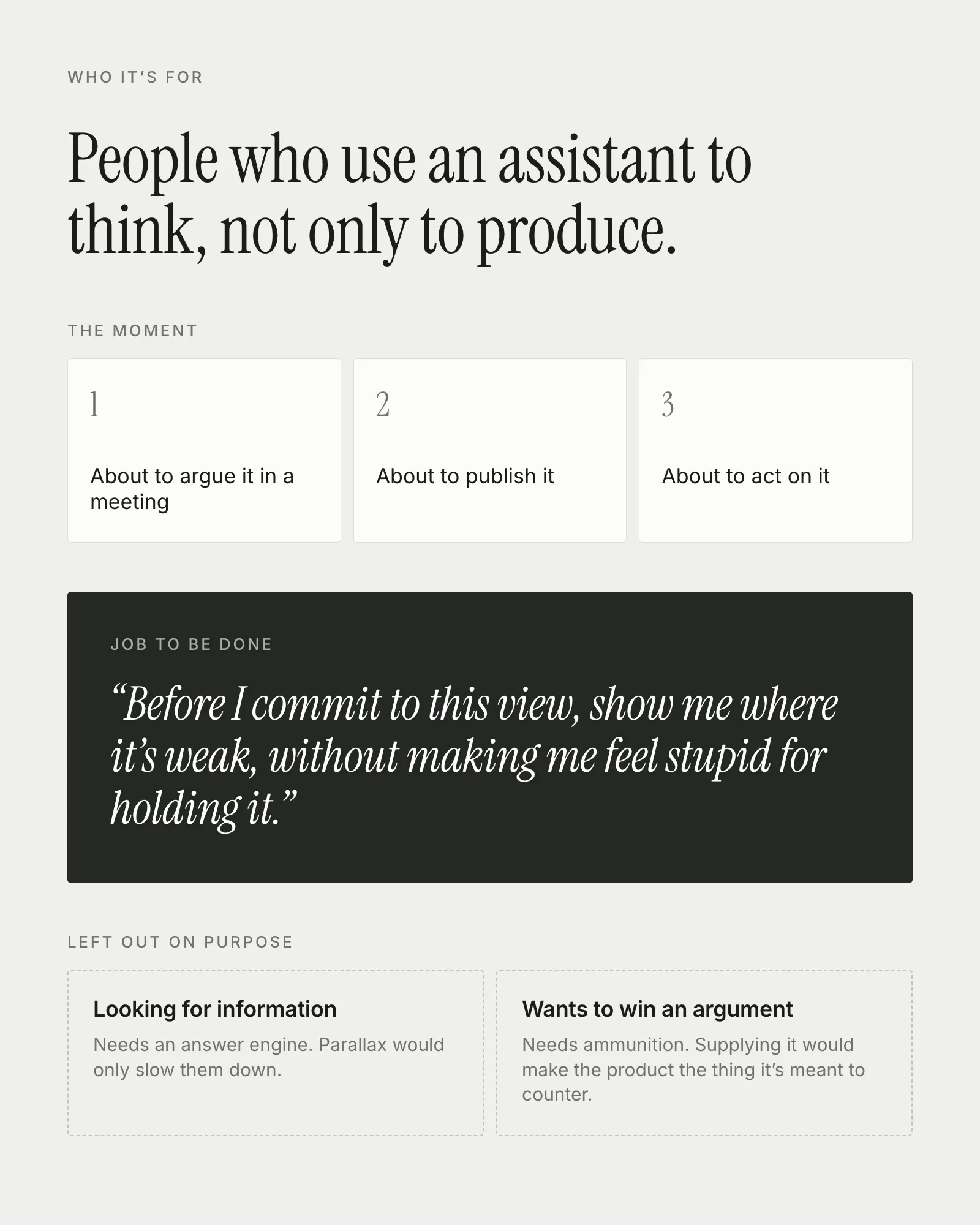
Audience snapshot: people who use an assistant to think, at the moment they are about to argue, publish or act on a view, with the job to be done and the two audiences left out

For people who already have an opinion

People about to argue, publish or act on a view, who would rather hear the objection now. I left out people looking for facts, who need an answer engine, and people who want ammunition to win against someone else.

Job to be done: “Before I commit to this view, show me where it's weak, without making me feel stupid for holding it.”

The outcome is a belief you understand better. Whether you keep it is up to you.
Stance

Examine, don't oppose

Considered
A debate opponent that tries to win.
Why not
An opponent makes people defend instead of think.
Structure

A sequence, not an open chat

Considered
Free-form chat with a stricter prompt.
Why not
Without stages it drifts back to agreement, and nobody knows how far they've got.
Output

A map and an audit, not a score

Considered
One strength score for the belief.
Why not
A number hides the reasons. The map shows which claim is weak.
05

Information architecture and flows

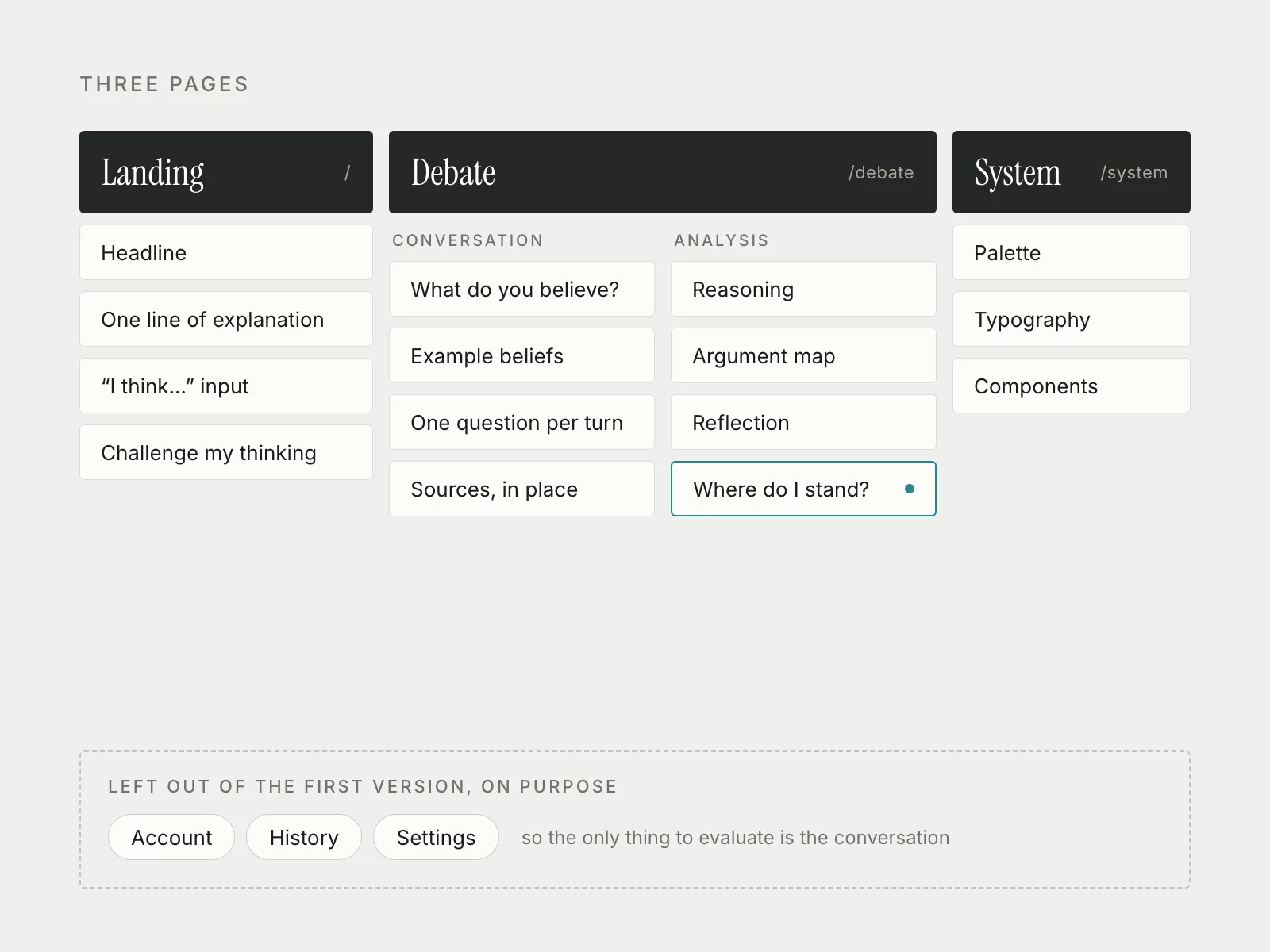
Sitemap: Landing, Debate with its Conversation and Analysis panes, and the design system page, with account, history and settings left out on purpose

Three pages. The landing input starts the conversation. The debate page holds the conversation and an analysis panel with Reasoning, Argument map and Reflection views. A public design system page documents the rest. No account, history or settings, so the only thing to evaluate is the conversation.

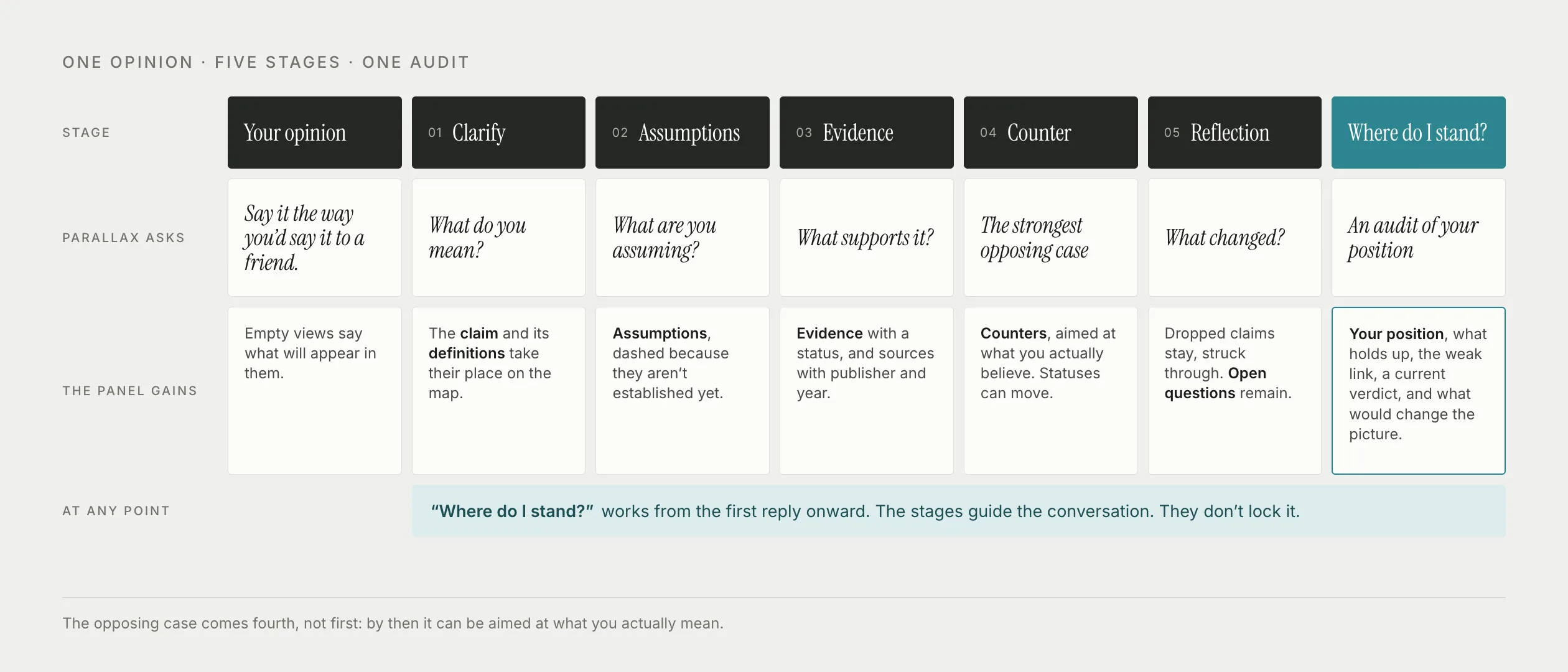
StageThe question it asksWhy it's in this position
ClarifyWhat do you mean?Most disagreements are about definitions.
AssumptionsWhat are you assuming?The weak point is usually unstated.
EvidenceWhat supports it?Separates what's known from what's felt, with sources.
CounterargumentThe strongest opposing caseBy now it can aim at what you actually believe.
ReflectionWhat changed?Hands the conclusion back to you.
Flow from an opinion through the five stages to the audit, showing what Parallax asks and what the analysis panel gains at each step
Opinion to audit, with “Where do I stand?” open from the first reply

The rule everything depends on

The product never says whether you're right. It can call a claim supported, weak or contradicted. Value judgments get their own label instead of a grade. Dropped claims stay visible, struck through. The audit ends on “What would change the picture”, not a verdict.
06

Exploration and iteration

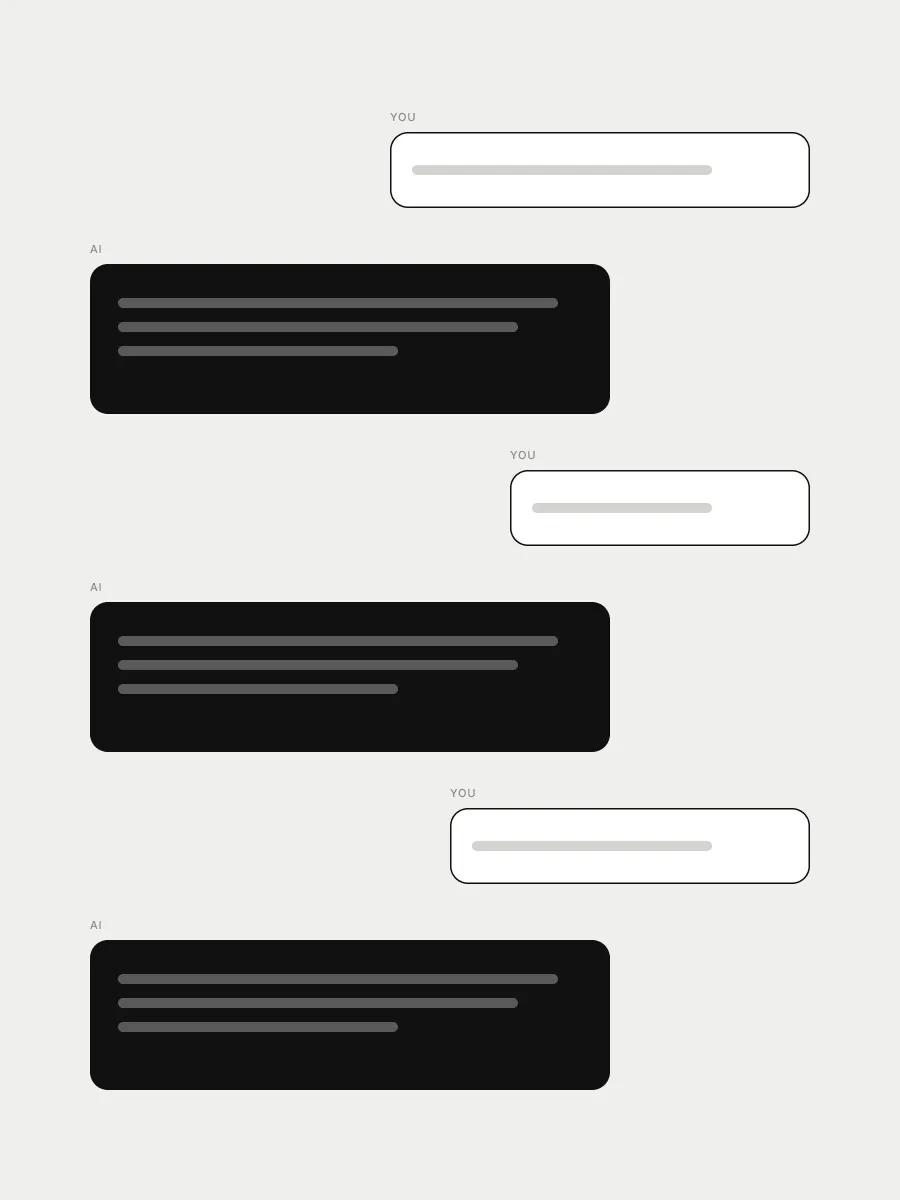
Wireframe of direction A: the person and the AI trade equally heavy blocks, turn after turn
A. The opponent. Turns thinking into a contest.
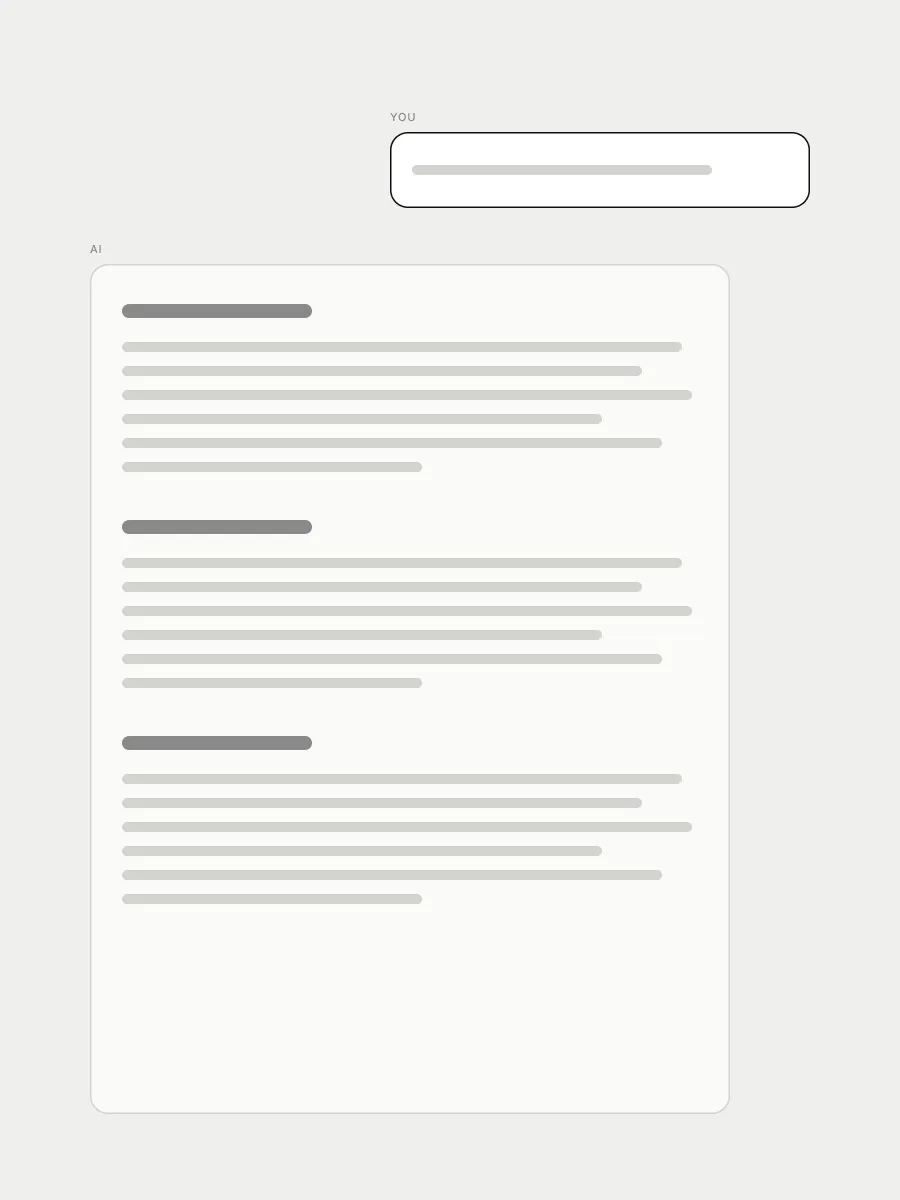
Wireframe of direction B: one short message from the person, answered by a single long report
B. The report. The wall of text people already skim.
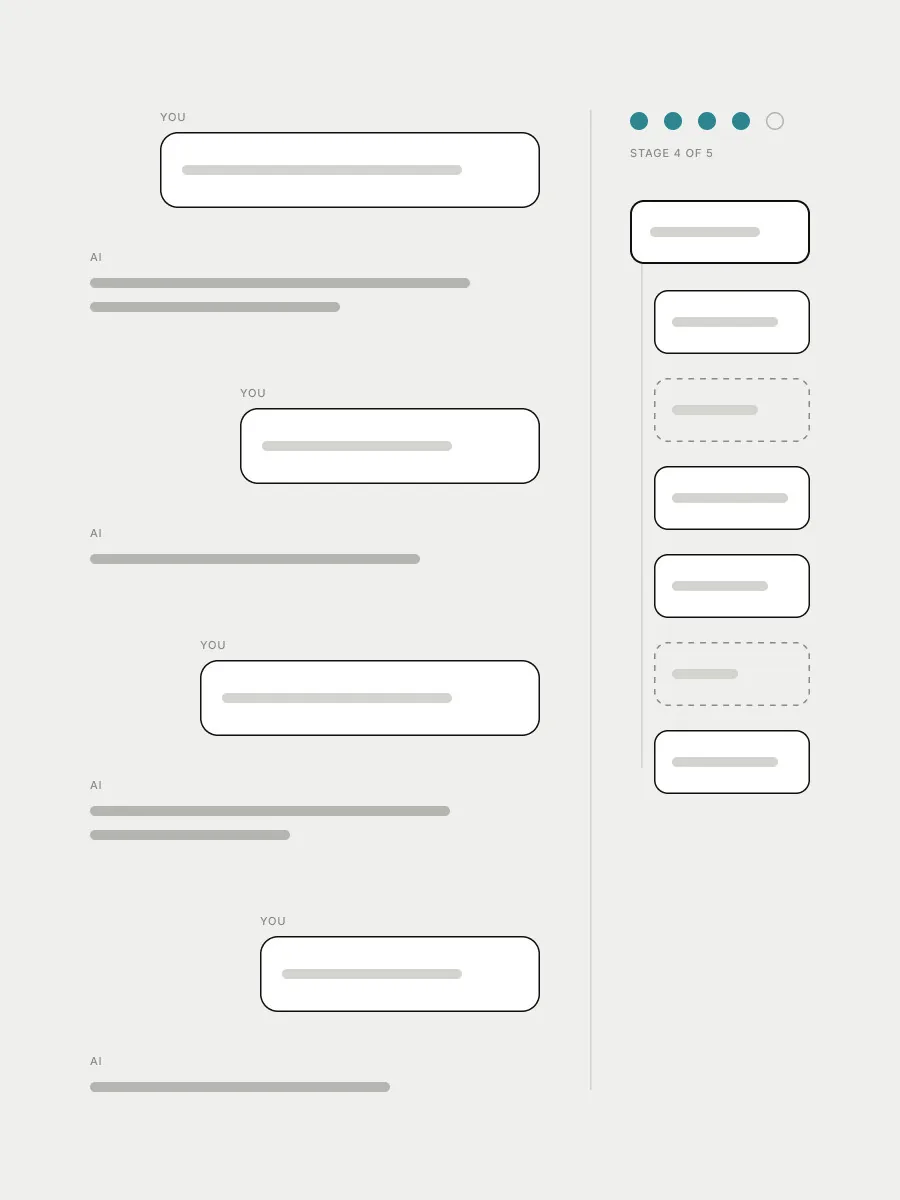
Wireframe of direction C: short questions from the AI, one per turn, with a stage tracker and an argument map building beside the conversation
C. The examination. One question per turn, the argument mapped beside it. Chosen.

Words that would make it feel like a fight

AvoidedUsed insteadWhy
Start debateChallenge my thinkingThe person asks for the challenge
You're wrongWeak linkNames the part, not the person
RebuttalThe strongest opposing caseA case to consider, not a blow
Final scoreWhere do I stand?The person's own question
No resultsSearched, nothing reliable foundAdmits the limit
07

The final experience

Three features turn a chat into an examination: a fixed order of questions, a map of the argument, and an audit you can ask for at any point.

Examine

One question per turn, in a fixed order

Parallax doesn't answer with an essay. It asks what you mean, what you're assuming and what supports it, then makes the strongest case against you and asks what changed. Each reply ends on one question, with its sources underneath.

What research showed
“By the next message it's on my side again.” 5 of 7 felt chatbot pushback fade, and 4 of 7 lost the thread in long replies.
What I designed
Five stages the conversation can't be talked out of, with the opposing case fourth, as the debate coach advised. Every reply lists its sources, or says “Searched, nothing reliable found”.
What testing showed
7 of 8 could say which source backed which claim, against 3 of 8 with a chatbot told to argue with them.
Map

The argument, drawn while you make it

Beside the conversation, every claim, definition, assumption and counter becomes a node with a status. Dropped claims stay on the map, struck through, so nothing quietly disappears.
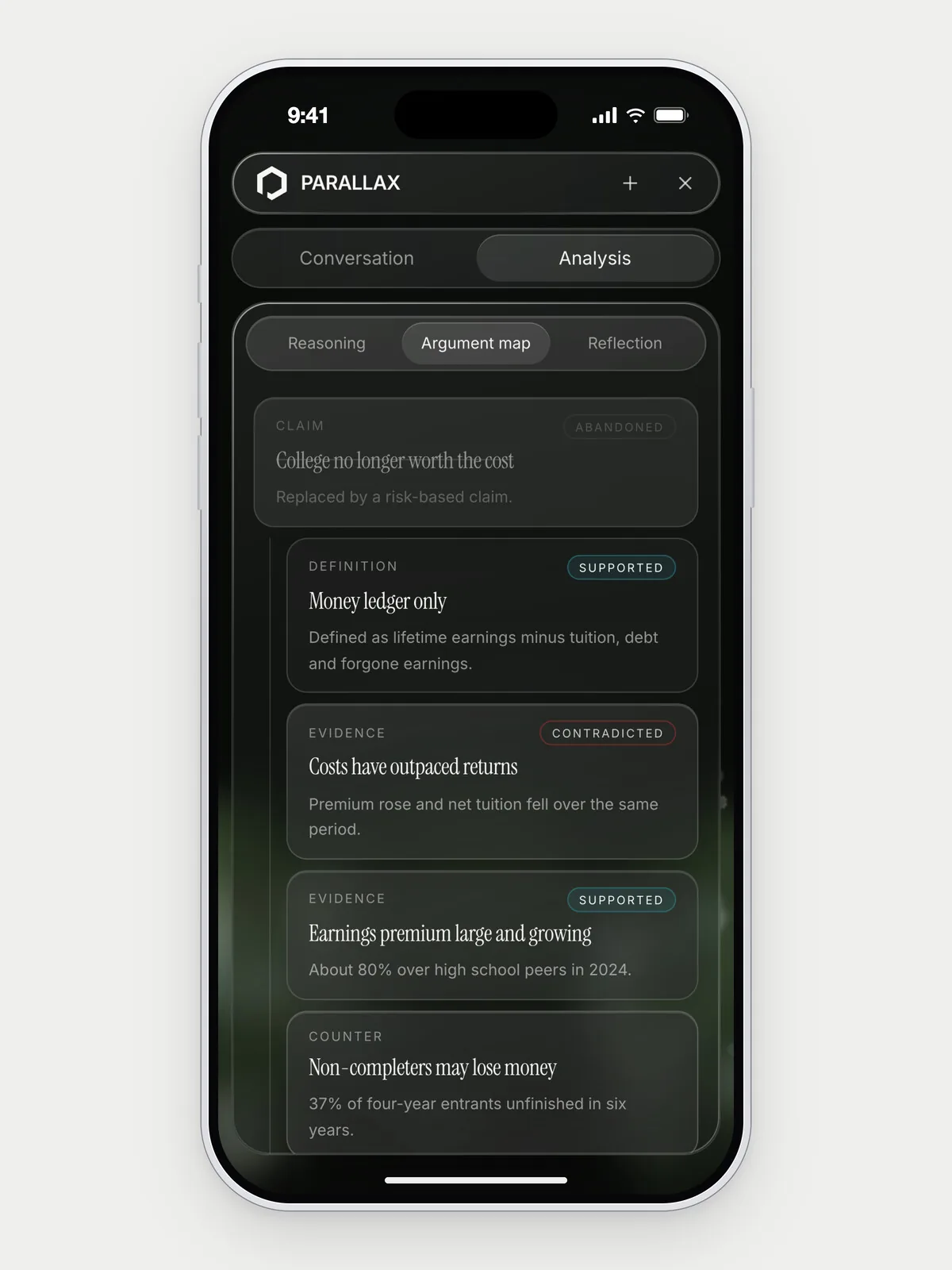
The Argument map view on a silver phone: the original claim marked abandoned, with definition, evidence, counter and assumption nodes beneath it, each carrying a status
What research showed
Few people can name their own weakest point. In interviews, 1 of 6 did it unaided.
What I designed
Borders carry meaning: solid for claims, dashed for assumptions, dotted for value judgments. Only supported and contradicted get colour, so the map never becomes a traffic light.
What testing showed
6 of 8 named the weakest part of their own argument, against 2 of 8. Most read it straight off the map.
Reflect

“Where do I stand?”

One tap gives an audit: your position quoted back to you, what holds up, the weak link, your assumption, and what would change the picture. The product never says whether you're right.
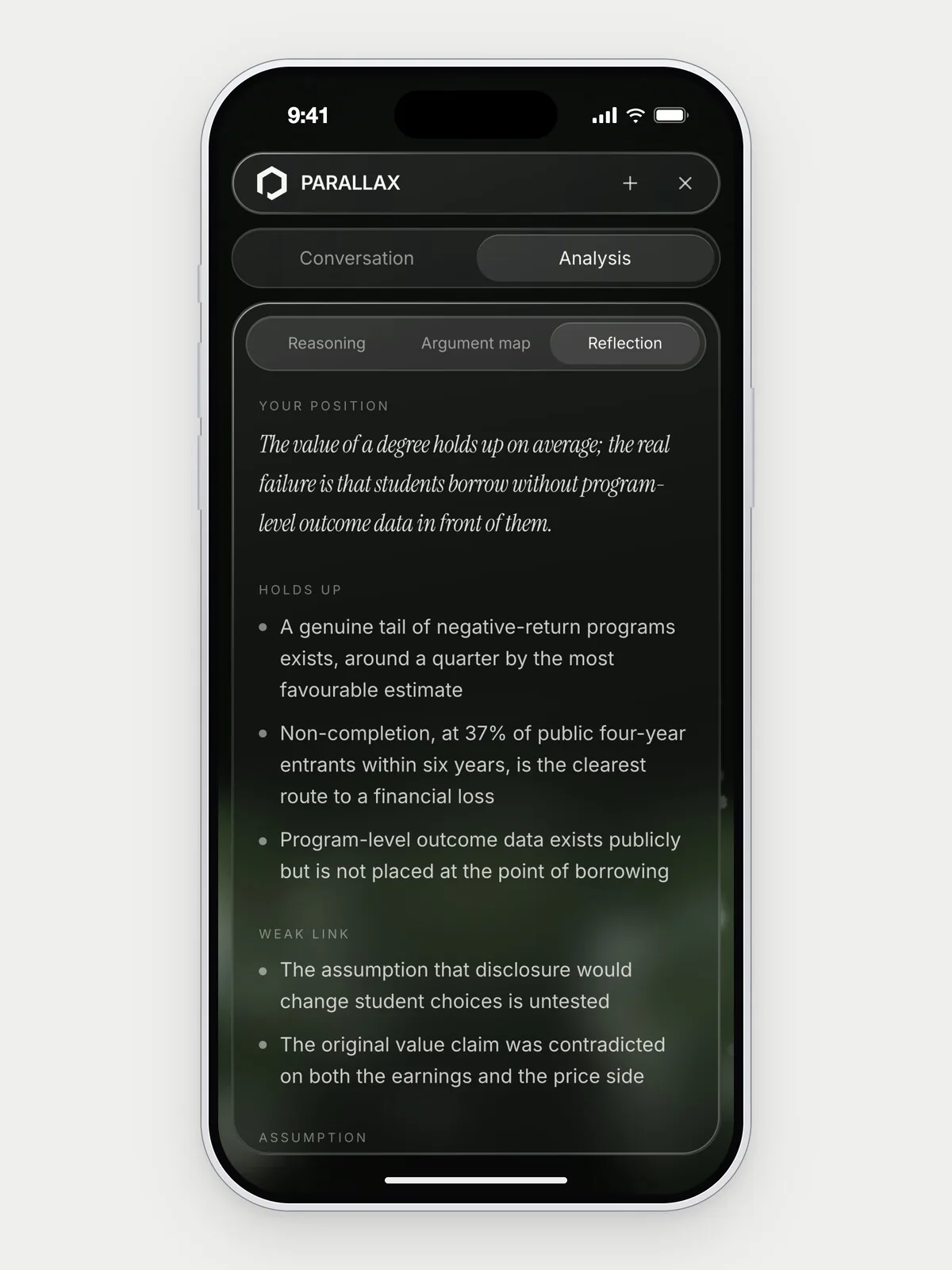
The Reflection view on a silver phone: the position restated in serif italic, followed by what holds up, the weak link and the assumptions
What research showed
“I don't want it to win. I want to know what I'll get grilled on.” People rated the agreeing reply higher, then quoted the critical one.
What I designed
Holding your view counts as a result, and the verdict is labelled “current” because you can keep going. The button sits above the composer from the second reply.
What testing showed
7 of 8 got a clear summary of where they stood, against 4 of 8. After moving the button, 5 of 5 found it.

Also in the product

  • The landing page is the first screen: type “I think…” and the conversation starts, with no account.
  • Example beliefs to tap, chosen so reasonable people disagree and nobody feels tested on a fact.
  • Two panes on a phone, with the composer kept clear of the keyboard.
  • A screen reader map as a nested list, with each status in the label.
  • A calm room: a meadow at night, glass spheres, Instrument Serif and one teal accent. The system is on a public page.
08

How I built it

I built in code from the start. I was designing the behaviour of a conversation, and a mockup can't show whether a question lands.

LayerWhat I usedWhy
InterfaceReact, three routesConversation, stage and panel are views of one state
StylingDesign tokens as CSS variablesOne source for colour and type, shown on the system page
MotionSpring-based layout animationControls, replies and map nodes all move the same way
ConversationOne endpoint returning a structured replySee below

The reply is data, not only text

Each turn returns the message, the current stage, the checks run, the map nodes with types and statuses, sources and, when asked, the audit. The stepper, map and conversation never disagree because they're drawn from the same reply. The audit is its own intent, so the same question always gets the same shape of answer.

The states nobody screenshots

  • Waiting: “Examining…”, announced to screen readers.
  • Errors: “Try again” resends exactly what was sent, and disappears at a usage limit, where it can't help.
  • Leaving mid-reply: “New belief” cancels the request in flight.
  • Keyboard: Enter sends, the view switcher is a real tab list, focus rings show on glass.
09

Validation and outcomes

I ran a within-subjects test with 8 weekly chatbot users, none from the interviews. Each brought an opinion and took it through a general chatbot told “argue against me” and through Parallax; half started with each. They did four tasks per version. I measured unaided completion and ease per task (SEQ, 1–7). The key check was whether they could name the weakest part of their own argument. The debate coach also scored each final position, blind to version, on a 1–5 reasoning rubric: 2.6 with the chatbot, 3.6 with Parallax.
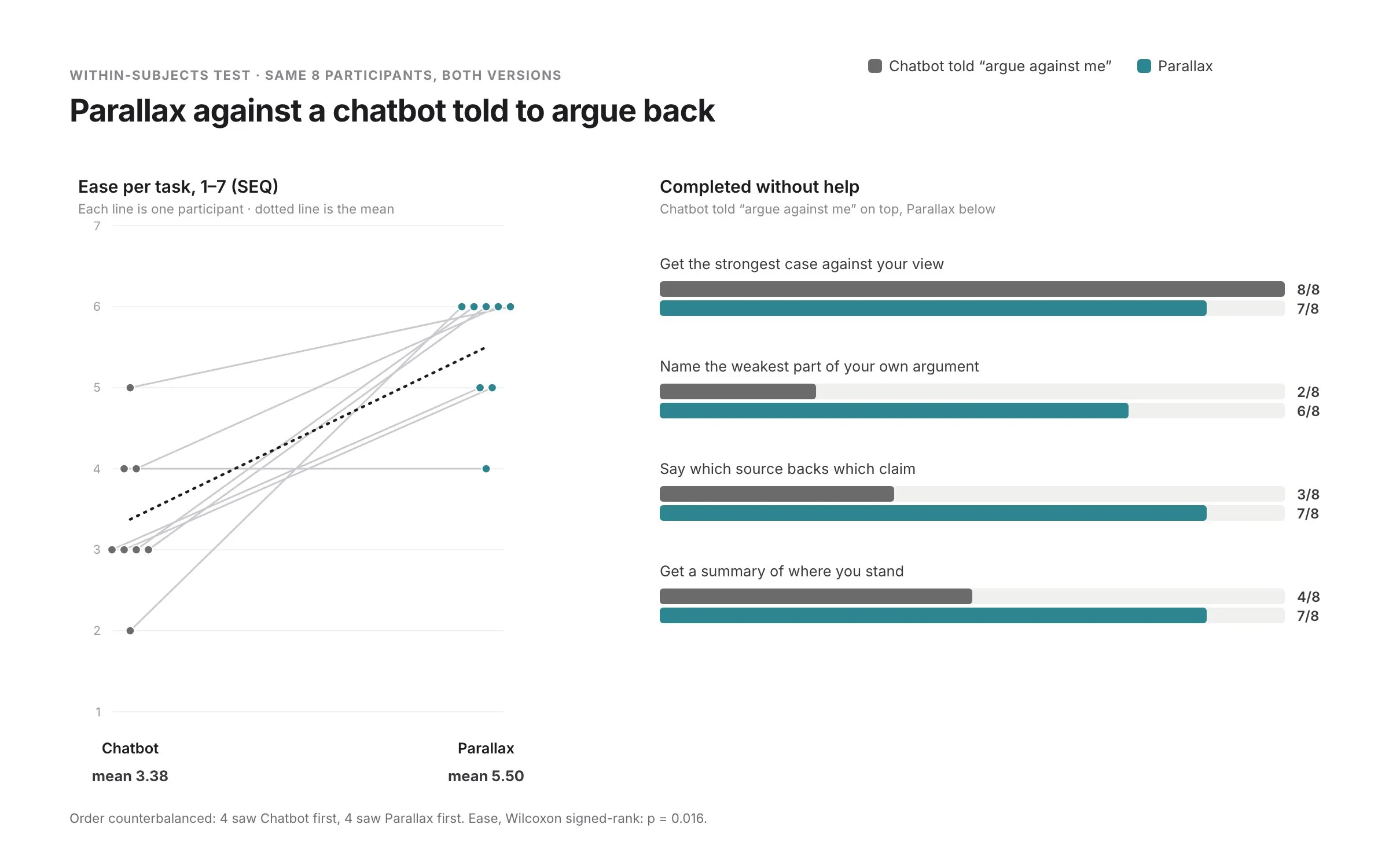
Within-subjects results for 8 participants: ease rose from a mean of 3.4 with the chatbot to 5.5 with Parallax, with one participant flat at 4, and bars showing unaided completion for four tasks
Same 8 people, both versions. Mean ease 3.4 to 5.5.
TaskChatbotParallaxWhat I saw
Get the strongest case against your view8 / 87 / 8The chatbot is faster here. One person left Parallax during Clarify.
Name the weakest part of your own argument2 / 86 / 8Most read it straight off the map's weak node.
Say which source backs which claim3 / 87 / 8Chatbot sources sat at the end, unlinked to claims.
Get a summary of where you stand4 / 87 / 8The chatbot restated the view in nicer words. One person missed the audit button.

What I changed, then tested again

  • 3 of 8 found “Where do I stand?” only after scrolling the panel → moved it above the composer after the second reply → 5 of 5 found it in round two.
  • 2 of 8 called Clarify stalling, and one quit there → a “Go to the opposing case” option after one clarifying answer → 5 of 5 reached the counterargument.
  • The map read as a flat list on a screen reader → nested list with each status in the label → the round-two screen reader user named their weak link from the map.

Still open: one participant's ease stayed at 4; they wanted the answer faster, and Parallax is slower by design. Only 3 of 8 opened a source. And people still said the chatbot felt nicer, though 6 of 8 chose Parallax for a real decision coming up.

Don't measure whether they liked it

That last result is the measurement trap from section 02. So the north star is examined beliefs: conversations that reach Reflection or an audit. Guardrails are drop-off after the counterargument, sources that don't support their claim, and the rate of changed minds. If nearly everyone changes their view, the product is persuading, not examining.

10

Reflection and next steps

What participants taught me

  • Order does most of the work. I planned to lead with the counterargument. The coach and P4 both said ask what I mean first, and the test bore it out.
  • Watch what people do with a reply, not how they rate it. P2 rated the agreeing reply higher and quoted the critical one.
  • Short is an accessibility feature. One question per turn helped the dictating, phone-only and screen reader participants most.
  • A machine can say what a friend can't. “A person would judge me. This doesn't.” That safety is the opening, and flattery wastes it.

What's next

  • History. Come back to “what would change the picture” weeks later.
  • An editable map. Let people correct a node they don't recognise as theirs.
  • A mode inside an existing assistant. A “challenge this” action on any answer, where measuring the right thing becomes the main design problem.

Sources

10
  1. Cheng, M. et al. “Sycophantic AI Decreases Prosocial Intentions and Promotes Dependence,” 2025. Preprint
  2. OpenAI. “Expanding on what we missed with sycophancy,” May 2025. Link
  3. Lee, H.-P. et al. “The Impact of Generative AI on Critical Thinking.” CHI ’25, 2025. PDF
  4. Kosmyna, N. et al. “Your Brain on ChatGPT: Accumulation of Cognitive Debt when Using an AI Assistant for Essay Writing Task,” 2025. Project page
  5. Sharma, M. et al. “Towards Understanding Sycophancy in Language Models,” 2023. Link
  6. Mercier, H. & Sperber, D. “Why do humans reason? Arguments for an argumentative theory.” Behavioral and Brain Sciences, 2011.
  7. Lord, C. G., Lepper, M. R. & Preston, E. “Considering the opposite: A corrective strategy for social judgment.” JPSP, 1984.
  8. Khan Academy. Khanmigo. Link
  9. Kialo. Link
  10. r/changemyview. Link