ResolveWhen a team lunch falls apart, someone has 26 minutes to fix it.
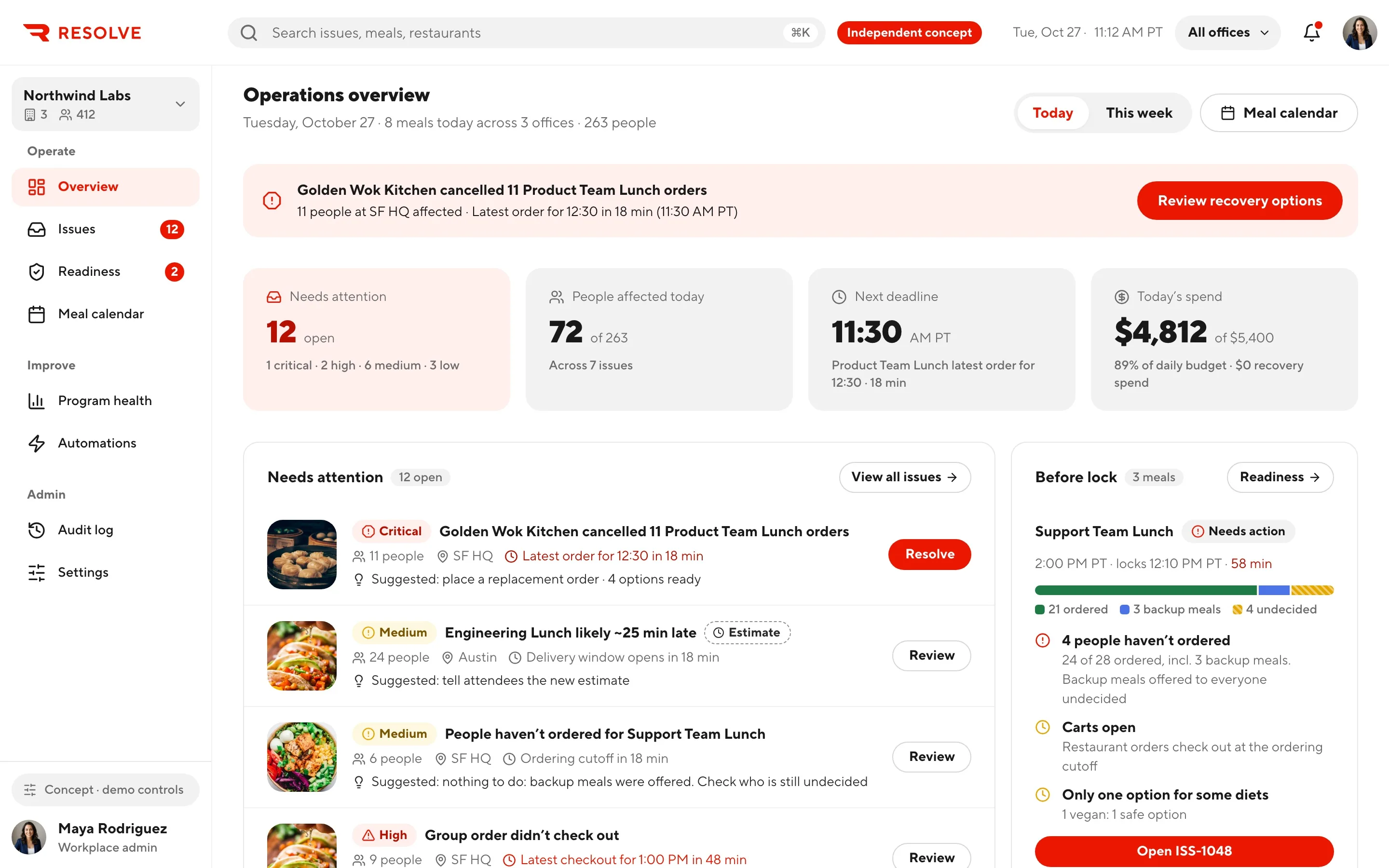
Resolve is a workspace for the person who runs a company’s team meals, for the moment one goes wrong. It’s my independent concept for DoorDash for Business. I designed and built it solo as a working prototype you can try. Research with admins is in the works, so nothing here is validated yet.
Desktop web app · React and TypeScript prototype, Figma library of 87 variables and 26 components
Status
Working prototype. Research in the works: plan, guides and screener ready
Methods
Public-source product audit, social listening on Reddit and review sites, prioritization, service blueprint
Users
Workplace admins and office managers, with finance as approver and employees as the people affected
Independent
Not affiliated with, endorsed by or commissioned by DoorDash
01
The hard part is the decision, not the delivery
When a work meal breaks, the facts, the money and the authority to fix it sit with different people. One person is still accountable for lunch.
I started by asking what DoorDash for Business offers the admin when an order fails. Publicly, it’s channels: a support line, email, credits, and “delete and recreate”. None of them is a place to decide. So Resolve doesn’t try to deliver faster. It puts the decision in one place, and leaves the doing to the people and systems that own it.
02
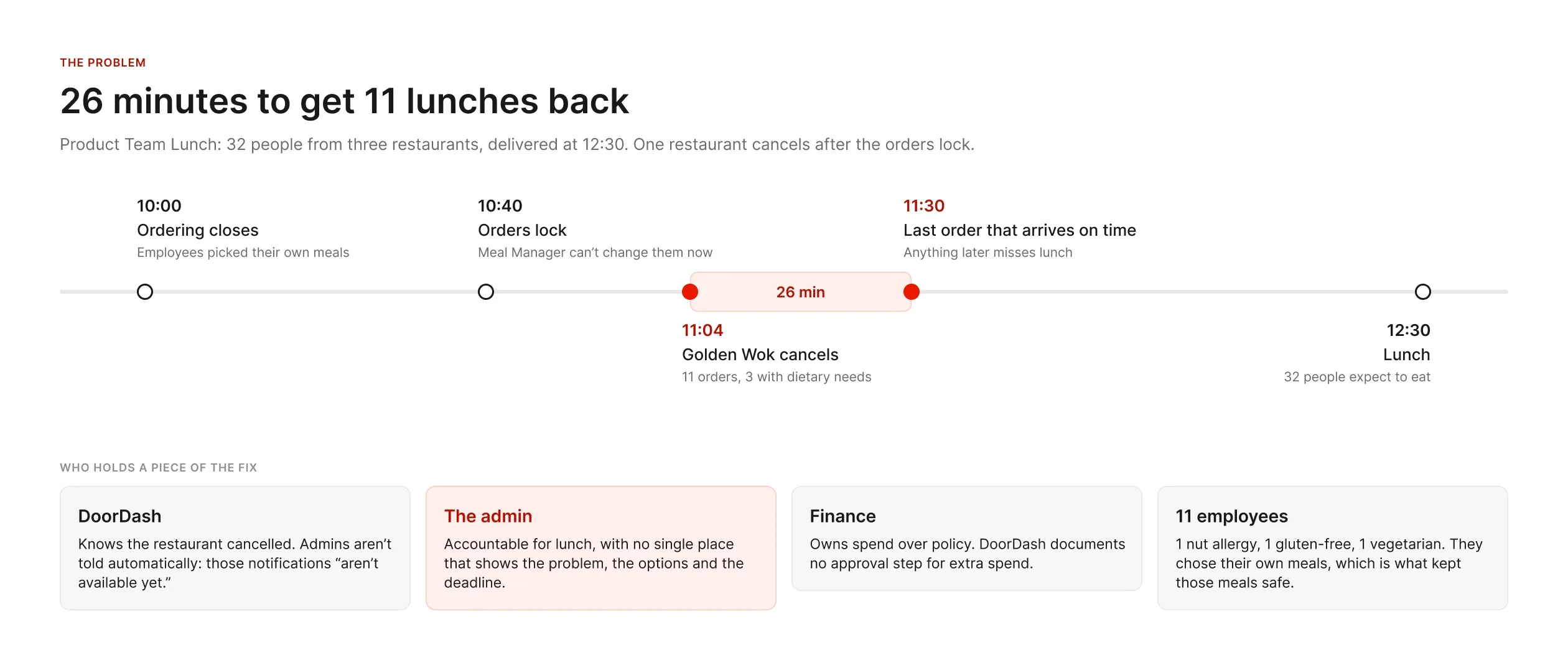
One cancellation, 26 minutes, four people involved
The scenario the whole prototype is built on. Times follow Meal Manager’s published limits.
30%
Faster growth in team-sized orders than in regular ordering, year over year, on DoorDash for Business.
DoorDash, April 2026
$2.3B
What Uber agreed to pay for ezCater, which sells human concierge service for catering. Workplace meals are a contested market.
The Next Web, October 2026
None found
Admin-side incident tools among the competitors I reviewed. They handle problems through people: account managers and care lines.
My audit, a hypothesis, not a market fact
03
Admins describe the scramble, not the software
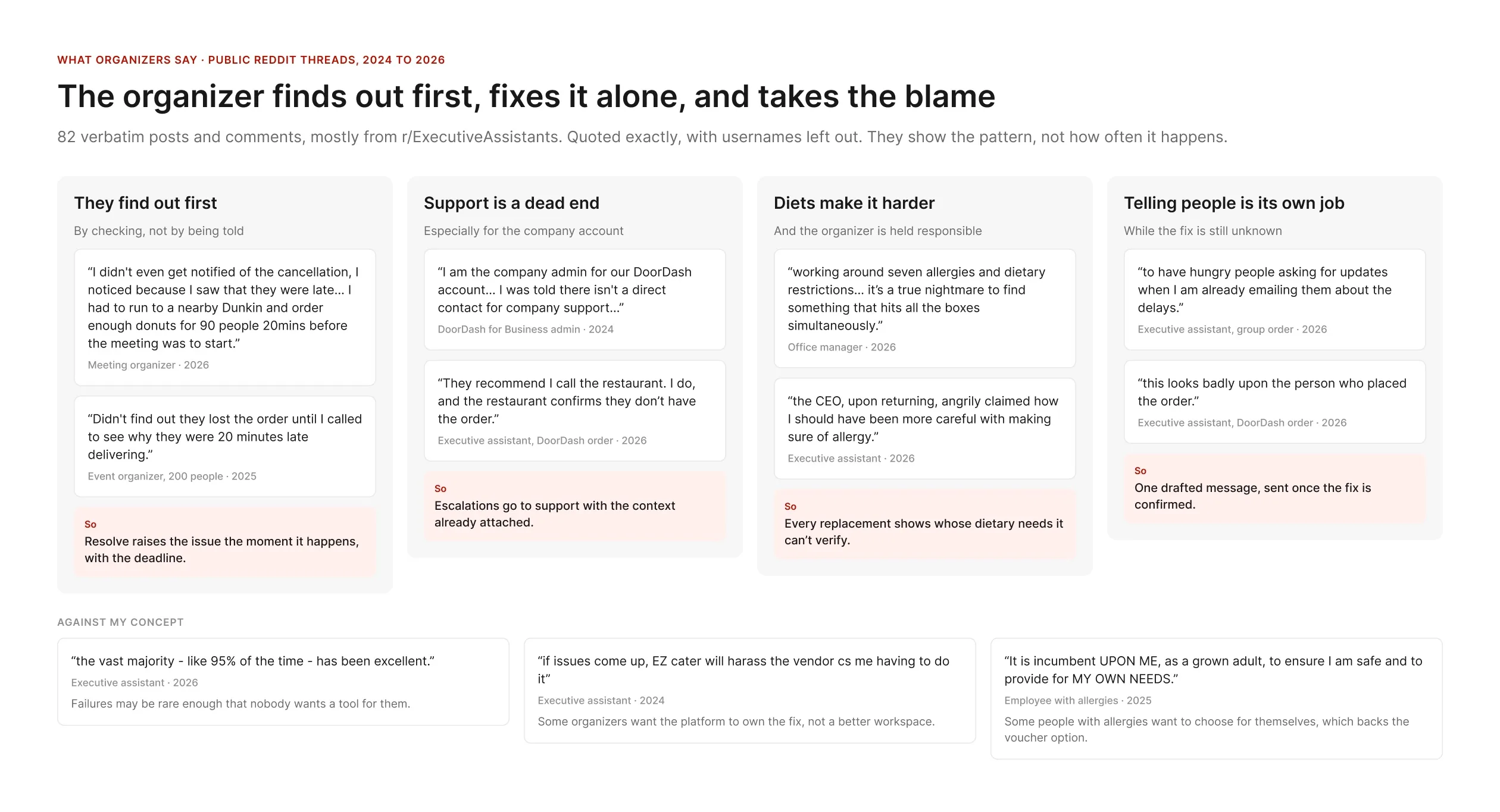
What do the people who order team meals say happens when one goes wrong, and what do DoorDash’s own docs say they can do about it?
Product audit
DoorDash for Business help docs, pricing and merchant guides, plus 6 competitors. Every claim sourced and dated
Social listening
Public Reddit threads from office managers, assistants and drivers, plus G2 reviews. Quoted verbatim, usernames left out
What it can’t show
How often this happens, or what admins would use. Those questions are for the interviews
From 82 public posts and comments, 2024 to 2026, mostly r/ExecutiveAssistants. Only one came from a confirmed DoorDash for Business admin.
“the thing i hate most about my job is being responsible for feeding people. especially when things go wrong.”
The evidence that pushes back matters most. Many organizers trust ezCater because its support “will harass the vendor” for them. That changed my framing: Resolve isn’t more work for the admin. It brings that level of support into DoorDash for Business, with the admin still in charge of the decision.
What I assumed
The admin needs a faster way to fix the order.
Swap the restaurant, done.
What the docs showed
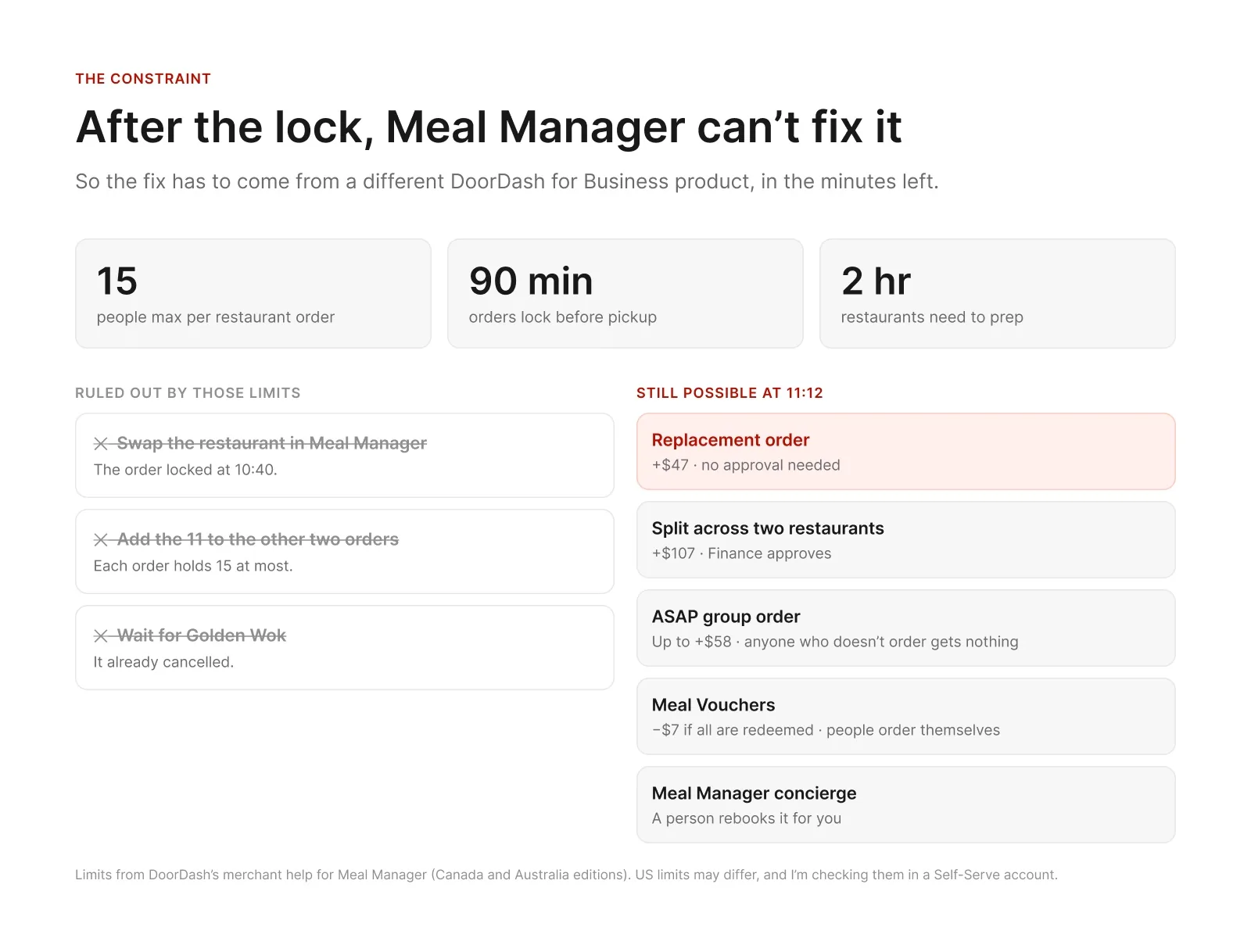
After the lock, the order can’t be fixed in place.
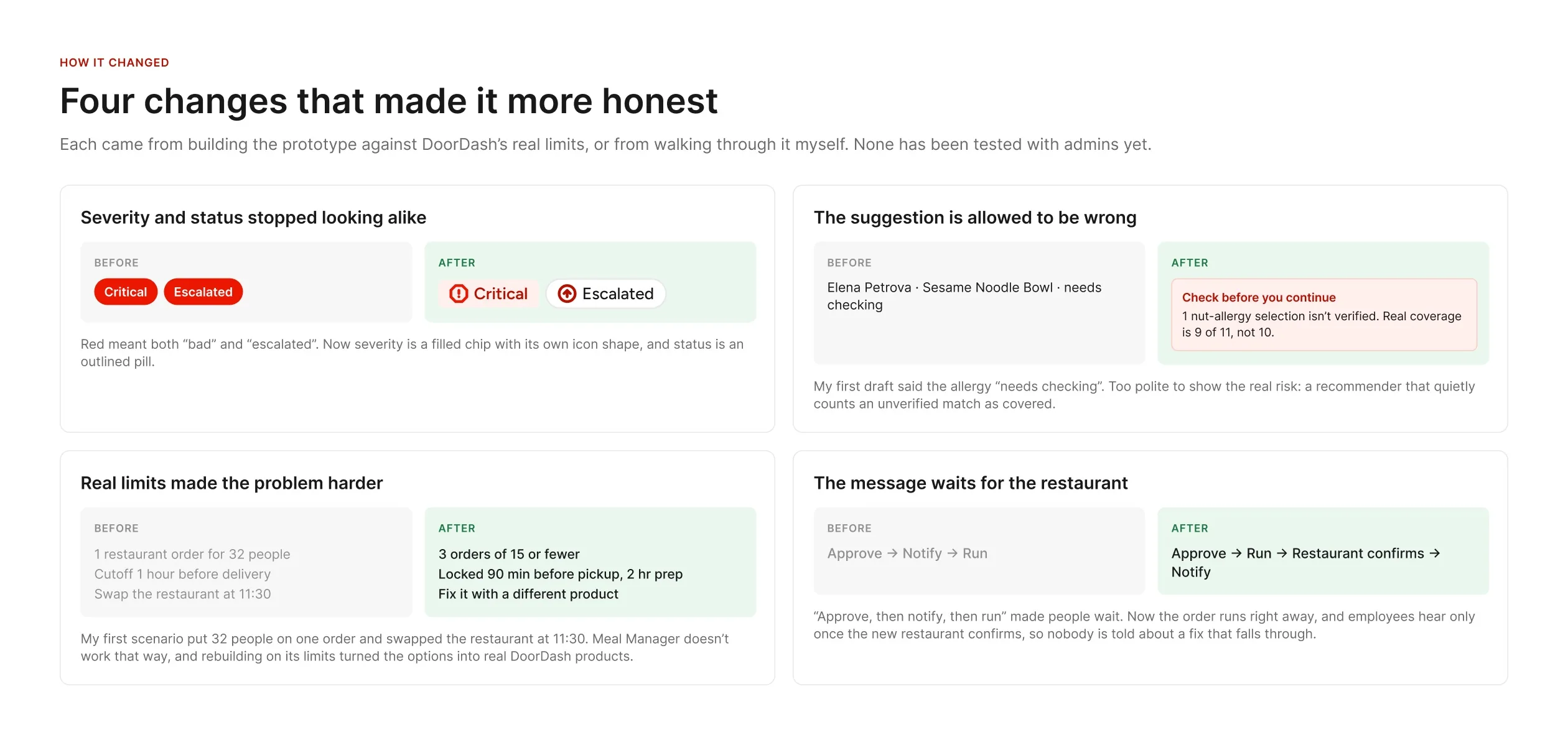
Meal Manager caps each restaurant order at 15 people, locks it 90 minutes before pickup, and needs 2 hours’ prep.
Product decision
Recovery means choosing a different product, fast.
Resolve compares the DoorDash products that still work in the minutes left.
04
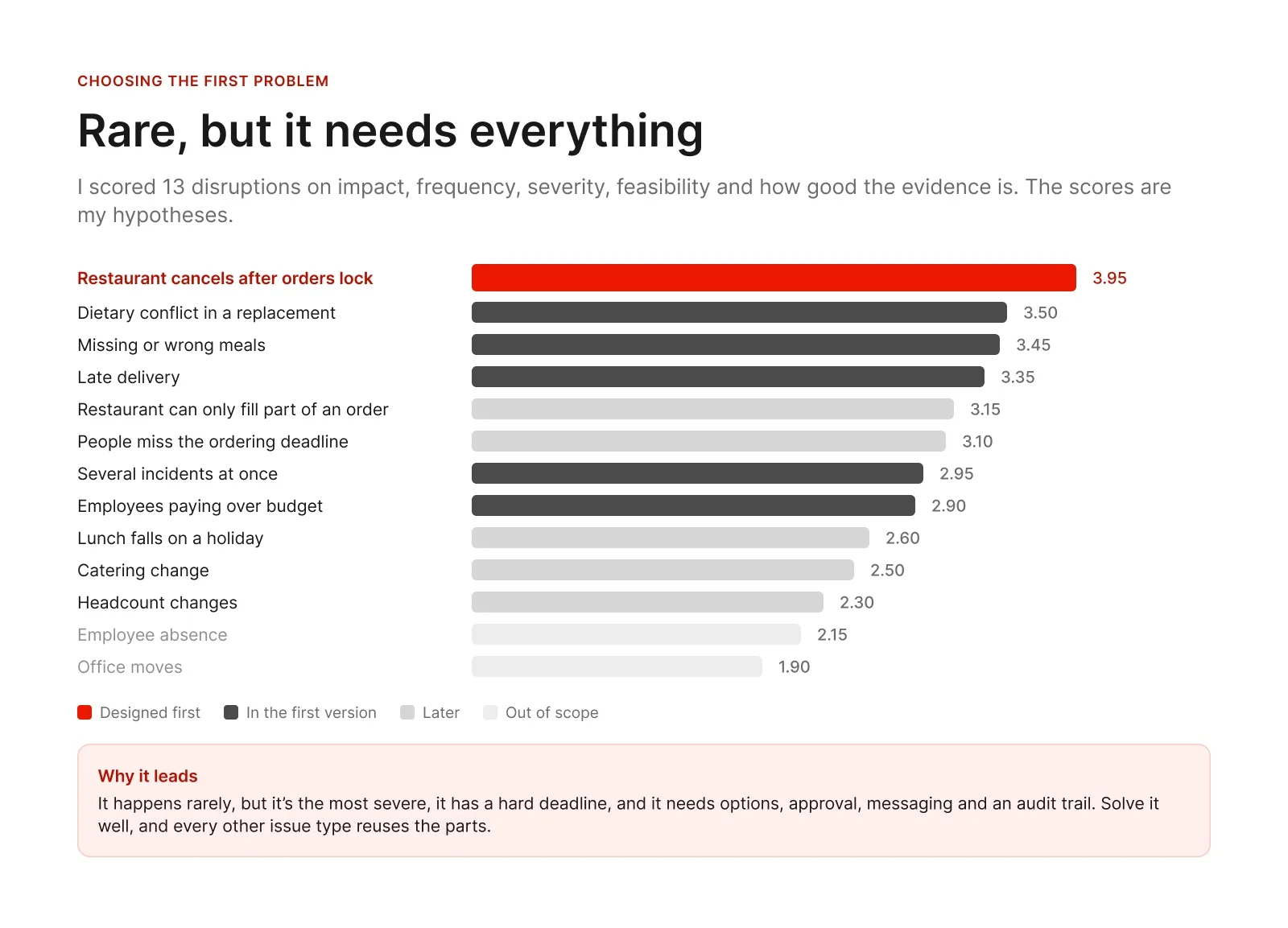
The rarest problem came first, because it needs everything
Late delivery and missing meals happen more often. But a cancellation after the lock is the most severe, it has a hard deadline, and it touches every stakeholder.
Designing it well produced the parts every other issue reuses: options, approval, messaging and an audit trail.
05
Four decisions, and what each one gave up
The options are built on real DoorDash for Business products, and the ruled-out ones stay visible with the limit that blocks them.
Control
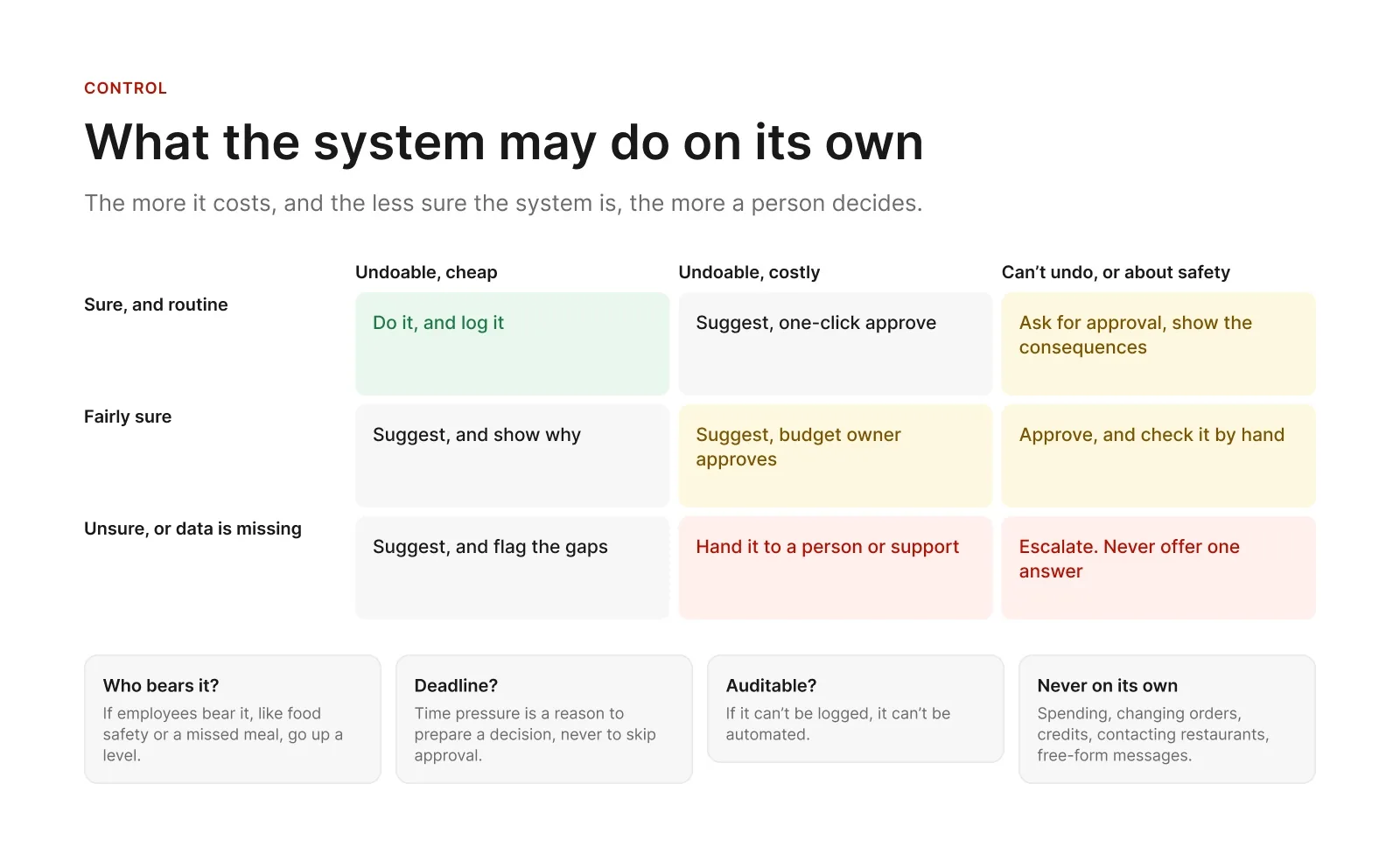
Prepare the decision, never make it
Over
Fixing lunch automatically. Faster when the system is right, and it would be right most days.
Gave up
Those seconds. Every recovery that spends money or changes an order waits for a person, even under a countdown.
I’d revisit if
Admins approve the suggestion unchanged every time, and still catch the gaps it flags.
Trust
Let the suggestion be wrong, on screen
Over
A demo where the recommendation is always right. Cleaner, and more convincing in a portfolio.
Gave up
Some confidence in the feature. The suggestion counts a nut-allergy order as covered, and Resolve has to catch it.
I’d revisit if
The flag in the table alone is enough, and the big warning panel is just noise.
Messaging
Tell employees only once it’s certain
Over
Messaging the team the moment the admin approves.
Gave up
A few minutes of silence while the new restaurant confirms, and people may ask the admin in the meantime.
I’d revisit if
Interviews show employees chase the admin within minutes, whatever the tool says.
Platform
Desktop first, phone alert next
Over
Phone first. An admin may be away from their desk at 11:04.
Gave up
That admin. Comparing five options with costs and approvals needed a wide screen first.
Next
A phone alert that opens straight into the comparison, then test it on a phone.
06
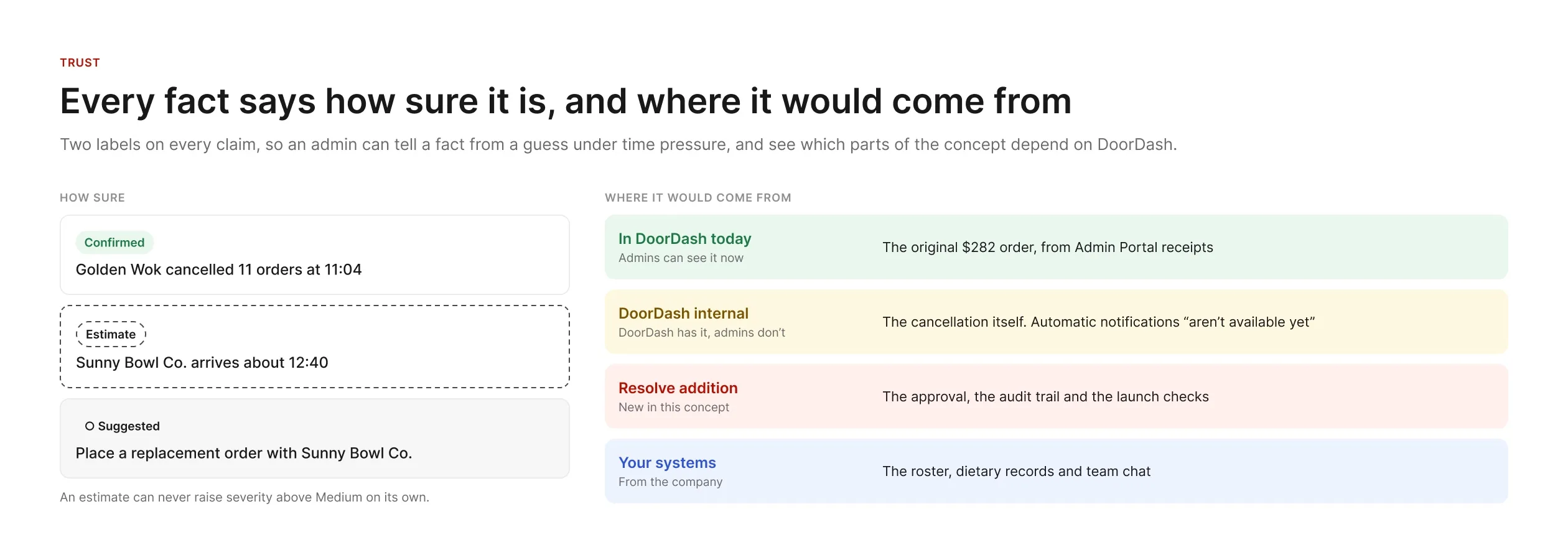
An admin can tell a fact from a guess at a glance
This turns “simulated” from a disclaimer into an argument: it shows exactly what the concept would need from DoorDash.
I wrote these rules before designing any automation. Time pressure is a reason to prepare a decision, never to skip approval.
07
Notice it, compare, check, tell the team
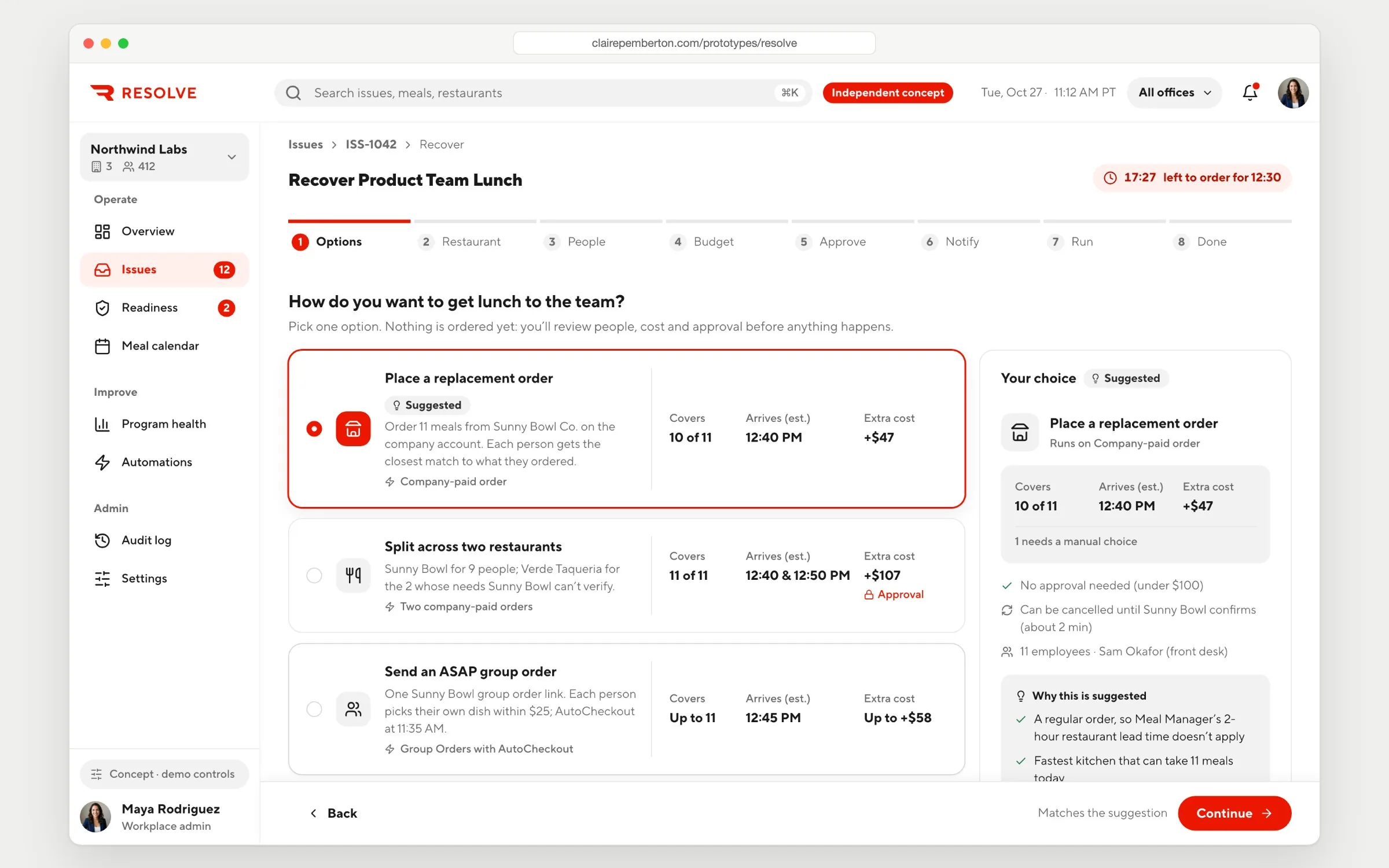
01 · Compare
Five ways out, on the same terms
Every option answers the same questions: who it covers, when it arrives, what it costs, and whether finance has to approve. The countdown stays in view.
02 · Check
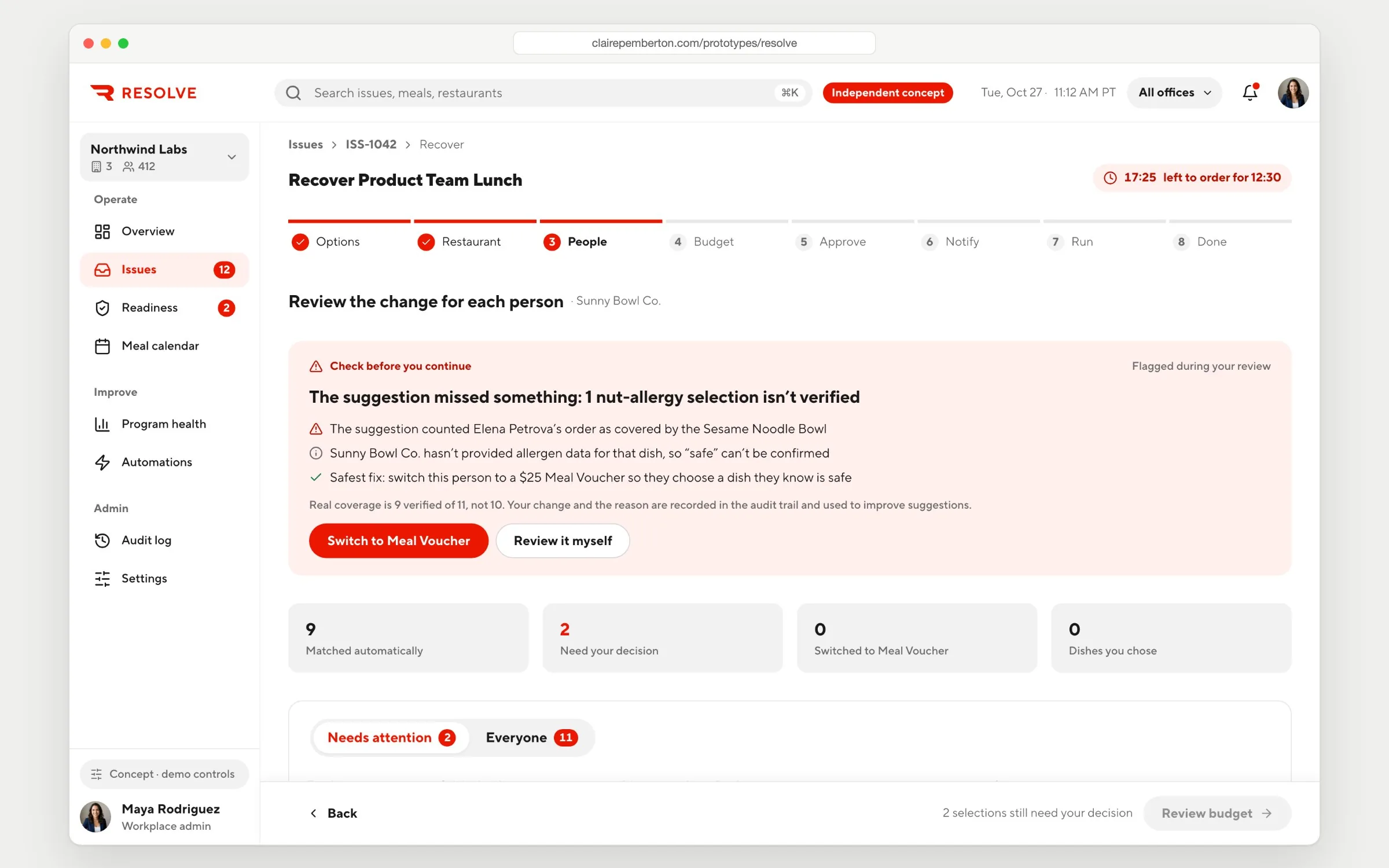
The suggestion is wrong here, on purpose
It counted Elena’s order as covered, but the restaurant has no allergen data for that dish. Resolve says real coverage is 9 of 11, not 10, and switching her to a Meal Voucher takes one click.
03 · Tell the team
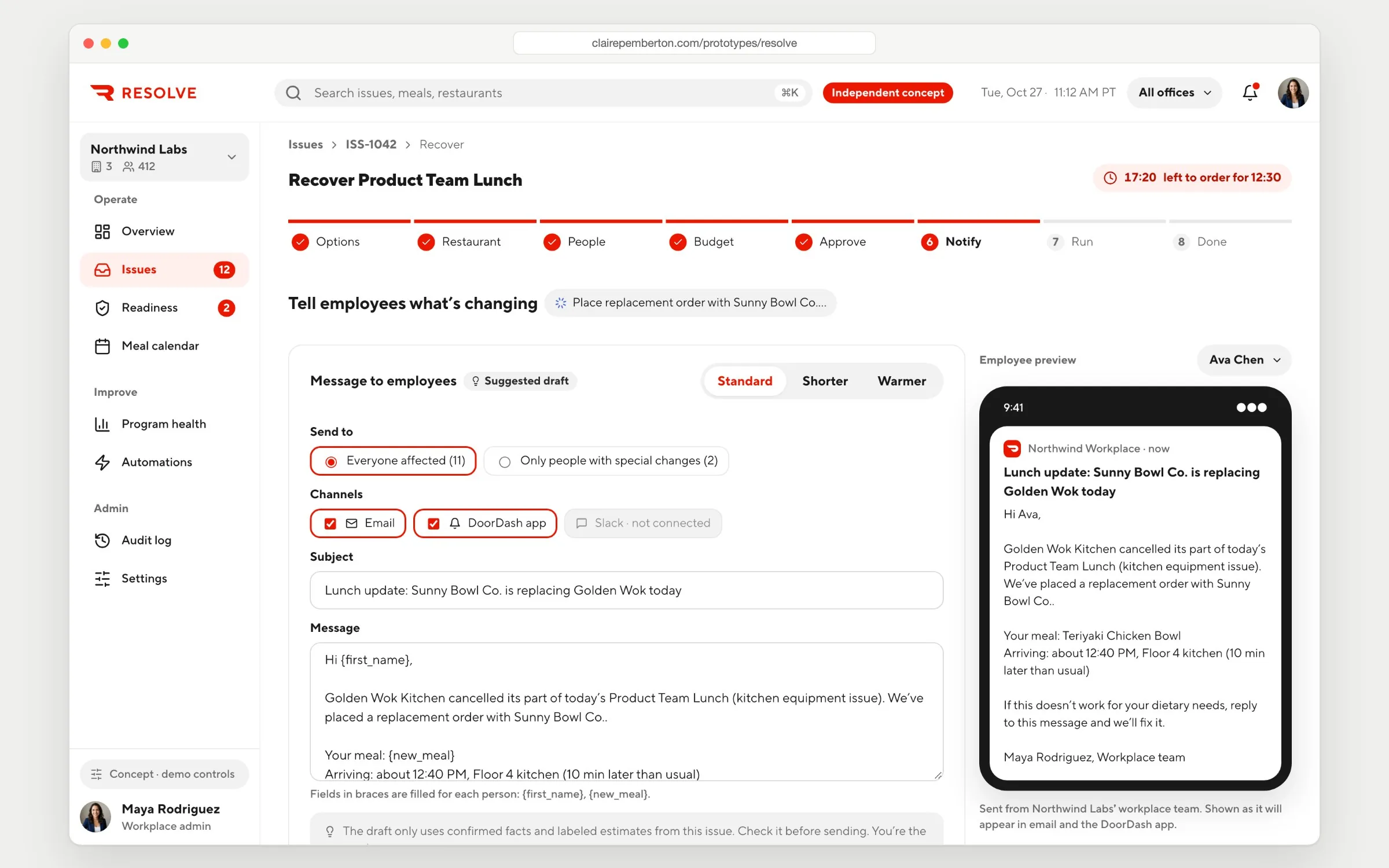
A message that waits for the restaurant
A drafted, editable message is filled in for each person, with a live preview of what they’ll see. It sends only when the new restaurant confirms.
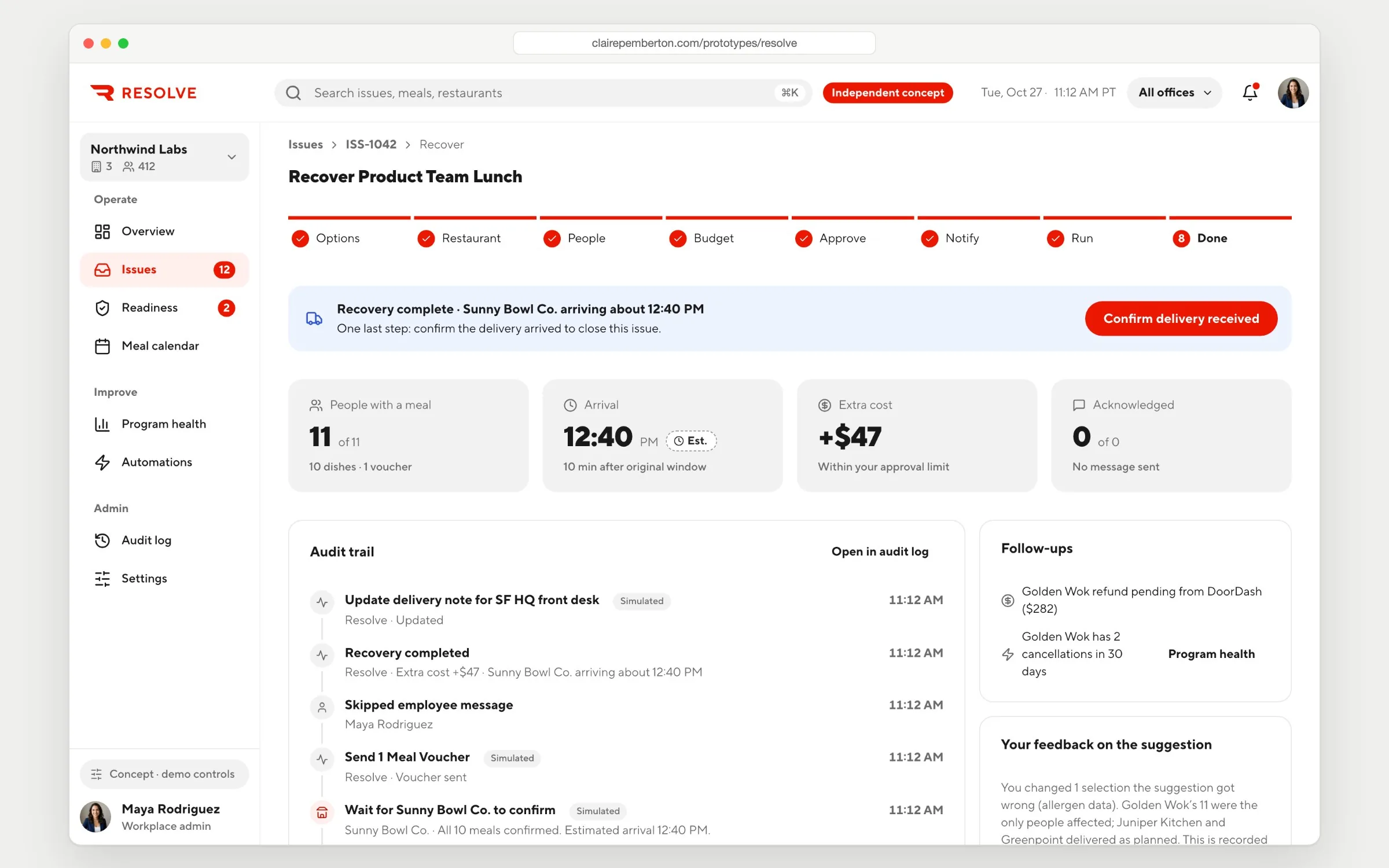
Afterward. Every step is in the audit trail, and simulated steps say so.
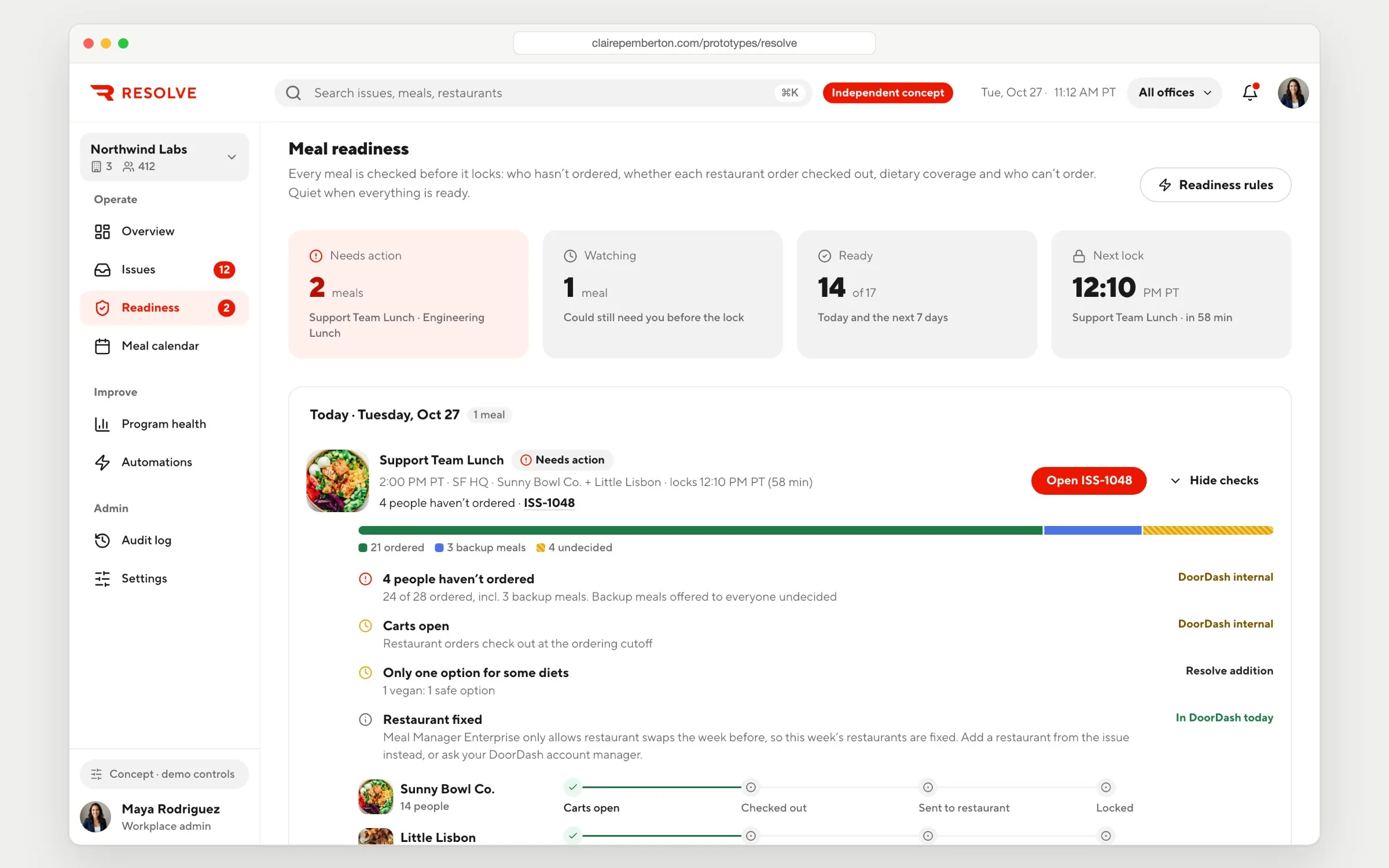
Before it breaks. Readiness checks each meal until it locks.
Also in the prototype
10 issue types, including “9 of 12 people would pay out of pocket”, since DoorDash charges overage to the employee’s card without telling the admin.
Program setup that mirrors Meal Manager’s fields, plus a launch check for the 15-person limit, partial allergen data and holidays.
Demo controls for the outcome (success, partial, restaurant declines), outages, and Admin, Finance or Office manager roles.
One token file that feeds both the Figma variables and the prototype’s CSS.
08
Building it against real limits changed the design
From my own walkthroughs and builds. None has been tested with admins yet.
09
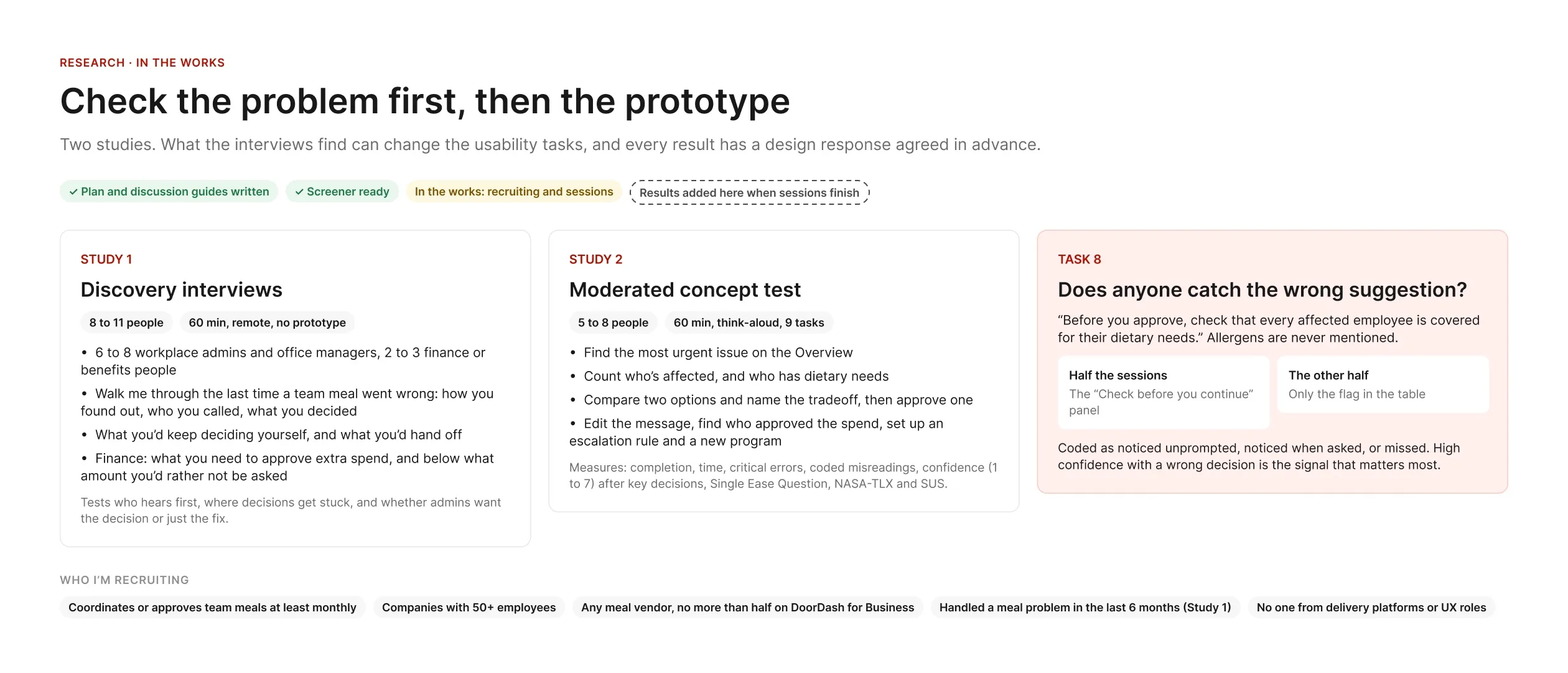
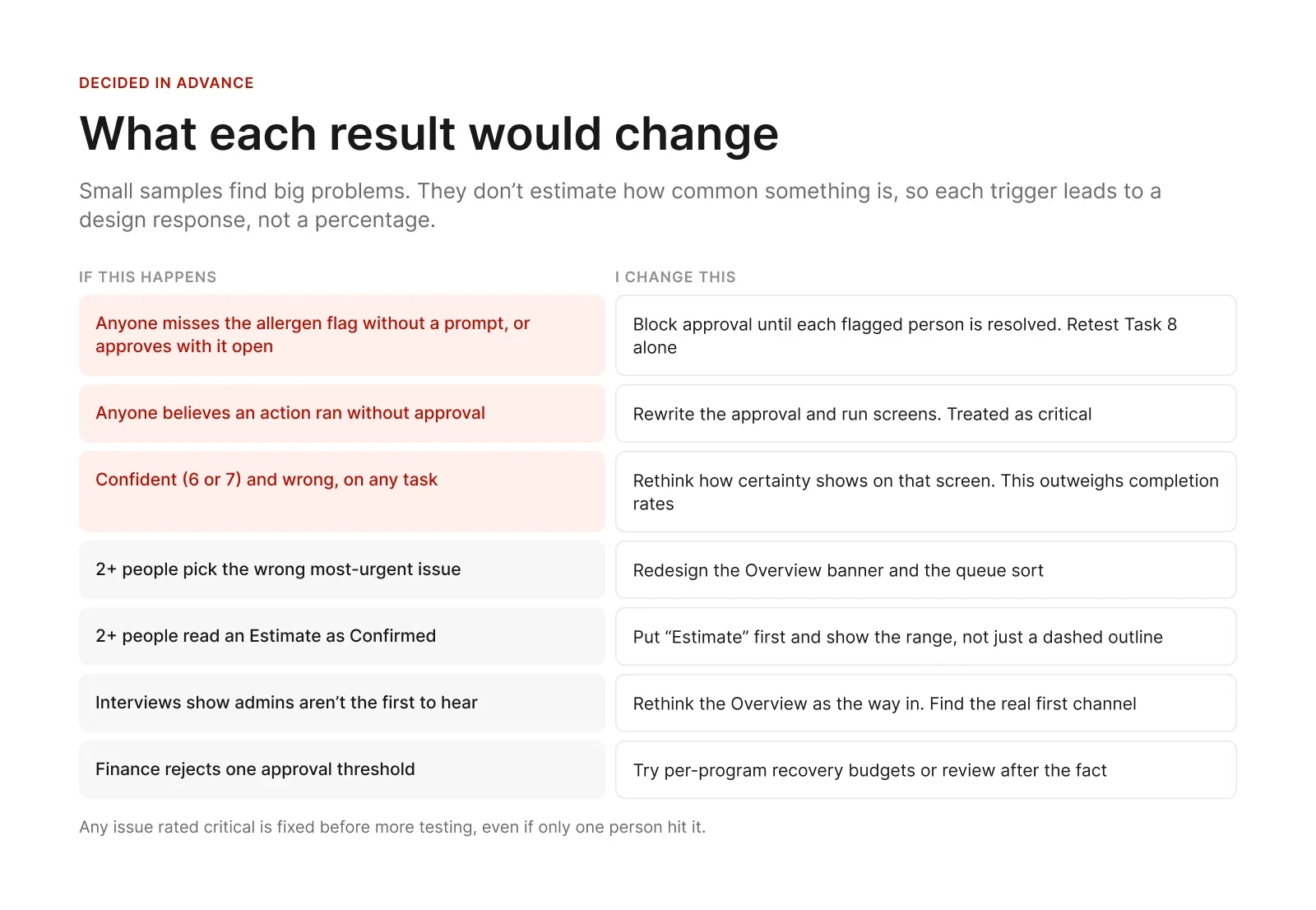
Research is in the works, and every result has a response
The primary metric is Task 8: does an admin catch the unverified allergy before approving, without being prompted? Pass: every participant catches it unprompted in the version with the panel. Fail: anyone approves with it open, and approval gets blocked until each flagged person is resolved. I’m also asking each participant how confident they are after key decisions, because confident and wrong is the riskiest result.
Then a pilot. Only real incidents show what matters to the business. Primary metric: the share of critical disruptions where everyone affected eats within 15 minutes of the original time.
Guardrails: zero recoveries that serve a dish with unverified allergens, and zero spend without approval. I’d also track how much recovery spend stays on DoorDash.
10
Design the moment a system is wrong
I started out designing a faster fix. The real job turned out to be helping someone decide under pressure, with a system that’s honest about what it doesn’t know.
What I learned
Real limits make a better brief. Rebuilding on Meal Manager’s rules made the problem harder and the options honest.
A recommender’s failure state is part of the design. The most important screen is the one where it’s wrong.
Labeling sources shows what a concept depends on. It turned a prototype into an integration argument.
Building it found the bugs a mockup hides, like prices that disagreed across four screens.
What I can’t answer yet
How often this happens, and who fixes it today.
Do admins want the decision, or would they rather DoorDash support just handle it?
Does finance want approval per incident, or a monthly budget for recovery?
Are Meal Manager’s US limits the same? I’m checking in a Self-Serve account.
Next step: run the discovery interviews. If admins aren’t the first to hear about a failure, the Overview is the wrong front door, and I’ll redesign it before testing anything else.
Sources
8
DoorDash for Business. “DoorDash for Business Launches Catering for the Workplace.” April 30, 2026. Link
The Next Web. “Uber to buy ezCater for $2.3bn.” October 2026. Link
Meal Manager’s operating limits come from DoorDash’s merchant help, published in Canadian and Australian editions. Reddit quotes are verbatim from public threads, with usernames left out. Resolve is an independent concept, not affiliated with, endorsed by or commissioned by DoorDash. Every company, person, restaurant and number in the prototype is made up.